Greenhouse Horticulture Market Size, Share, Growth & Industry Analysis, By Product Type (Glass Greenhouses, Plastic Greenhouses), By Technology (Heating Systems, Cooling Systems, LED Grow Lights, Irrigation Systems, Control Systems), By Crop Type (Fruits & Vegetables, Flowers & Ornamentals, Nursery Crops), By End-User (Commercial Growers, Research Institutions, Retail Growers), and Regional Analysis, 2024-2031
Greenhouse Horticulture Market: Global Share and Growth Trajectory
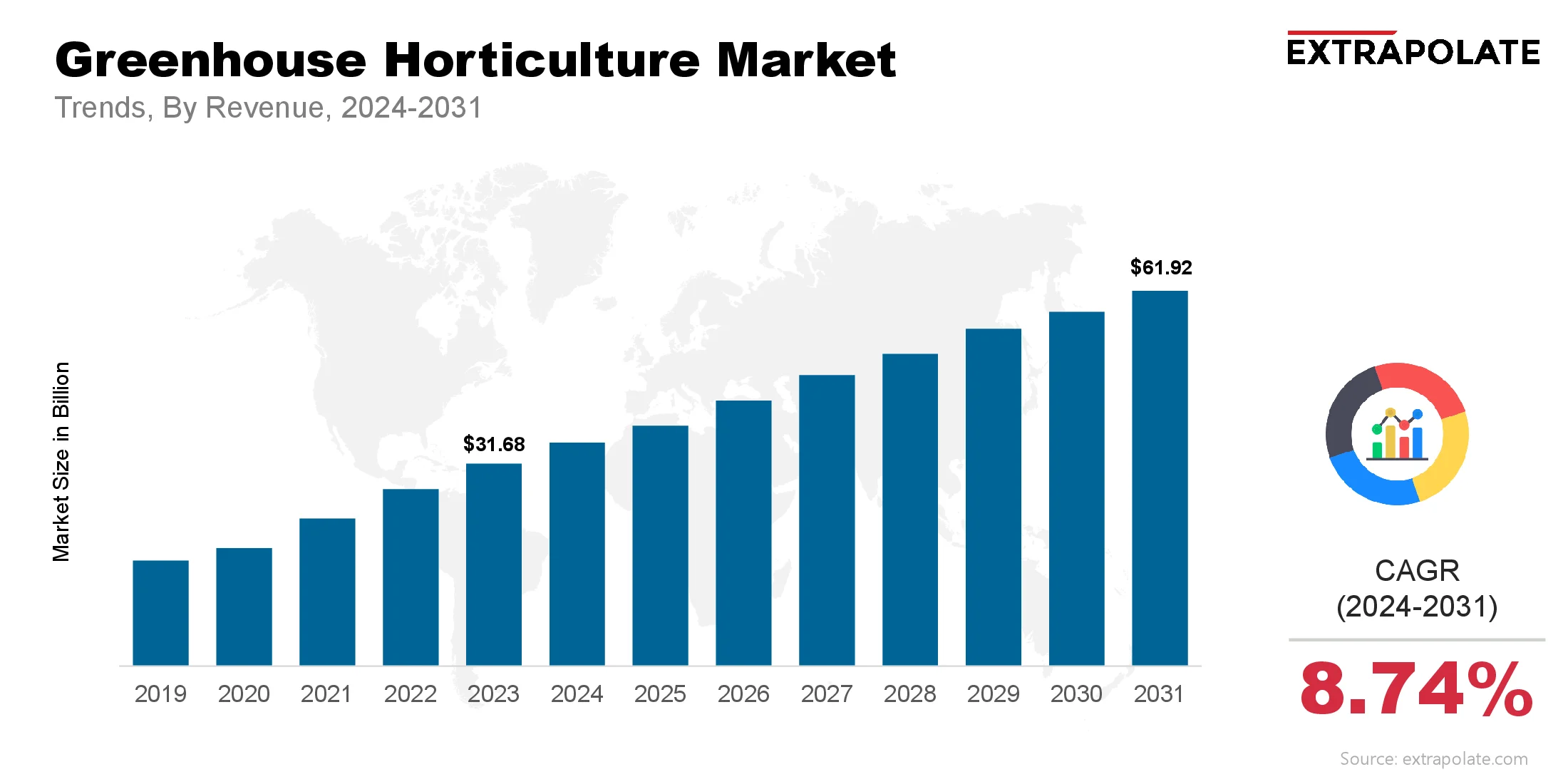
The global Greenhouse Horticulture Market size was valued at USD 31.68 billion in 2023 and is projected to grow from USD 34.43 billion in 2024 to USD 61.92 billion by 2031, exhibiting a CAGR of 8.74% during the forecast period.
The global greenhouse horticulture market is changing fast, driven by the need for sustainable agriculture, food security and rapid technological advancements. Greenhouse horticulture is the practice of growing crops in controlled environments that optimize growing conditions. This is seen as the solution to the global agricultural challenges of climate variability, decreasing arable land and resource constraints like water scarcity.
One of the biggest benefits of greenhouse horticulture is the ability to grow a wide variety of crops year round – vegetables, fruits, flowers and ornamental plants. This consistent production cycle means higher yields and better quality than traditional open field farming. Greenhouses provide a protective environment that shields crops from pests, extreme weather and seasonal limitations, thus increasing productivity and reducing crop losses.
Technology is key to the growth of the greenhouse horticulture market. The integration of advanced systems like automated climate controls, precision irrigation, artificial lighting (LED grow lights) and soil-less farming methods like hydroponics and aquaponics has changed the way crops are grown. These technologies allow farmers to monitor and adjust parameters like temperature, humidity, light exposure and nutrient levels in real time, resulting in more consistent outputs and lower production costs.
Urbanization and population growth has also driven the demand for fresh, safe and locally grown food. As consumers become more health conscious and environmentally aware, there is a growing preference for pesticide free produce grown sustainably. Greenhouse grown crops meet these expectations by offering better traceability, reduced chemical usage and proximity to urban markets which shortens supply chains and reduces transportation emissions.
The expansion of this sector is aided by government programs. Greenhouse adoption is being facilitated by grants, subsidies, improved infrastructure, and support for sustainable farming. At the same time, private businesses are funding greenhouse projects and aggrotech firms. This is stimulating innovation and accelerating the industry's growth.
The market for greenhouse horticulture is expanding globally. It is expanding because of new technologies, shifting consumer needs, and the need for sustainable farming. Greenhouses are a practical and well-rounded solution to the world's problems with food security and climate change. They protect the environment and increase productivity. This market is expected to grow quickly in the upcoming years with increased investment and innovation.
Trends Driving Growth and Adoption of Greenhouse Horticulture
- Sustainable Farming and Efficient Resource Use: Greenhouse horticulture is emerging as a greener option compared to open-field farming. It uses water more efficiently with systems like drip and ebb-and-flow. Chemical use is also much lower. The closed structure reduces environmental stress and makes better use of natural resources. As extreme weather becomes more common, protected farming is becoming a necessity.
- Use of Advanced Technologies: Smart greenhouses are gaining popularity. They include IoT sensors, automated irrigation, data tools, and AI. These systems monitor and control things like temperature, humidity, CO₂ levels, and light. This is precision farming, it improves crop quality and reduces waste. LED grow lights are now standard, helping boost photosynthesis and growth.
- Rising Demand for Local and Organic Produce: Urban consumers want food that’s fresh, local, and chemical-free. Greenhouses support this by offering consistent and traceable supply chains. Many are set up close to cities. Retailers and restaurants are partnering with greenhouse growers to meet demand for high-quality, sustainable produce.
- Focus on High-Value Crops: Greenhouses are perfect for growing crops like tomatoes, lettuce, strawberries, and exotic herbs. The controlled environment ensures consistent quality and supply. These crops fetch higher prices in both local and export markets. That makes greenhouse farming a smart choice in regions with strong market demand.
Major Players and Their Competitive Positioning
The greenhouse horticulture market is characterized by a mix of established players and innovative startups. Companies are competing on the basis of technology integration, system efficiency, product customization, and sustainability. Prominent players included are Netafim Ltd., Richel Group, Logiqs B.V., Certhon, Luiten Greenhouses, Hort Americas, Dalsem, Rough Brothers Inc. (Gibraltar Industries), Van der Hoeven Horticultural Projects, Priva Group and others.
These companies are actively developing and installing advanced greenhouse systems globally. Strategic collaborations, acquisitions, and partnerships are central to their competitive strategy. Many firms are investing in turnkey solutions and automation technologies to attract large-scale commercial growers and agribusinesses. For example, in July 10, 2025, At GreenTech Amsterdam, South Korean AI startup Croft partnered with Priva to launch an automated greenhouse system. Croft’s real time AI algorithms were integrated with Priva’s climate control to deliver fully autonomous growing and higher yields.
Consumer Behavior Analysis
Consumer behavior in the greenhouse horticulture market is influenced by several evolving trends and preferences:
- Health and Wellness Trends: With food related health issues on the rise, consumers are looking for fresh, chemical free produce. Greenhouse grown crops can be grown without pesticides and fungicides, so meet this expectation. Urban farming and greenhouse grown organic vegetables are becoming more popular with health conscious consumers.
- Local and Seasonal Eating: Consumers are becoming more aware of their carbon footprint and are prioritizing local, in season food. Greenhouse horticulture allows crops to be grown locally all year round even in colder climates, so meets consumer demand while reducing transportation emissions.
- Quality Over Quantity: Greenhouse produce often commands a premium price due to its consistency in size, color, texture and nutritional value. Consumers especially in developed regions are willing to pay more for better quality and taste, so demand for greenhouse cultivation.
- Institutional Buyers Drive Bulk Demand: Retailers, foodservice operators and institutional buyers are the main drivers of greenhouse produce demand. These entities require predictable, high volume and high quality supply chains – something greenhouse growers are well equipped to deliver through controlled production.
Pricing Trends
Greenhouse horticulture has always required a big upfront investment in infrastructure, climate control and lighting. But technology and economies of scale are driving costs down. Modular greenhouse kits, vertical farming systems and government incentives are making this more accessible to small and medium growers.
Operating costs vary depending on energy requirements especially in colder climates where artificial heating and lighting is needed. Energy efficient greenhouses and solar powered systems are getting more attention as cost effective solutions. Hydroponic systems may be expensive to start with but tend to give better returns on investment because of higher productivity and water savings.
Overall the decreasing cost of sensors, automation tools and climate control systems is helping to improve ROI making greenhouse horticulture more viable for farmers worldwide.
Growth Factors
Here are the factors driving the growth of the greenhouse horticulture market:
- Technology: AI controlled systems, vertical farming and smart irrigation are revolutionizing greenhouse operations. Both big and small growers are benefiting from increased productivity and reduced labor and resources.
- Climate Change and Environmental Pressures: Extreme weather, soil degradation and declining water resources are pushing governments and farmers towards controlled environment agriculture. Greenhouses protect against weather, pests and drought and ensure food production in uncertain climate.
- Government Support and Subsidies: Many governments are providing financial incentives, technical assistance and subsidies to promote protected cultivation. National programs in India, Netherlands, Canada and UAE among others are supporting greenhouse adoption through tax benefits and grants.
- Urbanization and Land Scarcity: With land becoming scarce especially in urban and peri-urban areas, greenhouse farming is a space efficient option. Rise of rooftop and vertical greenhouses in cities is helping meet local food demand with minimal land usage.
- Export Oriented Growth: Countries with favorable climate and infrastructure are expanding greenhouse horticulture to meet the growing demand for fresh produce in international markets. Export led growth is more prominent in regions like Southern Europe, North Africa and parts of Asia.
Regulatory Environment
The greenhouse horticulture industry is regulated by agricultural, food safety and environmental regulations. Key areas include:
- Food Safety Standards: Producers must comply with local and international standards like GLOBALG.A.P., USDA Organic and HACCP to ensure food safety and traceability. Certification often opens up access to premium retail markets and export opportunities.
- Environmental Regulations: Greenhouse construction and operation are subject to regulations around energy use, water conservation, pesticide application and waste management. Many countries have rules to limit greenhouse gas emissions and encourage renewable energy use.
- Import and Export Compliance: Cross border trade of greenhouse produce must comply with phytosanitary standards, customs procedures and labeling requirements. Harmonization of regulations across regions like the EU makes export easier for greenhouse growers.
Recent Developments
Biggest Trends in Greenhouse Horticulture:
- AI Greenhouses: Companies like Priva and Certhon are launching greenhouses powered by AI. These systems control climate, lighting, and irrigation on their own. They help save resources and boost productivity.
- Hydroponics and Aquaponics: Soilless farming is becoming more popular. It uses less water and lowers the risk of disease. Hydroponic greenhouses are especially growing in urban and semi-urban areas.
- Sustainable Building Materials: New materials are making greenhouses stronger and greener. UV-resistant polycarbonate, ETFE films, and energy-efficient glazing are some examples.
- Partnerships and M&A: Companies are teaming up to improve their tech. Greenhouse builders are joining hands with agri-tech firms to offer fully automated setups.
Current and Future Growth Implications
a. Demand-Supply Analysis: Global demand for greenhouse grown produce is growing fast, especially in areas with climate volatility. Supply expansion depends on access to capital, technology and skilled labor. Many countries are still developing their infrastructure to support year round production.
b. Gap Analysis: Greenhouse horticulture is growing well in regions like North America and Europe. However, adoption in developing countries is still low. This is mainly due to high costs and technical challenges. Bridging this gap requires financial support, localized training, and affordable technology. These steps are key for balanced market growth.
Top Companies in the Greenhouse Horticulture Market
- Netafim Ltd.
- Richel Group
- Logiqs B.V.
- Certhon
- Luiten Greenhouses
- Dalsem
- Priva Group
- Hort Americas
- Van der Hoeven Horticultural Projects
- Rough Brothers Inc.
Greenhouse Horticulture Market: Report Snapshot
Segmentation | Details |
By Product Type | Glass Greenhouses, Plastic Greenhouses |
By Technology | Heating Systems, Cooling Systems, LED Grow Lights, Irrigation Systems, Control Systems |
By Crop Type | Fruits & Vegetables, Flowers & Ornamentals, Nursery Crops |
By End-User | Commercial Growers, Research Institutions, Retail Growers |
By Region | North America, Europe, Asia-Pacific, Latin America, Middle East & Africa |
Primary Segments
- Glass Greenhouses: Durable and better light diffusion, glass greenhouses are popular in Europe and North America.
- LED Lighting Systems: Energy efficient LED systems for year round growing, especially in low light or winter.
- Hydroponics Crops: High water efficiency and fast growth cycles make hydroponic vegetables a fast growing segment.
Innovations
- Autonomous Climate Control Systems: AI and sensor integrated software that adjusts temperature, light and humidity in real time.
- Vertical Greenhouse Structures: Multi level growing systems that maximize productivity per square meter in limited urban spaces.
- Water Recycling Technology: Closed loop systems that purify and reuse water, reduce resource waste and operational costs.
Growth Opportunities
- Urban and Rooftop Farming: Urban agriculture using modular greenhouses on rooftops and vertical installations is gaining traction in cities worldwide.
- Renewable Energy Integration: Solar powered greenhouses reducing energy costs and carbon footprint, especially in sunny regions. In May 2025, Mulberry Greenhouses launched their new range of high performance polycarbonate greenhouses designed for better light diffusion, thermal retention and energy efficiency. This means lower energy bills and year round growing.
- Digital Agriculture Platforms: Cloud based platforms for real time monitoring, crop planning and predictive analytics for greenhouse management.
Extrapolate Research Says
The Greenhouse Horticulture Market is set to grow notably, driven by increasing global demand for sustainable agriculture, year round production and innovative farming technologies. Extrapolate says the integration of automation, climate control systems and advanced hydroponics is transforming greenhouse operations, resulting in higher yield and resource efficiency.
With more investment in smart agriculture and awareness of food security, stakeholders across the value chain, from growers to tech providers, are offered with immense opportunities. This report provides a strategic roadmap to help businesses align with the trends, capitalize on regional opportunities and stay ahead in the market.
ARE YOU SEEKING COMPREHENSIVE INSIGHT ON VARIOUS
MARKETS?
CONTACT OUR EXPERTS TODAY
Greenhouse Horticulture Market Size
- August-2025
- 148
- Global
- agritech
Related Research
Agricultural Biologicals Market Size, Share, and COVID-19 Impact Analysis, By Function Type (Biopest
July-2022
Agricultural Supply Chain Service Market Size, Share, Growth & Industry Analysis, By Service Type (P
June-2025
Agrigenomics Market Size, Share, Growth & Industry Analysis, By Technology (Gene Editing, Genetic Se
March-2025
Agritourism Market Size, Share, Growth & Industry Analysis, By Activity Type (Farm Stays, Direct Mar
May-2025
Feed Grade Vitamin and Mineral Premixes Market Insights 2022, Global Analysis and Forecast to 2030
July-2021
Global Acid And Nutrient In Animal Nutrition Market Research Report 2022 (Status and Outlook)
June-2022
Global Advanced Herbicides Market Research Report 2022
December-2022