Healthcare Supply Chain Management Market Size, Share, Growth & Industry Analysis, By Component (Software, Services), By Deployment Mode (Cloud-based, On-premise), By Application (Pharmaceuticals, Medical Devices, Healthcare Services), By End User (Hospitals, Clinics, Pharmaceuticals, Healthcare Providers), and Regional Analysis, 2024-2031
Healthcare Supply Chain Management Market: Global Share and Growth Trajectory
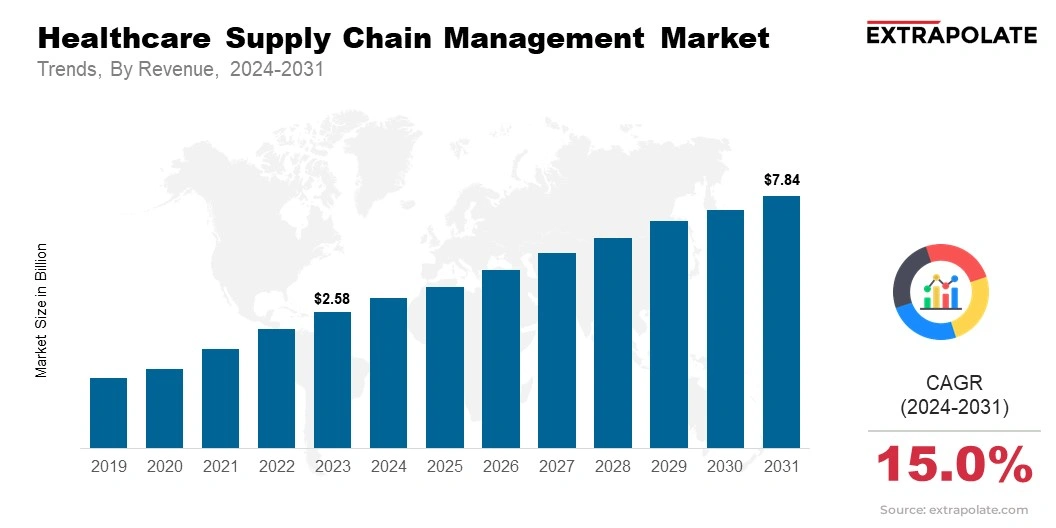
The global Healthcare Supply Chain Management Market size was valued at USD 2.58 billion in 2023 and is projected to grow from USD 2.96 billion in 2024 to USD 7.84 billion by 2031, exhibiting a CAGR of 15.0% during the forecast period.
The global healthcare supply chain management market is experiencing substantial growth, driven by increasing healthcare demands, technological advancements, and the growing need for operational efficiency across healthcare systems.
This market involves various processes, including the procurement, storage, distribution, and management of pharmaceuticals, medical devices, and other healthcare supplies.
As healthcare providers face growing pressures to deliver high-quality services while controlling costs, the role of efficient supply chain management solutions has become more critical than ever.
Technology is playing a pivotal role in transforming healthcare supply chains, with innovations such as artificial intelligence (AI), blockchain, and the Internet of Things (IoT) reshaping operations. These technologies are enabling healthcare organizations to gain real-time insights into their supply chain, optimize inventory management, and reduce the risk of stockouts or overstocking.
By automating routine tasks and enhancing transparency, healthcare supply chains are becoming more agile, resilient, and capable of meeting the dynamic demands of the healthcare sector. The use of AI-powered analytics, for example, is allowing for more accurate demand forecasting, better decision-making, and enhanced tracking of medical supplies and equipment.
The ongoing rise in chronic diseases and the increasing emphasis on personalized medicine have added complexity to healthcare supply chains, further increasing the need for advanced management solutions. The growing demand for healthcare products and services, along with regulatory pressures aimed at improving supply chain efficiency and compliance, are fueling the need for innovation and optimization in this space.
North America and Europe continue to dominate the healthcare supply chain management market, driven by advanced healthcare infrastructure, high technology adoption, and stringent regulatory requirements.
However, the Asia-Pacific region is poised for the fastest growth, particularly due to expanding healthcare needs in countries like China and India, where healthcare access is rapidly improving, and demand for medical supplies is increasing.
As the healthcare sector continues to evolve, the healthcare supply chain management market is expected to witness sustained growth, with healthcare providers adopting advanced technologies and solutions to improve efficiency, reduce costs, and enhance patient care across the globe.

Key Market Trends Driving Product Adoption
The healthcare supply chain management market is characterized by continuous technological advancements, changing consumer demands, and a focus on improving operational efficiency. Key trends driving market growth include:
- Efficiency and Automation: The growing adoption of automation and AI in healthcare supply chains is significantly improving the efficiency and reliability of logistics, resulting in faster delivery times and reduced errors.
- Technological Advancements: Innovations in IoT, blockchain, and cloud-based systems are improving visibility, traceability, and security within healthcare supply chains, enhancing overall supply chain management.
- Demand for Transparency: Increasing patient safety concerns and regulatory requirements are pushing for greater transparency in healthcare supply chains, ensuring the tracking and authentication of products from manufacturers to end users.
- Cost Management: Healthcare organizations are focused on reducing operational costs, and SCM solutions are helping them optimize their inventory management and procurement processes, minimizing waste and lowering expenses.
- Focus on Patient-Centric Models: There is a growing emphasis on patient-centered healthcare, which includes more responsive supply chains that can adapt to patient needs, improve service delivery, and reduce waiting times.
Major Players and their Competitive Positioning
The healthcare SCM market is dominated by key players such as SAP SE, Oracle Corporation, and IBM, who are continuously innovating to improve their offerings. Smaller companies and startups are also emerging with specialized solutions for specific regions or aspects of healthcare supply chain management, such as cold chain logistics and real-time tracking of medical supplies.
Consumer Behavior Analysis
The demand for healthcare SCM solutions is being driven by:
- Operational Efficiency: Healthcare providers and organizations are adopting SCM systems to streamline operations, improve efficiency, and reduce errors in the delivery of medical products and services.
- Cost Control: Healthcare institutions are looking for solutions that help them manage costs while maintaining the quality of care and meeting regulatory requirements.
- Regulatory Compliance: With increasing global regulations surrounding the healthcare industry, organizations are increasingly reliant on SCM systems to ensure they remain compliant and up-to-date with requirements such as the track and trace of medical devices.
Pricing Trends
Healthcare SCM market pricing trends are based on system complexity, deployment size, and the type of features included in the solution. With maturing markets, there is a decreasing cost trend because more cloud-based solutions and SaaS models are becoming available. The shift towards subscription models is also keeping healthcare supply chain management systems within reach and scalable for smaller institutions and healthcare providers.
Growth Factors
Several key factors are contributing to the growth of the healthcare SCM market:
- Technological Integration: The integration of AI, machine learning, blockchain, and IoT into healthcare supply chains is significantly enhancing efficiency and accuracy in healthcare logistics.
- Rising Demand for Healthcare Services: The global increase in healthcare demand, driven by aging populations and chronic diseases, is further fueling the need for advanced supply chain management solutions.
- Regulatory Pressures: The implementation of more stringent regulations in the healthcare sector regarding product traceability, patient safety, and compliance is driving the demand for sophisticated SCM systems.
- Globalization of Healthcare: The expansion of global supply chains to meet growing demand for medical products and services is increasing the complexity of healthcare SCM and necessitating advanced systems for efficient management.
Regulatory Landscape
Healthcare supply chain management is guided by both local and foreign legislation intended to safeguard patient safety, assure compliance, and advance transparency. Regulatory agencies like the FDA in America, EMA in Europe, and other respective national health regulators are more often requiring track-and-trace technology, requiring healthcare organizations to maintain standards of the secure storage and transportation of medical products.
Recent Developments
The healthcare SCM market is undergoing continuous innovation, with several breakthroughs shaping the future:
- Blockchain for Transparency: Blockchain technology is reshaping the tracking of pharmaceuticals and medical devices, validating and minimizing simulated threats in the healthcare supply chain.
- AI and Machine Learning: AI and machine learning improve supply the optimization of the supply chain by streamlining inventory, estimating demand, and implementing automated processes.
- Cold Chain Logistics: Widening cold chain logistics is essential for the protection of vaccines and biologics. This trend is influencing the future of healthcare supply chain management.
- Cloud-Based Solutions: Healthcare organizations are growing in the use of SCM platforms that are cloud-based. These solutions amplify supply chain management by providing expandability , flexibility, and immediate access to data.
Current and Potential Growth Implications
Demand Supply Analysis:
As healthcare organizations scale their operations to meet global demand, there is an increasing need for efficient supply chain management systems that can handle large volumes of products, from medical supplies to pharmaceuticals.
Gap Analysis:
While the healthcare SCM market is evolving, there are gaps in:
- Improving interoperability between different systems and platforms.
- Reducing the cost and complexity of adopting advanced SCM technologies for smaller healthcare institutions.
- Keeping the sustainable healthcare supply chains in good condition, addressing the increase in ecological problems.
Top Companies in the Healthcare Supply Chain Management Market
- SAP SE
- Oracle Corporation
- IBM
- McKesson Corporation
- AmerisourceBergen Corporation
- GE Healthcare
- Cerner Corporation
- Honeywell International
- Kinaxis
- LogistiCare Solutions
Healthcare Supply Chain Management Market: Report Snapshot
Segmentation | Details |
By Component | Software, Services |
By Deployment Mode | Cloud-based, On-premise |
By Application | Pharmaceuticals, Medical Devices, Healthcare Services |
By End User | Hospitals, Clinics, Pharmaceuticals, Healthcare Providers |
By Region | North America, Europe, Asia-Pacific, Latin America, MEA |
High Growth Segments
Considerable development is expected in the following market segments:
- Pharmaceutical Logistics: The rise in compliance requirements and worldwide increase are promoting the acceptance of pharmaceutical supply chain management systems.
- Medical Devices Supply Chains: A focus on improving the efficiency of medical devices distribution and tracking, driven by the rise in surgical procedures and healthcare innovation.
Major Innovations
Innovation remains critical to success in the market. Key innovations include:
- Advanced Forecasting Systems: AI-driven systems to predict demand fluctuations in healthcare products and ensure supply chain continuity.
- Real-Time Tracking Systems: Enhanced tracking solutions using RFID and IoT to provide real-time visibility into the movement of healthcare products.
- Sustainability Solutions: Green logistics solutions designed to reduce the carbon footprint of healthcare supply chains.
Potential Growth Opportunities
In spite of robust potential for growth, companies in the market encounter multiple obstacles:
- Legacy System Integration: High reliance on legacy systems in healthcare can be a hindrance for the effortless transition and integration of recently developed SCM solutions.
- Rising Cybersecurity Threats: Making the network in healthcare supply chains stronger has intensified the importance of ensuring confidentiality and protecting privacy.
- Escalating Healthcare Expenses: The pressure for reducing expenses without compromising the quality of service is driving the transition toward more sustainable SCM solutions.
Extrapolate Research Says:
Driven by fast-evolving technology, compliance needs, and increasing healthcare infrastructure sophistication, the healthcare supply chain management market is poised to experience major improvements. Organizations focusing on seamless integration will have an edge. Those prioritizing resilience and recovery against cyber attacks can tap into emerging opportunities.
ARE YOU SEEKING COMPREHENSIVE INSIGHT ON VARIOUS
MARKETS?
CONTACT OUR EXPERTS TODAY
Healthcare Supply Chain Management Market Size
- March-2025
- 148
- Global
- healthcare-medical-devices-biotechnology
Related Research
2022-2030 Global and Regional B-Cell Non-Hodgkin`s Lymphoma (NHL) Treatment Industry Production, Sa
February-2021
2022-2030 Global and Regional Organ Transplant Diagnostics Industry Production, Sales and Consumpti
February-2021
2022-2030 Global and Regional Prostacyclin Drug Industry Production, Sales and Consumption Status a
February-2021
2022-2030 Global and Regional Spinal and Bulbar Muscular Atrophy Treatment Industry Production, Sal
February-2021
2% Chlorhexidine Gluconate (CHG) Cloths-Global Market Status & Trend Report 2022-2030 Top 20 Countri
April-2021
2021-2027 Global and RegioAnal Nasal Gels Industry Production, Sales and Consumption Status and Pros
February-2021
2021-2027 Global and Regional 2019-nCoV Detection Server Industry Production, Sales and Consumption
February-2021
2021-2027 Global and Regional ? Collagen Quantitative Determination Kit Industry Production, Sales a
February-2021
2021-2027 Global and Regional Anti-TNF Monoclonal Antibody Industry Production, Sales and Consumptio
February-2021