Extrapolate Extrapolate
  • 888-328-2189
  • ABOUT US
  • CONTACT US
  • SIGN IN
  • INDUSTRIES
  • BLOGS
  • Home
  • Healthcare, Medical Devices & Biotechnology
  • Emergency medical services market

Emergency Medical Services Market Size, Share, Growth & Industry Analysis, By Product Type (Life Support and Emergency Resuscitation Equipment, Patient Monitoring Systems, Wound Care Equipment, Infection Control Supplies, Others) By Service Type (Basic Life Support (BLS), Advanced Life Support (ALS)) By End-User (Hospitals, Emergency Departments, Ambulatory Surgical Centers, Home Care Settings, Others), and Regional Analysis, 2024-2031

  • Description
  • Table Of Content
  • Sample Request

Emergency Medical Services (EMS) market: Global Share and Growth Trajectory

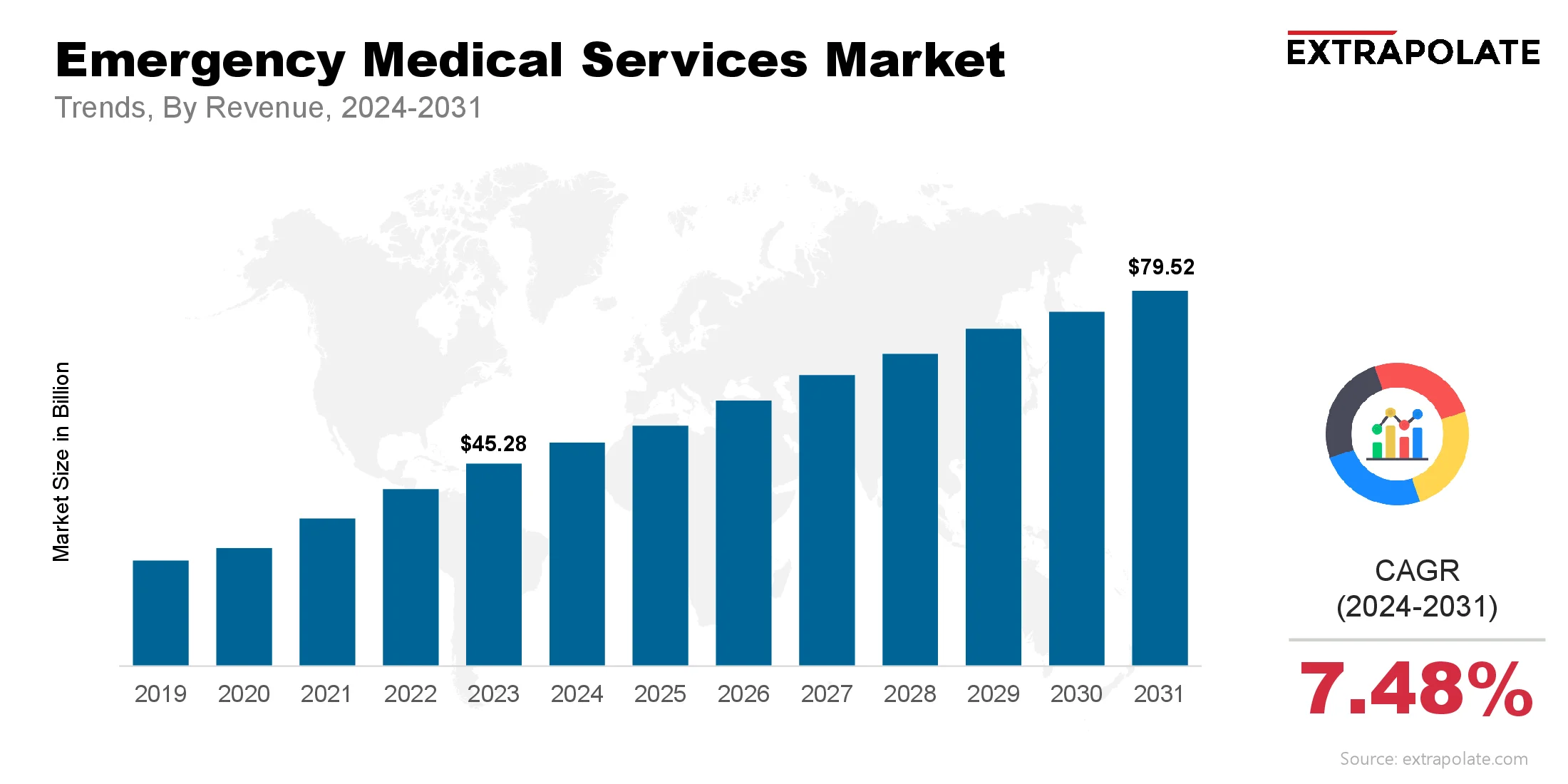
The global Emergency Medical Services Market size was valued at USD 45.28 billion in 2023 and is projected to grow from USD 47.97 billion in 2024 to USD 79.52 billion by 2031, exhibiting a CAGR of 7.48% during the forecast period.

The EMS world is changing fast, driven by a surge in medical emergencies, technology and investment in healthcare. EMS is the backbone of any healthcare system, providing rapid medical attention and transport for people with acute illnesses, injuries or trauma. The EMS ecosystem includes ambulance services, emergency room operations, paramedics and first responders all working together to provide pre-hospital care and stabilise patients in the moment of crisis.

A big driver of EMS growth is the rising global incidence of cardiovascular disease, road traffic accidents, respiratory complications and age related health issues. These conditions require immediate medical attention, so governments and private entities are strengthening EMS capabilities. Better training protocols, streamlined communication networks and real-time data systems are being prioritised to reduce response times and improve clinical outcomes.

Urbanisation and population growth are also playing a big role in shaping EMS demand. As cities grow and rural populations get access to healthcare, there is more emphasis on decentralising EMS infrastructure to cover underserved areas. Emerging economies are seeing more efforts to build emergency transport networks, recruit and train skilled paramedics and integrate EMS into national health strategies.

Public private partnerships are emerging as the model for expanding EMS infrastructure. Collaborations between healthcare providers, ambulance service operators and government bodies are driving innovation and continuous improvement in service delivery. These partnerships often focus on universal emergency care access, especially in low and middle income countries.

Looking forward the EMS market will continue to grow, driven by favourable regulations, growing awareness of emergency care and technological advancements. With its life saving role and health outcomes, EMS is not just a market segment but the foundation of global public health readiness.

In summary the EMS world is changing fast, with a future shaped by smart technology, strategic investment and growing commitment to health equity. As demand for emergency response increases the sector will see sustained growth and innovation and be a cornerstone of modern healthcare systems.

Emergency Medical Services Market Size & Share, By Revenue, 2024-2031Key Market Trends Driving Product Adoption

Surge in Out-of-Hospital Emergency Incidents

A notable trend propelling EMS adoption is the increasing frequency of out-of-hospital emergencies, including road accidents, cardiac arrests, strokes, and drug overdoses. These events necessitate swift medical intervention to improve survival rates and reduce long-term complications. EMS providers are thus experiencing rising demand for rapid-response vehicles and mobile intensive care units equipped with life-saving tools.

Integration of Advanced Communication Technologies

Modern EMS operations rely heavily on real-time communication. Next-generation 911 systems, GPS-enabled dispatch, and vehicle telemetry improve resource allocation and patient triage. These tools enable paramedics to relay critical data to emergency departments before arrival, enhancing preparedness and ensuring timely intervention.

Emphasis on Community Paramedicine

EMS is evolving beyond traditional response roles into community-based care. Programs focused on chronic disease monitoring, mental health crisis intervention, and post-discharge follow-up services are gaining traction. Community paramedicine models reduce hospital readmissions and improve outcomes, positioning EMS as a cost-effective extension of primary care.

Telemedicine and Remote Diagnostics

Telemedicine is revolutionizing emergency care. With portable diagnostic devices and secure video conferencing, paramedics can consult physicians remotely, enabling accurate field diagnoses and real-time treatment decisions. This trend enhances care delivery, especially in rural or underserved regions.

Expansion of EMS in Emerging Markets

Rapid urbanization and improving healthcare infrastructure in Asia-Pacific, Latin America, and the Middle East are creating fertile ground for EMS growth. Governments are allocating higher budgets for ambulance fleets, training programs, and emergency response protocols to meet population health demands.

Major Players and Their Competitive Positioning

The EMS market is highly competitive, featuring a mix of global medical device manufacturers, ambulance service providers, and health IT companies. Key players continuously invest in technology upgrades, fleet expansion, and partnerships to gain a competitive edge.

Prominent market players include: Philips Healthcare, Medtronic plc, Stryker Corporation, GE Healthcare, ZOLL Medical Corporation, Ambu A/S, Henry Schein Medical, Smiths Medical, Falck A/S, Air Methods Corporation.

These companies are focusing on innovations such as portable defibrillators, automated CPR devices, and cloud-based EMS data management systems. Collaborations with government bodies and healthcare institutions are further expanding their reach in the EMS ecosystem.

Consumer Behavior

  • Public Awareness and Expectations: As public awareness of timely emergency care grows, demand for efficient and well equipped EMS providers is increasing. Consumers expect fast response times, trained personnel and on site treatment.
  • Patient Preferences for Mobile Healthcare: Patients are choosing in home and mobile treatment options especially for non critical conditions. This is driving the development of non emergency medical transport services and community paramedic programs which fall under the EMS umbrella.
  • Cost and Insurance: Cost is a big factor in EMS utilization. In many areas high out of pocket costs for ambulance services are deterrents to use. But expanded insurance coverage and government subsidies are making it more accessible and increasing utilization rates.
  • Demand for Digital Transparency: Consumers want transparency in EMS operations from estimated response times to medical billing. This is driving the adoption of mobile apps, GPS tracking and electronic health records to improve patient trust and satisfaction.

Pricing Trends

Pricing in the EMS market varies greatly based on the type of service, location, regulatory environment and level of care. ALS services cost more than BLS services but reimbursement models are shifting to value based pricing.

High Upfront Cost: The cost of setting up an EMS system includes ambulances, communication infrastructure, medical equipment and workforce training. For ambulance service providers, capital expenditure is a barrier to entry.

Leasing Models on the Rise: To reduce high upfront costs, leasing models for medical equipment, vehicles and software are becoming more popular. Subscription based services and bundled procurement packages are helping providers stay financially agile.

Reimbursement Reforms: Public and private payers are updating EMS reimbursement frameworks to include performance metrics such as patient satisfaction and clinical outcomes. This is impacting provider pricing and investment decisions.

Growth Drivers

Several key factors are driving the growth of the EMS market:

  • Trauma and Cardiac Conditions on the Rise: Global increase in injuries, cardiovascular emergencies and respiratory disorders is driving demand for EMS systems that can intervene rapidly and provide high quality pre-hospital care.
  • Aging PopulationL: Aging global population, especially in Europe and Asia-Pacific is more prone to medical emergencies. EMS is evolving to cater to geriatric care with specialized protocols and transport capabilities.
  • Urbanization and Infrastructure Development: Improving road networks, smart city initiatives and healthcare facility expansions in emerging markets is making EMS more viable and efficient.
  • Technology: From portable ventilators to automated dispatch systems, technology is improving EMS delivery. AI, IoT and wearable health monitors are enabling faster diagnosis and better patient outcomes.
  • Government Policy and Public Funding: Government initiatives for universal health coverage, disaster preparedness and emergency health response programs are major growth drivers. Public private partnerships are fuelling EMS deployment..

Regulatory Landscape

EMS operations are subject to strict regulations to ensure the safety and reliability of pre-hospital care:

  • United States: In the U.S., EMS must follow NHTSA and HHS rules. State EMS agencies handle licenses and procedures. They ensure care meets national and local standards.
  • European Union: EU EMS systems follow strict rules. These cover devices, vehicle safety, and emergency steps. Cross-border help is handled by the EU Civil Protection Mechanism.
  • Global ISO Standards: Global ISO standards guide EMS equipment quality. ISO 9001 and 13485 ensure safety and proper management. Certified makers meet trusted global benchmarks.

Regulatory compliance is essential for public trust, insurance reimbursement, and operational continuity.

Recent Developments

The EMS market has seen numerous recent developments that underscore its evolution:

  • Tele-EMS Platforms: Tele-EMS platforms are now in use. They let paramedics talk to doctors in real time. This helps diagnose faster and treat patients quickly.
  • AI-Based Dispatch Systems: AI-based dispatch systems are improving EMS response. Smart algorithms assign resources better and spot emergency hotspots. This boosts speed and efficiency.
  • Electric and Hybrid Ambulances: Electric and hybrid ambulances are gaining use. They cut emissions and lower running costs. EMS providers worldwide are adopting them.
  • Public-Private Partnerships: Governments are teaming up with private ambulance firms. These partnerships boost EMS access. Rural and underserved areas benefit most.
  • Expanded Scope of EMS: EMS roles are expanding in some areas. They now offer vaccines, mental health checks, and home care. This widens their role in public health.

Current and Potential Growth Implications

a. Demand-Supply Analysis

EMS demand is rising fast. Supply can't keep up, especially in developing areas. This creates pressure on services and resources. The EMS sector faces major hurdles. Equipment is short, and training is limited. Poor infrastructure adds to the challenge.

b. Gap Analysis

EMS is growing but gaps remain. Rural, remote, and low-income areas still lack access. These regions need more support and coverage. Mobile units, training, and local EMS networks are key. These investments help fill service gaps. They improve access in underserved areas.

Top Companies in the Emergency Medical Services Market

  • Philips Healthcare
  • Medtronic plc
  • Stryker Corporation
  • GE Healthcare
  • ZOLL Medical Corporation
  • Ambu A/S
  • Henry Schein Medical
  • Smiths Medical
  • Falck A/S
  • Air Methods Corporation

Emergency Medical Services Market: Report Snapshot

Segmentation

Details

By Product Type

Life Support and Emergency Resuscitation Equipment, Patient Monitoring Systems, Wound Care Equipment, Infection Control Supplies, Others

By Service Type

Basic Life Support (BLS), Advanced Life Support (ALS)

By End-User

Hospitals, Emergency Departments, Ambulatory Surgical Centers, Home Care Settings, Others

By Region

North America, Europe, Asia-Pacific, Latin America, Middle East & Africa

High Growth Segments

  • Advanced Life Support (ALS): ALS services are seeing higher demand. People need critical care during transport and on-site. This boosts use of ALS tools and systems.
  • Mobile Health and Monitoring Devices: Mobile health tools are on the rise. Telemedicine and remote tracking drive this trend. Portable diagnostics and communication systems are key.
  • Rural and Underserved Regions: Rural and underserved areas are seeing more EMS support. Mobile units and local partnerships are growing. These efforts improve emergency care and access.

Major Innovations

  • Smart Ambulances: Smart ambulances now have advanced tech. They include onboard diagnostics and EHR systems. Fast internet allows doctors to consult remotely.
  • Automated CPR Devices: Automated CPR devices give steady chest compressions. This boosts survival chances during cardiac arrest. They help when manual CPR isn't enough.
  • Drone-Assisted EMS: Drones are now helping EMS teams. They carry AEDs and supplies to hard-to-reach places. This speeds up emergency response.

Potential Growth Opportunities

  • AI and Predictive Analytics: AI and predictive tools help plan better. They forecast emergencies and spot trends. This improves response times and resource use.
  • Expansion into Emerging Markets: Emerging markets offer big chances for growth. Better infrastructure and health reforms help. Asia, Africa, and Latin America lead this trend.
  • Training and Simulation Technologies: Training tech is getting better for EMS. VR-based simulations are now used in training. These tools help workers get ready for real situations.

Extrapolate Research Says:

The emergency medical services market will grow fast in the next few years. With more medical emergencies, technology integration and infrastructure investment, EMS is becoming a vital part of modern healthcare systems. As governments, providers and innovators align, the market will become more efficient, responsive and life saving.

FAQ

The global market is projected to reach USD 79.52 billion by 2031, growing at a CAGR of 7.48% from 2024 to 2031.
The global market was valued at USD 47.97 billion in 2024.
A notable trend propelling EMS adoption is the increasing frequency of out-of-hospital emergencies, including road accidents, cardiac arrests, strokes, and drug overdoses. These events necessitate swift medical intervention to improve survival rates and reduce long-term complications.
Key players in the market are Philips Healthcare, Medtronic plc, Stryker Corporation, GE Healthcare, ZOLL Medical Corporation, Ambu A/S, Henry Schein Medical, Smiths Medical, Falck A/S, Air Methods Corporation. and Others.

ARE YOU SEEKING COMPREHENSIVE INSIGHT ON VARIOUS MARKETS?
CONTACT OUR EXPERTS TODAY

Speak to an Expert
Emergency medical services market

Emergency Medical Services Market Size

  • August-2025
  • 148
  • Global
  • healthcare-medical-devices-biotechnology
3499

SELECT AN OPTION

  • 1 User Access
  • PDF Report View
  • Non-Printable
  • 32 Man-hours Analyst Support
  • Post-Sale Support 48 Hours
  • Access upto 5 users
  • PDF Report View
  • Print Available
  • Access to Data Sheet
  • Up to 10% Customization
  • 40 Man-hours Analyst Support
  • Post-Sale Support 72 Hours
  • Annual Update
  • Unlimited User Access
  • Downloadable PDF Report. Data Sheet, Power Point Presentation
  • Print Available
  • Up to 20% Customization
  • 72 Man-hours Analyst Support
  • Post-Sale Support 120 Hours
  • Bi-Annual Update

ENQUIRE NOW REQUEST SAMPLE
Dale Byrne

HAVE A QUESTION?
Samuel will help you find what you are looking for.


Call: 888-328-2189


Related Research

2022-2030 Global and Regional B-Cell Non-Hodgkin`s Lymphoma (NHL) Treatment Industry Production, Sa

February-2021


2022-2030 Global and Regional Organ Transplant Diagnostics Industry Production, Sales and Consumpti

February-2021


2022-2030 Global and Regional Prostacyclin Drug Industry Production, Sales and Consumption Status a

February-2021


2022-2030 Global and Regional Spinal and Bulbar Muscular Atrophy Treatment Industry Production, Sal

February-2021


2% Chlorhexidine Gluconate (CHG) Cloths-Global Market Status & Trend Report 2022-2030 Top 20 Countri

April-2021


2% Chlorhexidine Gluconate (CHG) Cloths-Global Market Status and Trend Report 2022-2030

April-2021


2021-2027 Global and RegioAnal Nasal Gels Industry Production, Sales and Consumption Status and Pros

February-2021


2021-2027 Global and Regional 2019-nCoV Detection Server Industry Production, Sales and Consumption

February-2021


2021-2027 Global and Regional ? Collagen Quantitative Determination Kit Industry Production, Sales a

February-2021


2021-2027 Global and Regional Anti-TNF Monoclonal Antibody Industry Production, Sales and Consumptio

February-2021


Sample Request

Emergency Medical Services Market Size, Share, Growth & Industry Analysis, By Product Type (Life Support and Emergency Resuscitation Equipment, Patient Monitoring Systems, Wound Care Equipment, Infection Control Supplies, Others) By Service Type (Basic Life Support (BLS), Advanced Life Support (ALS)) By End-User (Hospitals, Emergency Departments, Ambulatory Surgical Centers, Home Care Settings, Others), and Regional Analysis, 2024-2031

Publisher: Kings Research   |   Date: 2025-08-07   |   No. Of Pages: 148

Send Your Query

Emergency Medical Services Market Size, Share, Growth & Industry Analysis, By Product Type (Life Support and Emergency Resuscitation Equipment, Patient Monitoring Systems, Wound Care Equipment, Infection Control Supplies, Others) By Service Type (Basic Life Support (BLS), Advanced Life Support (ALS)) By End-User (Hospitals, Emergency Departments, Ambulatory Surgical Centers, Home Care Settings, Others), and Regional Analysis, 2024-2031

Publisher: Kings Research   |   Date: 2025-08-07   |   No. Of Pages: 148
Extrapolate

Extrapolate has a refined network of top publishers across the globe covering markets and micro markets who bring in the power of decision making. Our network of publishers is ranked based on the quality of reports produced along with customer feedback Indexing.

 talk@extrapolate.com

888-328-2189


Connect With Us

twitter logo

Industry

Quick Links

  • About Us
  • Contact Us
  • FAQ
  • Privacy Policy
  • Disclaimer
  • Refund Policy
  • Sitemap


Payment Gateway
Sign up for newsletter and updates


Powered By

Kings Research
© 2025 Kingsresearch. All Rights Reserved.