3D Printing Photopolymer Market Size, Share, Growth & Industry Analysis, By Technology (Digital Light Processing, Polyjet, Stereolithography, Urethane Casting), By Light Spectrum (Ultraviolet, Visible, Infrared), Vertical (Healthcare, Aerospace & Defense, Automotive, Heavy Industry, Manufacturing, Consumer Goods, Electronics & Electrical, & Others), and Regional Analysis, 2024-2031
3D Printing Photopolymer Market Size
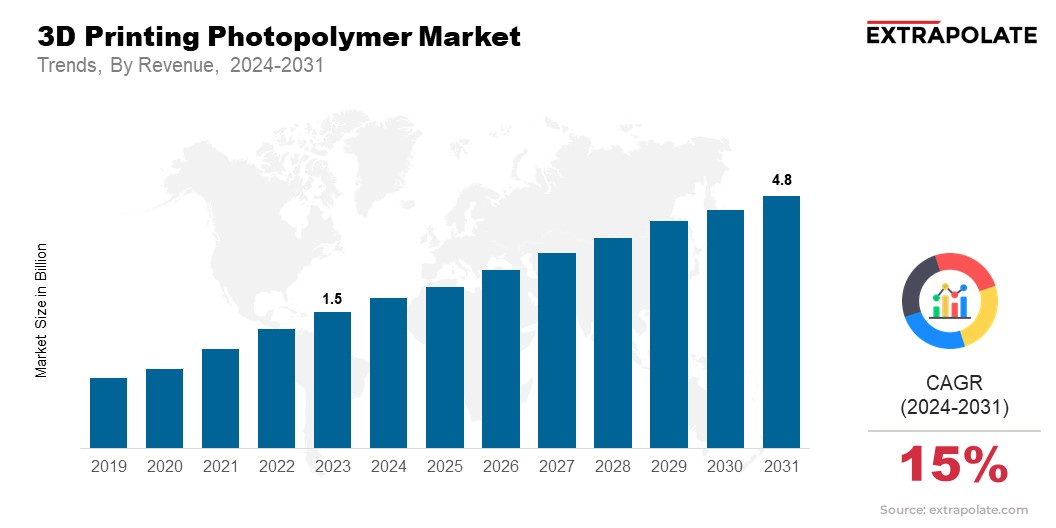
The global 3D printing photopolymer market size was valued at USD 1.5 billion in 2023 and is projected to reach USD 4.8 billion by 2031, exhibiting a CAGR of 15% during the forecast period, driven by the increasing adoption of additive manufacturing across various industries. The development of advanced photopolymer materials with enhanced mechanical properties and specialized features is further expanding the applications of 3D printing across sectors such as healthcare, automotive, and aerospace.
Photopolymers are vital in 3D printing. They have superior mechanical properties, flexibility, and precision. This makes them ideal for healthcare, automotive, aerospace, and consumer goods. The rise of digital manufacturing and demand for custom products are driving the adoption of 3D printing. This is increasing the demand for photopolymers. New, advanced photopolymer resins for specific industrial uses are boosting the market.
Also, the focus on sustainability is boosting the production of bio-based and recyclable photopolymers. This is driving market growth. The evolution of 3D printing technologies is expected to grow the photopolymer market. It will be driven by advanced technology and more R&D investment.

3D Printing Photopolymer Market Trends
Three major trends are impacting the 3D printing photopolymer market. They are, high-performance resins, more use of photopolymers in healthcare, and a focus on sustainability. High-performance photopolymers are gaining traction in aerospace and automotive for specific industrial needs, like high-temperature resistance and durability. These resins produce prototypes and end-use parts that follow strict industry standards. In healthcare, biocompatible photopolymers are used more in medical devices, dental work, and prosthetics.
Biocompatible photopolymers find widespread application in medical devices and dental prosthetics. Sustainability is now a core focus. So, there is a push for eco-friendly photopolymers that are biodegradable or from renewable sources. As environmental concerns rise, the demand for sustainable 3D printing materials is expected to grow, with companies investing in green innovations. These trends show a market's shift toward higher functionality, broader applications, and sustainability.
3D Printing Photopolymer Market Growth Factors
Several key factors drive the growth of the 3D printing photopolymer market. They are technological advancements, increased use in industry, and a rising demand for customization. Continuous innovation in 3D printing, especially in photopolymerization, is boosting performance. This includes processes like stereolithography (SLA) and digital light processing (DLP with improved speed and precision. This has led to wider use in industries needing high accuracy and complex shapes. The healthcare industry is a major factor driving the growth of customized implants, dental solutions, and medical devices.
The automotive and aerospace sectors are boosting the market, using photopolymer-based 3D printing for rapid prototyping, tooling, and making lightweight parts. Also, the trend of mass customization is growing. Consumers want personalized products, which drives the demand for photopolymer materials in bespoke items in fashion, jewelry, and consumer electronics. The market benefits from R&D investments, leading to new, application-specific photopolymer resins.
Segmentation Analysis
The 3D printing photopolymer market has key segments that indicate industry dynamics, technology advances, and application areas. These segments are Technology, Light Spectrum, and Vertical. Each being key to the market's growth.
By Technology
The technology segment has been segmented into stereolithography (SLA), digital light processing (DLP), and polyjet printing. SLA dominated the market, occupying 45% of the 2023 market space due to its high precision and ability to make complex shapes with smooth finishes in healthcare and aerospace applications. DLP is gaining traction in the dental and jewelry industries due to faster printing at low cost. Meanwhile, applications that demand high resolution and fine details use Polyjet printing as it is versatile and uses multiple materials at once.
By Light Spectrum
Based on light spectrum, the market has been categorized as ultraviolet (UV), visible, and infrared (IR) light spectrums. The UV light spectrum segment dominated the market with 60% share. Its curing capabilities surpass others, as it transforms photopolymers with precision.
UV-based 3D printing technologies gain acceptance in industrial uses demanding strength and accuracy. The visible light spectrum is used in specialized applications where safety and material properties are critical. The infrared spectrum is, however, still emerging and focused on advanced R&D.
By Vertical
The 3D printing photopolymer market has been segmented by vertical into healthcare, automotive, aerospace, and consumer goods. Healthcare led the market with nearly 30% of the total revenue due to high demand for customized medical devices, dental implants, and surgical tools.
The automotive and aerospace industries are using 3D printing to quickly prototype and produce lightweight parts with photopolymers. The consumer goods segment is growing as there is a rising demand for personalized fashion, eyewear, and electronic items.
Regional Analysis of 3D Printing Photopolymer Market
The 3D printing photopolymer market exhibits significant regional diversity, influenced by many factors. Technology adoption, rapid industrialization, and investments in additive manufacturing are the major determinants of this diversity. In 2023, North America held nearly 40% of global revenue. The U.S. has been a key contributor with advanced manufacturing, top 3D printing firms, and high demand from aerospace and healthcare.

The region has seen major investments in R&D that have spurred innovation in photopolymer materials for various uses. Europe is another key market. It has major automotive and industrial hubs in Germany, the UK, and France. The region is seeing more 3D printing in the automotive and aerospace sectors. It is due to a need for lightweight, durable parts that use high-performance photopolymers.
The Asia-Pacific region is expected to be the fastest-growing market. This growth may arise from rapid industrialization, a booming consumer electronics and automotive sector, and government initiatives to promote advanced manufacturing technologies.
China, Japan, and South Korea lead this growth, with investments in 3D printing technologies and a focus on developing cost-effective photopolymer solutions. Also, the region's demand for custom, high-precision products is boosting the use of photopolymer-based 3D printing.
Latin America and the Middle East & Africa are emerging as the gradual adopters of 3D printing technologies with the growth of industries and digital manufacturing.
Regional differences in technology, industry, and policies shape the 3D printing photopolymer market's growth in these areas.
Competitive Landscape of 3D Printing Photopolymer Market
The 3D printing photopolymer market is competitive. with both established players and small innovative startups. 3D Systems, Stratasys, BASF, and Formlabs lead the market with their vast portfolios of photopolymer resins and focus on R&D. These industry giants stay competitive by launching new, high-performance materials for various industrial uses.
Startups and smaller companies gain traction by offering niche products and specialized solutions, especially biocompatible and eco-friendly photopolymers. Key players use strategic partnerships and collaborations to expand their market reach and enhance product offerings. They also use regular product launches and a focus on innovation to meet the evolving demands of various industries.
List of Key Players in 3D Printing Photopolymer Market
- Dassault Systèmes
- Stratasys
- 3D Systems Corporation
- Kudo3D
- BASF
- Formlabs
- Arkema
- ENVISIONTEC US LLC
- SABIC
- MAKEX
Recent Industry Developments
The 3D printing photopolymer market is characterized by recent developments that highlight continuous innovation and growth. For instance, in 2023, BASF launched new photopolymer resins for high-precision uses targeted at automotive and aerospace industries. Formlabs launched a highly accurate and bio-compatible dental resin as a part of its customized dental solutions.
Also, Stratasys expanded its photopolymer portfolio. It introduced eco-friendly materials to reduce environmental impact while maintaining high performance. These industry advancements underscore the ongoing efforts to enhance material properties, expand application areas, and address sustainability concerns in the 3D printing photopolymer market.
The global 3D Printing Photopolymer Market is segmented as:
By Technology
- Digital Light Processing
- Polyjet
- Stereolithography
- Urethane Casting
By Light Spectrum
- Ultraviolet
- Visible
- Infrared
By Vertical
- Healthcare
- Aerospace & Defense
- Automotive
- Heavy Industry
- Manufacturing
- Education
- Electronics & Electrical
- Others
By Region
- North America
- U.S.
- Canada
- Mexico
- Europe
- Germany
- UK
- France
- Italy
- Spain
- Russia
- Rest of Europe
- Asia-Pacific
- China
- Japan
- India
- South Korea
- Rest of Asia-Pacific
- Middle East & Africa
- GCC
- South Africa
- North America
- Rest of Middle East & Africa
- Latin America
- Brazil
- Argentina
- Rest of Latin America
ARE YOU SEEKING COMPREHENSIVE INSIGHT ON VARIOUS
MARKETS?
CONTACT OUR EXPERTS TODAY
D Printing Photopolymer Market Size
- September-2024
- 148
- Global
- healthcare-medical-devices-biotechnology
Related Research
2022-2030 Global and Regional B-Cell Non-Hodgkin`s Lymphoma (NHL) Treatment Industry Production, Sa
February-2021
2022-2030 Global and Regional Organ Transplant Diagnostics Industry Production, Sales and Consumpti
February-2021
2022-2030 Global and Regional Prostacyclin Drug Industry Production, Sales and Consumption Status a
February-2021
2022-2030 Global and Regional Spinal and Bulbar Muscular Atrophy Treatment Industry Production, Sal
February-2021
2% Chlorhexidine Gluconate (CHG) Cloths-Global Market Status & Trend Report 2022-2030 Top 20 Countri
April-2021
2021-2027 Global and RegioAnal Nasal Gels Industry Production, Sales and Consumption Status and Pros
February-2021
2021-2027 Global and Regional 2019-nCoV Detection Server Industry Production, Sales and Consumption
February-2021
2021-2027 Global and Regional ? Collagen Quantitative Determination Kit Industry Production, Sales a
February-2021
2021-2027 Global and Regional Anti-TNF Monoclonal Antibody Industry Production, Sales and Consumptio
February-2021