Extrapolate Extrapolate
  • 888-328-2189
  • ABOUT US
  • CONTACT US
  • SIGN IN
  • INDUSTRIES
  • BLOGS
  • Home
  • Chemicals and Advanced Materials
  • Alcohol ingredients market

Global Alcohol Ingredients Market Size, Share, Growth & Industry Analysis, By Type (Yeast, Enzymes, Flavorings, Colorants, Stabilizers, Others), By Application (Beer, Wine, Spirits, RTD Beverages, Others), and Regional Analysis, 2024-2031

  • Description
  • Table Of Content
  • Sample Request

Alcohol Ingredients Market: Global Share and Growth Trajectory

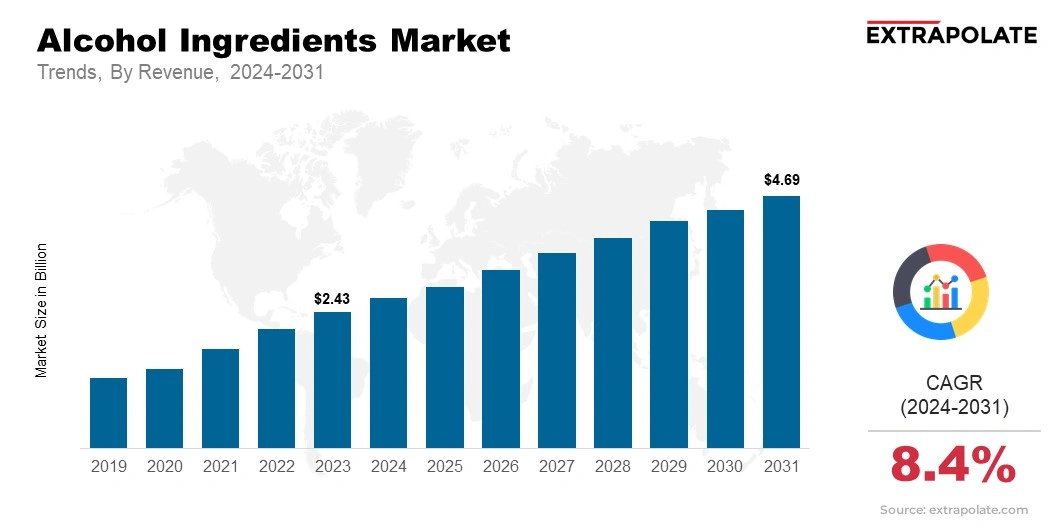
The global Alcohol Ingredients Market size was valued at USD 2.43 billion in 2023 and is projected to grow from USD 2.66 billion in 2024 to USD 4.69 billion by 2031, exhibiting a CAGR of 8.4% during the forecast period.

The global market for alcohol ingredients is experiencing a stable growth mainly because of growing demand for alcohol beverages, new trends in flavoring and restoration components, as well as alcohol consumption in general throughout several areas. Alcohol ingredients are the vital part of brewing and producing alcohol drinks, ranging from beer, wine, and spirits to RTD beverages. The ingredients responsible for the alcoholic beverages' quality are yeast, enzymes, flavorings, and stabilizers that facilitate the fermentation process and impart a characteristic flavor. Consumers with advanced demands ask for freshness and newness in alcohol-based ingredients, resulting in a rather thrilling and stiff market of food and beverage giants around the globe.

Alcohol Ingredients Market Size, By Revenue, 2024-2031

Key Market Trends Driving Product Adoption

The alcohol ingredients market is noticing various key trends driving product adoption:

  • Craft Alcoholic Beverages: Increased demand due to the demand for distinct and high-quality ingredients focusing on flavor and character of such beverages, particularly in terms of craft beers, artisanal spirits, and small-batch production.
  • Natural and Organic Ingredients: With the emergence of health consciousness, the spotlight in the future is sure to lie on natural and organic alcohol ingredients. The demand for non-artificial flavors, preservatives, and subsidiaries are increasing, driving innovation in finding sources for those ingredients.
  • Flavors and Botanicals: Increase in flavored alcoholic drinks like flavored vodkas, gins, and RTDs fuel the demand for botanicals, herbs and spices for distilling various flavor profiles that interest multiple consumer segments.
  • Advances in Fermentation Technology: The growth of modern fermentation techniques is allowing for the intensification of alcoholic beverage production processes while increasing efficiency and stability. This is driving the demand for specialty yeast and enzyme ingredients.
  • Sustainability Trends: The new direction toward sustainability is dictating sourcing of ingredients. Manufacturers opt for sustainable and environmentally friendly practices. Consumers look to offset the environmental impact of what they eat and drink, which encourages key companies to adopt sustainable ingredients and processes.

Major Players and their Competitive Positioning

The alcohol ingredients market is majorly competitive with various large companies and an increasing number of specialized suppliers ruling the industry. Key players such as DSM, Chr. Hansen, Kerry Group, and Lesaffre are on the frontline, offering a vast range of ingredients to enhance the quality and taste of alcoholic beverages. In addition to this, smaller players and startups coming into view are innovating with niche products like botanicals, specialty flavors, and natural additives to meet the increasing demand for exclusive alcohol offerings.

Consumer Behavior Analysis

Consumers are becoming savvier with their drink selection, especially the younger generation that is looking for something unique and customized. The following factors are propelling the demand for alcohol ingredients:

  • Health-Related Decisions: Consumers' growing health concerns lead them to seek drinks manufactured from organic and non-GMO materials, maintaining clean processes in production. Healthy variants of alcohol drinks are becoming a preferred choice for these consumers.
  • Premiumization: Premium and craft alcohols are gaining high consumer demand, which in turn fuels increased and diverse demand for premium and creative ingredients.
  • Flavor Innovation: The ever-rising need for new and fusion flavors has been inspiring manufacturers to try botanicals, spices, and exotic fruits in alcoholic beverages.
  • Sustainability: With sustainability at the top of the list of consumer's concerns, brands that allow eco-friendly and sustainable ingredients have been slowly growing consumer loyalty as well as preference.

Pricing Trends

Pricing in the alcohol ingredients market is determined by factors like sourcing of ingredients, quality, and the production process. Natural and organic ingredients are usually overpriced due to the costs linked with sustainable sourcing and processing. However, as the demand for these ingredients surges and production scales, prices are expected to strengthen. The market also sees superior pricing for elite and customized ingredients, such as rare botanicals or specialty enzymes, which add value to craft and high-end alcoholic beverages.

According to market projections, the alcohol ingredients market is assumed to grow remarkably, driven by the growing demand for unique products, flavor innovations, and evolution in fermentation technology.

Growth Factors

Several key factors drive the growth of the alcohol ingredients market:

  • Increasing Alcohol Consumption: The growing demand for alcoholic drinks at the global level, particularly in developing markets, fuels the requirement for alcohol ingredients to meet a wide array of consumer tastes and preferences.
  • Premiumization and Craft Beverages: The premiumization trend, which illustrates a strong drive toward premium, high-quality, and artisanal beverages, has been stressing the need for unique and specialized alcohol ingredients.
  • Technology and modernization: With modernization and technological advancement, the fermentation and flavoring technologies have improved considerably, which helps the manufacturers increase the quality and consistency of alcoholic beverages, thus impacting the uptake of specialty alcohol ingredients.
  • Increasing Demand for Flavored Alcoholic Beverages: With the rising popularity of flavored alcoholic drinks, including RTDs and flavored spirits, the demand for natural flavoring agents, botanicals, and herbs is growing.

Regulatory Landscape

The alcoholic ingredients market is highly variable. It depends on the region and the kind of alcoholic beverage. It is standardized by the actual ingredients permitted via various standards; for example, in the United States, alcohol beverage manufacturing is controlled by TTB. Meanwhile, in Europe, the constituents of food and drinks including ingredients of alcoholic beverages are evaluated by the EFSA. Ingredient labeling, food safety, and consumer protection have to be followed by manufacturers in order to continue accessing the market.


Recent Developments/ Market Highlights

Notable events in the recent past in the alcohol ingredients market are:

  • Botanical and Herbal Infusions: Craft spirits and cocktails have increased in popularity with the increased application of botanicals and herbs, such as juniper, lavender, and citrus, in beverages.
  • Technological advancements in yeast and enzymes: New developments in fermentation technology have created special yeast and enzyme strains that, although making alcohol production more efficient, also bring a richer flavor profile and consistency to the end product.
  • Procurement of sustainability ingredients: With the spotlight on sustainability, companies are pivoting their practices toward sourcing ingredients from suppliers specializing in environmentally friendly and sustainable ingredients, gaining a vital competitive edge. This strategic shift not only enhances their offerings but also fosters a commitment to a more eco-conscious future.

Current and Potential Growth Implications

Demand Supply Analysis: The demand for alcohol ingredients is going to increase in both developed and emerging markets because of reasons such as shift in consumer preference, growth in the craft beverage industry, and consumption of flavored alcoholic beverages.

Gap Analysis: Even though the alcohol ingredient market is increasing, the gap is still evident in the offer of natural and organic ingredients, mainly for certain categories of beverages, including low-alcohol beverages and alternatives that are not alcoholic.

  • Customization: There is an increasing demand for custom formulations to create unique and signature flavors, particularly for craft distillers and small-batch producers.
  • Integration of Sustainable Practices: More and more brands are integrating sustainability into the sourcing and production practices. This approach offers opportunities for vendors who have environmentally friendly and sustainable offerings.

Top Companies in the Alcohol Ingredients Market

Some of the leading companies in the alcohol ingredients market are:

  • DSM
  • Chr. Hansen
  • Kerry Group
  • Lesaffre
  • BASF
  • Synergy Flavors
  • IFF (International Flavors & Fragrances)
  • Givaudan
  • Archer Daniels Midland Company
  • Firmenich

Alcohol Ingredients Market: Report Snapshot

Segmentation

Details

By Type

Yeast, Enzymes, Flavorings, Colorants, Stabilizers, Others

By Application

Beer, Wine, Spirits, RTD Beverages, Others

By Region

North America, Europe, Asia-Pacific, Latin America, Middle East & Africa

Alcohol Ingredients Market: High Growth Segments

The following areas are expected to experience high growth rates:

  • Flavored Alcoholic Beverages: The growing demand for flavored alcohols, including spirits and RTDs, raises the demand for natural flavorings and botanicals.
  • Craft and Premium spirits: The growth in craft drinks needs better, more innovative high-quality, bespoke ingredients.
  • Sustainability and Natural Ingredients: Natural, organic, and sustainable ingredients are becoming increasingly prominent to address the demand for healthier, more eco-friendly products.

Major Innovations
Innovation in the alcohol ingredients market has been a key driver of the latest trends, which are as follows:

  • Flavor Innovations: Exotic fruits, botanicals, herbs being infused in alcoholic beverages.
  • Fermentation Technologies: Improved process to produce alcohol that brings about better flavoring, but with greater consistency in the process.
  • Sustainability Initiatives: Development of sustainable and eco-friendly ingredient sourcing to address consumer demands for more environment-friendly products.

Alcohol Ingredients Market: Potential Growth Opportunities

Several potential opportunities are going to set the alcohol ingredients market on a growth path:

  • Expansion in Emerging Markets: Increased alcohol consumption in emerging markets provides significant growth opportunities for alcohol ingredient suppliers.
  • Increasing Demand for Craft Beverages: The trend of premium and craft beverages provides an opportunity for companies to provide unique and special ingredients.
  • Health-Conscious Consumer Trends: Manufacturers are increasingly focused on developing healthier, low-alcohol, and non-alcoholic beverages, creating demand for ingredients that cater to these trends.

Kings Research says:

The alcohol ingredients market is on the verge of explosive growth. With evolving consumer preferences, cutting-edge technology, and sustainability at the forefront, the future looks bright. High-quality, innovative, and eco-friendly ingredients are prime pickings for companies ready to dive in. A growing inclination toward healthy choices and premium products creates an environment marked with opportunities. Ingredient suppliers can now cater to the shifting demands of the global alcohol industry with better efficiency.

FAQ

The global market is projected to reach USD 4.69 billion by 2031, growing at a CAGR of 8.4% from 2024 to 2031.
The global market was valued at USD 2.43 billion in 2023.
The growing demand for alcoholic drinks at the global level, particularly in developing markets, fuels the requirement for alcohol ingredients to meet a wide array of consumer tastes and preferences.
Key players in the market are DSM, Chr. Hansen, Kerry Group, Lesaffre, BASF, Synergy Flavors, IFF (International Flavors & Fragrances), Givaudan, Archer Daniels Midland Company, Firmenich

ARE YOU SEEKING COMPREHENSIVE INSIGHT ON VARIOUS MARKETS?
CONTACT OUR EXPERTS TODAY

Speak to an Expert
Alcohol ingredients market

Global Alcohol Ingredients Market Size

  • January-2025
  • 148
  • Global
  • Chemicals-and-Advanced-Materials
3499

SELECT AN OPTION

  • 1 User Access
  • PDF Report View
  • Non-Printable
  • 32 Man-hours Analyst Support
  • Post-Sale Support 48 Hours
  • Access upto 5 users
  • PDF Report View
  • Print Available
  • Access to Data Sheet
  • Up to 10% Customization
  • 40 Man-hours Analyst Support
  • Post-Sale Support 72 Hours
  • Annual Update
  • Unlimited User Access
  • Downloadable PDF Report. Data Sheet, Power Point Presentation
  • Print Available
  • Up to 20% Customization
  • 72 Man-hours Analyst Support
  • Post-Sale Support 120 Hours
  • Bi-Annual Update

ENQUIRE NOW REQUEST SAMPLE
Dale Byrne

HAVE A QUESTION?
Samuel will help you find what you are looking for.


Call: 888-328-2189


Related Research

Carbohydrases Market Size, Share & Trends Analysis Report By Application (Food and beverages, Anima

January-2021


0-Global Market Status & Trend Report 2022-2030 Top 20 Countries Data

August-2021


0-Global Market Status & Trend Report 2022-2030 Top 20 Countries Data

April-2021


0-Global Market Status and Trend Report 2022-2030

August-2021


0-Global Market Status and Trend Report 2022-2030

April-2021


1,2,3,4-Tetrahydroquinaldine Reagent (CAS 1780-19-4) -Global Market Status & Trend Report 2022-2030

August-2021


1,2,3,4-Tetrahydroquinaldine Reagent (CAS 1780-19-4) -Global Market Status and Trend Report 2022-203

August-2021


1,2,3,4-Tetrahydroquinoline Reagent (CAS 635-46-1)-Global Market Status & Trend Report 2022-2030 Top

August-2021


1,2,3,4-Tetrahydroquinoline Reagent (CAS 635-46-1)-Global Market Status and Trend Report 2022-2030

August-2021


1,2-Dichloroethylene Market Insights 2022, Global Analysis and Forecast to 2030

July-2021


Sample Request

Global Alcohol Ingredients Market Size, Share, Growth & Industry Analysis, By Type (Yeast, Enzymes, Flavorings, Colorants, Stabilizers, Others), By Application (Beer, Wine, Spirits, RTD Beverages, Others), and Regional Analysis, 2024-2031

Publisher: Kings Research   |   Date: 2025-01-10   |   No. Of Pages: 148

Send Your Query

Global Alcohol Ingredients Market Size, Share, Growth & Industry Analysis, By Type (Yeast, Enzymes, Flavorings, Colorants, Stabilizers, Others), By Application (Beer, Wine, Spirits, RTD Beverages, Others), and Regional Analysis, 2024-2031

Publisher: Kings Research   |   Date: 2025-01-10   |   No. Of Pages: 148
Extrapolate

Extrapolate has a refined network of top publishers across the globe covering markets and micro markets who bring in the power of decision making. Our network of publishers is ranked based on the quality of reports produced along with customer feedback Indexing.

 talk@extrapolate.com

888-328-2189


Connect With Us

twitter logo

Industry

Quick Links

  • About Us
  • Contact Us
  • FAQ
  • Privacy Policy
  • Disclaimer
  • Refund Policy
  • Sitemap


Payment Gateway
Sign up for newsletter and updates


Powered By

Kings Research
© 2025 Kingsresearch. All Rights Reserved.