Motorcycle Gear Market Size, Share, Growth & Industry Analysis, By Product Type (Helmets, Jackets, Gloves, Boots, Pants, Riding Suits, Smart Gear), By Application (Commuting, Racing, Adventure Touring, Off-road Riding), By End User (Men, Women, Kids), Large Enterprises), and Regional Analysis, 2024-2031
Motorcycle Gear Market: Global Share and Growth Trajectory
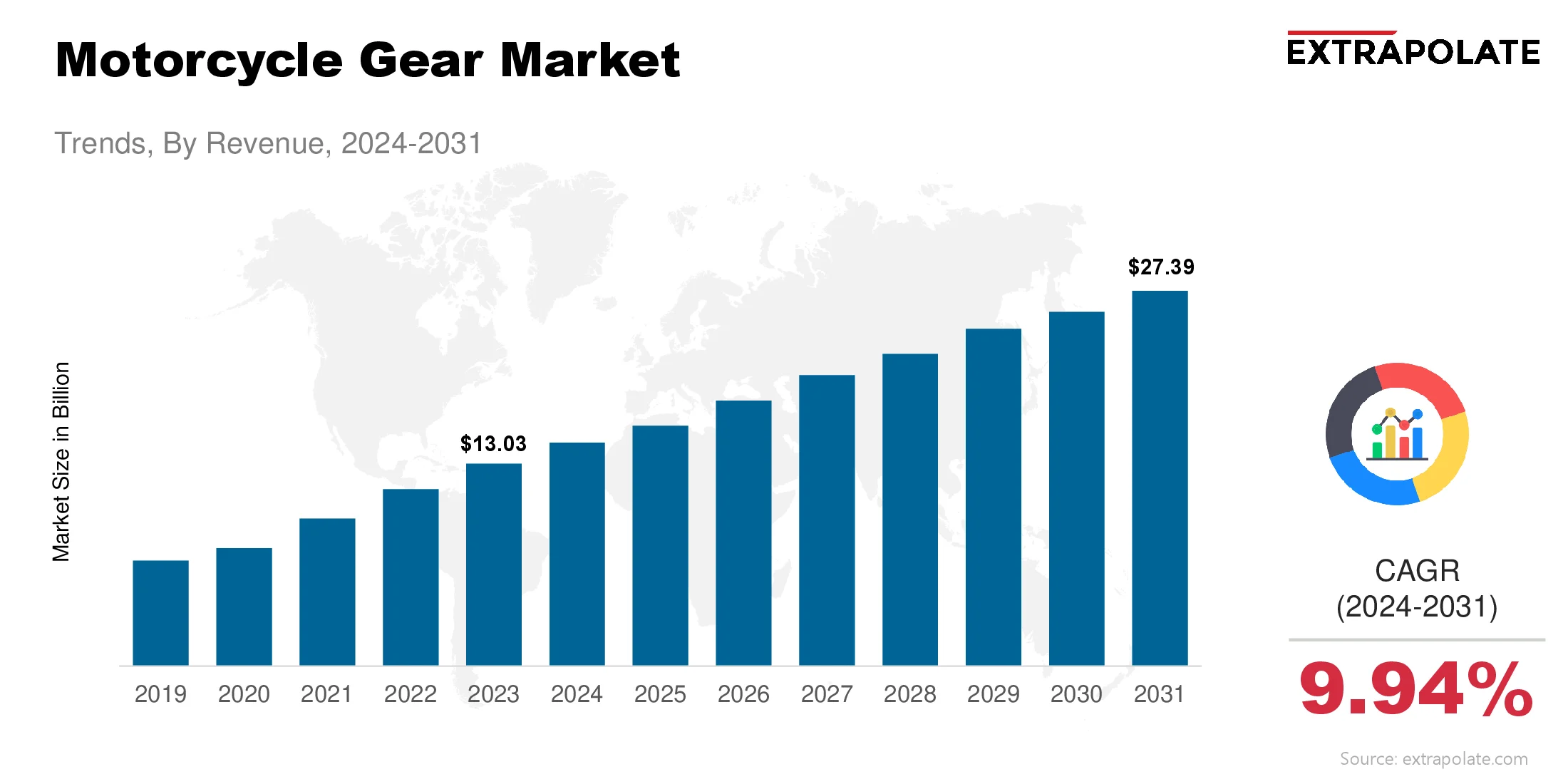
The global Motorcycle Gear Market size was valued at USD 13.03 billion in 2023 and is projected to grow from USD 14.11 billion in 2024 to USD 27.39 billion by 2031, exhibiting a CAGR of 9.9% during the forecast period.
The global motorcycle gear market is experiencing robust and sustained growth, driven by a combination of heightened safety awareness, expanding motorcycle ownership across emerging economies, and the growing popularity of motorcycling as a recreational and adventure activity. As motorcycles continue to be an increasingly preferred mode of personal transportation and sport, the demand for reliable, functional, and stylish protective gear is witnessing a significant upsurge.
Motorcycle gear encompasses a broad range of products designed to enhance rider safety, comfort, and performance. Key product categories include helmets, jackets, gloves, boots, pants, riding suits, and armoured inserts. Helmets represent the largest segment of the market due to stringent regulations and mandatory helmet laws in several countries. Moreover, innovations such as smart helmets with Bluetooth connectivity, heads-up displays, and crash detection sensors are pushing the boundaries of safety and convenience, further propelling demand.
The rise in adventure touring, motorsport events, and long-distance motorcycle travel has significantly influenced gear design and functionality. Today’s riders seek gear that balances protection with comfort, breathability, weather resistance, and style. This has led to a surge in demand for multi-functional gear constructed from advanced materials such as Kevlar, Gore-Tex, and reinforced composites. Leading manufacturers are continually investing in research and development to deliver products that offer superior impact resistance while maintaining lightweight and ergonomic characteristics.
Geographically, Asia Pacific holds a dominant share in the global motorcycle gear market, driven by high motorcycle penetration in countries like India, China, Indonesia, and Vietnam. These regions not only account for a large rider population but are also witnessing rising incomes, urbanization, and a growing emphasis on road safety, contributing to increased gear adoption. Meanwhile, North America and Europe remain key markets due to strong safety regulations, a well-established motorcycling culture, and consumer willingness to invest in premium gear products.
The market is characterized by intense competition, with both established brands and new entrants striving to capture consumer interest through innovation, branding, and pricing strategies. Leading players are increasingly focusing on digital channels, e-commerce platforms, and direct-to-consumer sales to enhance accessibility and customer engagement. Additionally, collaborations with professional riders, influencers, and motorsport events are helping brands build credibility and expand their market presence.
Regulatory frameworks and safety standards continue to shape market dynamics. Certifications such as DOT (Department of Transportation), ECE (Economic Commission for Europe), and Snell play a crucial role in consumer purchasing decisions. Compliance with these standards is essential for market entry and brand reputation.
As sustainability becomes a priority, manufacturers are exploring eco-friendly materials and production processes, reflecting a broader trend toward responsible consumption. From recycled fabrics to biodegradable packaging, the push for green innovation is expected to become a key differentiator in the competitive landscape.

Key Market Trends Driving Product Adoption
The motorcycle gear market is marked by technological innovation, style consciousness, and stringent safety regulations. Key trends driving market growth include:
- Enhanced Safety Features: The integration of advanced safety technologies such as impact-absorbing materials, MIPS (Multi-directional Impact Protection System), and CE-certified armor is improving rider protection. For instance, in January 2025, BMW Motorrad launched the GS Rallye Carbon helmet featuring a lightweight carbon-fiber shell with MIPS Integra TX system. The helment integrates a low-friction layer into the comfort padding to reduce rotational forces during angled impacts.
- Smart Gear Integration: Smart helmets with features like Bluetooth connectivity, voice command, built-in navigation, and cameras are gaining popularity among tech-savvy riders. In April 2024, Ather Energy, a prominent Indian electric two-wheeler manufacturer, launched the Halo Smart Helmet series. The Halo series includes two variants: the full-face Halo and the half-face Halo Bit, equipped with bluetooth and dual Harman Kardon speakers and a built-in microphone.
- Ergonomic Design and Comfort: Products are being engineered for better airflow, lightweight wear, and ergonomic fits to enhance long-distance riding comfort.
- Sustainability and Eco-friendly Materials: The industry is witnessing a shift toward eco-conscious manufacturing, using sustainable fabrics and materials in riding gear. In March 2025, Urge introduced the Treps helmet, an open-face trail and enduro helmet constructed from over 90% recycled materials, including EPS, PET, PA, ABS plastics, and organic components like bamboo liners.
- Customization and Fashion Appeal: Riders are increasingly opting for gear that aligns with their personal style. Brands are responding with customizable designs, color variants, and heritage-inspired collections.
Major Players and their Competitive Positioning
The motorcycle gear market is dominated by key players such as Alpinestars, Dainese, REV’IT! Fox Racing, and Shoei. These companies are leading the industry through continuous innovation, extensive safety testing, and collaborations with motorsport athletes. Numerous regional brands are also emerging, offering competitively priced gear for the mass market.
Consumer Behavior Analysis
Consumers are becoming more informed and selective, seeking gear that balances safety, comfort, style, and value. Common consumer motivations include:
- Safety Compliance: Consumers are prioritizing certified helmets and protective gear to meet local legal standards and ensure personal protection. According to the S. National Highway Traffic Safety Administration, motorcycle helmet use among motorcycle riders increased from 66.5% in 2022 to 73.8% in 2023. Similarly, helmet use among motorcycle riders with passengers rose from 58.3% in 2022 to 72.3% in 2023.
- Adventure and Touring Trends: Increased demand for gear designed for long-distance rides and varying weather conditions.
- Brand Loyalty and Community Identity: Preference for brands that resonate with specific motorcycling subcultures (e.g., cruisers, sport riders, off-roaders).
- E-commerce Convenience: Growing preference for online platforms offering wide product ranges, user reviews, and easy return policies.
Pricing Trends
Pricing in the motorcycle gear market varies widely based on brand reputation, product quality, certifications, and technology. While high-end gear can command premium prices, especially for professional and adventure riders, budget-friendly and entry-level products are also seeing significant traction, particularly in emerging markets.
Growth Factors
Key growth drivers include:
- Rising Motorcycle Sales: Higher two-wheeler sales in urban and developing markets are directly fuelling demand for motorcycle gear.
- Stringent Safety Regulations: Government mandates for wearing certified helmets and protective gear are boosting market penetration.
- Growing Adventure and Sports Segment: Rising popularity of motorsports and adventure touring is creating demand for specialized gear.
- Technological Advancements: Innovations in material science, smart textiles, and sensor integration are redefining product capabilities.
Regulatory Landscape
Regulatory bodies in various regions have introduced helmet safety standards and certification systems (e.g., DOT, ECE, Snell), which manufacturers must comply with. Adherence to these standards is a key factor in consumer trust and product approval.
Recent Developments
The motorcycle gear market is evolving rapidly with new innovations and partnerships. Key developments include:
- Smart Helmets: Introduction of helmets with head-up displays, crash sensors, and audio systems.
- Modular and Convertible Gear: Growing trend toward gear adaptable for different riding styles and weather conditions.
- Collaborations with Motorsports: Brands are increasingly partnering with racing events and teams to enhance visibility and credibility.
- Sustainable Initiatives: Use of recycled and plant-based materials in gear manufacturing.
Current and Potential Growth Implications
- Demand Supply Analysis
There is a strong upward demand trajectory for protective gear, especially in developing countries where motorcycle commuting is predominant. However, global supply chains remain sensitive to raw material availability and cost fluctuations. - Gap Analysis
Despite the market’s progress, several challenges remain:
- Low Penetration in Rural Areas: Limited awareness and affordability hinder gear adoption.
- Counterfeit Products: The prevalence of fake or non-compliant gear undermines consumer trust.
- Limited Female-specific Gear: The need for more ergonomic and stylish options for female riders is growing.
- Climate-Adaptable Gear: Increased demand for versatile gear that can handle extreme temperatures and weather changes.
Top Companies in the Motorcycle Gear Market
- Alpinestars
- Dainese
- REV’IT!
- Shoei Co., Ltd.
- Fox Racing
- AGV (subsidiary of Dainese)
- Arai Helmet, Ltd.
- Rynox Gears
- Klim (owned by Polaris Inc.)
- LS2 Helmets
Motorcycle Gear Market: Report Snapshot
Segmentation | Details |
By Product Type | Helmets, Jackets, Gloves, Boots, Pants, Riding Suits, Smart Gear |
By Application | Commuting, Racing, Adventure Touring, Off-road Riding |
By End User | Men, Women, Kids |
By Region | North America, Europe, Asia-Pacific, Latin America, Middle East & Africa |
High Growth Segments
- Smart Helmets: Offering real-time communication, navigation, and crash detection.
- Adventure Touring Gear: Durable, all-weather equipment designed for long-distance rides.
- Women's Gear Segment: Dedicated designs catering to increasing female ridership.
- E-commerce Distribution: Platforms offering broader access and user-driven customization.
Major Innovations
- Smart Textile Integration: Materials that can regulate temperature or offer active illumination.
- 3D Printing: Custom-fitted gear manufactured using 3D scanning and printing technology.
- Airbag Jackets: Built-in airbags that deploy upon crash detection for additional safety.
Potential Growth Opportunities
Key challenges and opportunities in the market include:
- Consumer Education: Raising awareness about the importance of certified protective gear.
- Urban Mobility Trends: Capitalizing on electric two-wheelers and micro mobility growth.
- Regulatory Enforcement: Strengthening helmet and gear laws to drive compliance.
- Retail Expansion: Growth of branded stores and digital retail channels to increase market reach.
Extrapolate Research says:
The global motorcycle gear market is set to expand steadily, driven by growing safety awareness, technological innovation, and evolving rider preferences. Companies that invest in advanced R&D, sustainable practices, and inclusive product lines will be well-positioned to lead in this dynamic and competitive market.
ARE YOU SEEKING COMPREHENSIVE INSIGHT ON VARIOUS
MARKETS?
CONTACT OUR EXPERTS TODAY
Motorcycle Gear Market Size
- May-2025
- 148
- Global
- smart-utilities
Related Research
Collaborative Robot Market By Payload (Upto 5 Kg, Upto 5-10 Kg, Upto 10-20 Kg, above 20 Kg), Compone
February-2023
E-Cigarette and Vaping Market By Product (Rechargeable, Disposable, Modular, Modular, and Others), D
January-2023
Global Smart Clothing Market: by Product (Outer Wear, Inner Wear), Fabric Type (Active Smart, Passiv
January-2023
Infuser Water Bottles Market Size, Share, Growth & Industry Analysis, By Product Type (Plastic Infus
June-2025
Modular Kitchen Appliances Market By Product Type (Built-in Ovens, Built-in Microwaves, Built-in Dis
May-2023
Motorcycle Gear Market Size, Share, Growth & Industry Analysis, By Product Type (Helmets, Jackets, G
May-2025
Online Home Services Market Size, Share, Growth & Industry Analysis, By Service Type (Cleaning, Repa
June-2025
Smart Manufacturing Market Size, Share, Growth & Industry Analysis, By Component (Services, Solution
September-2024
Smart Plugs Market By Type (Bluetooth, Zigbee, Wi-Fi, and Others), Application (Household, Commercia
March-2023
Smart Remote Market Size, Share, Growth & Industry Analysis, By Type (Infrared Smart Remote-Control,
September-2024