Wide Format Printers Market Size, Share, Growth & Industry Analysis, By Printer Type (Inkjet, Solvent, UV, Dye Sublimation, Latex) By Application (Advertising & Signage, Textile & Apparel, Architectural & Engineering, Packaging, Others) By End User (Commercial Printing, Retail, Textile Industry, Architecture & Engineering Firms, Others), and Regional Analysis, 2024-2031
Wide Format Printers Market: Global Share and Growth Trajectory
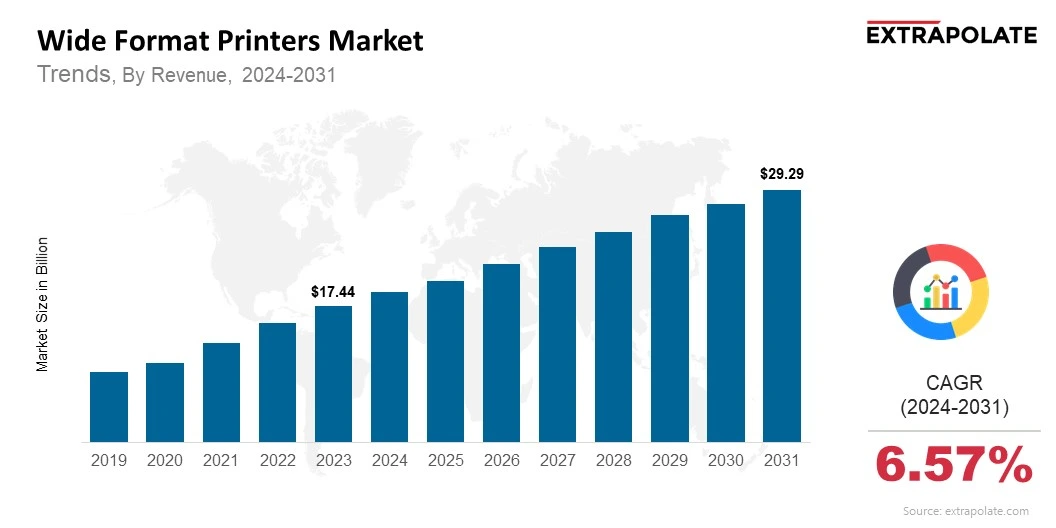
The global Wide Format Printers Market size was valued at USD 17.44 billion in 2023 and is projected to grow from USD 18.75 billion in 2024 to USD 29.29 billion by 2031, exhibiting a CAGR of 6.57% during the forecast period.
The global market is witnessing robust growth, fuelled by expanding applications across various industries, technological innovations, and rising demand for high-quality large-scale printing.
This market includes a broad spectrum of printers capable of producing large graphics, banners, signage, wallpapers, and technical drawings. As businesses and creative sectors increasingly require customized, vibrant, and durable print solutions, wide format printers are becoming indispensable tools worldwide.
Wide format printers serve diverse sectors such as advertising and marketing, architecture, engineering, construction, textiles, and retail. The increasing need for visually appealing promotional materials and branded content has driven demand in the advertising industry, where vivid and large prints capture consumer attention effectively.
Similarly, in architecture and engineering, precision and clarity in blueprints and technical drawings necessitate advanced wide format printing technology. The retail sector also leverages these printers to produce eye-catching store displays, packaging prototypes, and point-of-sale materials.
Technological advancements play a pivotal role in shaping the market landscape. The integration of cutting-edge print heads, ink formulations, and software solutions has enhanced print speed, quality, and versatility.
Printers now support multiple media types, including vinyl, fabric, canvas, and paper, broadening their application spectrum. Innovations such as eco-solvent and UV-curable inks not only improve print durability but also address environmental concerns by reducing harmful emissions and waste.
Furthermore, the rise of digital printing techniques has transformed traditional printing paradigms, allowing for on-demand production and greater customization. This flexibility is especially valuable for small and medium enterprises (SMEs) and creative professionals who require short print runs without compromising quality.
The adoption of automation and smart printing workflows also contributes to operational efficiency, minimizing human error and reducing turnaround times.
Geographically, North America and Europe hold significant shares in the wide format printers industry, driven by the presence of established industries and early adoption of advanced printing technologies.
However, the Asia-Pacific region is emerging as the fastest-growing market, propelled by rapid urbanization, expanding retail sectors, and increased infrastructure development. Countries such as China, India, and Japan are investing heavily in print technologies to meet rising consumer and industrial demand.
Market players are focusing on strategic partnerships, mergers, and acquisitions to enhance their product portfolios and expand global reach. The competitive landscape is characterized by key manufacturers introducing innovative models with improved functionalities and cost efficiencies.
Additionally, the provision of after-sales services and technical support has become a critical differentiator in customer retention and satisfaction.
Despite the promising outlook, the market faces certain challenges. High initial investment costs, maintenance requirements, and the need for skilled operators may hinder adoption, especially among smaller businesses.
Moreover, fluctuations in raw material prices and regulatory compliance related to ink chemicals and emissions can impact production costs and market growth.
Looking ahead, the market is expected to continue its upward trajectory, driven by increasing digitalization, the growing importance of brand visibility, and the rising trend of personalized marketing.
Emerging technologies such as 3D printing integration and Internet of Things (IoT)-enabled printers are anticipated to further revolutionize the industry, providing enhanced functionality and connectivity.
Key Market Trends Driving Product Adoption
The wide format printers market is characterized by continuous advancements, increasing competition, and evolving end-user needs. Key trends accelerating market growth include:
- Technological Innovations: Incorporation of eco-friendly inks, improved print speeds, and enhanced resolution capabilities are boosting product efficiency and quality. In January 2025, Hubergroup launched its DYNAMICA Ink Series, a new line of eco-friendly, fast-setting inks designed for commercial printing. This innovative series is free from cobalt and mineral oil, aligning with sustainable practices in the printing industry.
- Diverse Application Areas: Growing demand from advertising, architecture, interior décor, textile printing, and packaging sectors is broadening market reach.
- Shift to Digital Printing: Rising preference for digital wide format printing over traditional methods due to cost-effectiveness and customization.
- Sustainability Focus: Adoption of sustainable printing solutions with low environmental impact, including solvent-free and water-based inks.
- Integration with Design Software: Advanced connectivity with design and workflow software is simplifying printing operations and improving output accuracy.
Major Players and their Competitive Positioning
The wide format printers market is dominated by leading companies such as HP, Canon, Epson, Roland DG, and Mimaki. These players continually innovate to offer faster, more reliable, and eco-friendly printing solutions. Additionally, emerging companies are introducing niche products tailored for specific industrial applications.
Consumer Behavior Analysis
End-users across industries are increasingly adopting wide format printers for:
- Marketing and Advertising: Creating large, eye-catching promotional materials and displays.
- Architectural and Engineering Use: Printing blueprints, maps, and technical drawings with precision.
- Textile and Apparel Printing: Enabling customized fabric and garment printing.
- Interior Decoration: Producing murals, wallpapers, and other décor items.
- Packaging: Delivering vibrant, customized protective packaging designs for brand differentiation.
Pricing Trends
Pricing in the wide format printers market varies according to printer technology, print size capacity, and ink types. High-end printers with advanced features command premium pricing, while entry-level models targeting small businesses and startups offer affordable options. Leasing and subscription models are also becoming popular.
According to industry reports, the global wide format printers market is projected to grow at a Compound Annual Growth Rate (CAGR) of approximately 7-9% between 2023 and 2028, with significant expansions in regions such as North America, Europe, and Asia-Pacific.
Growth Factors
The market growth is driven by:
- Advances in Printing Technology: Improved precision, speed, and color management.
- Rising Demand for Customization: Increasing need for personalized and on-demand large-scale prints.
- Expansion in Advertising and Retail Sectors: Boosting demand for outdoor and indoor signage solutions.
- Digital Transformation: Shift towards digital workflows and automation.
- Sustainability Initiatives: Growing awareness and regulations favoring eco-friendly printing.
Regulatory Landscape
Regulations related to ink emissions, waste disposal, and energy consumption are shaping market developments. Compliance with environmental standards and certifications is increasingly important for manufacturers.
Recent Developments
Recent innovations in the wide format printers market include:
- Use of advance ink solutions including UV-curable and eco-solvent inks for vibrant, durable prints. For instance, in April 2025, HP launched the Latex R530 printer, which uses HP Latex Inks. These inks are water-based and designed as an alternative to both eco-solvent and UV-curable inks, offering vibrant colors, outdoor durability, and reduced environmental impact. HP Latex Inks avoid hazardous chemicals and produce odorless, safe prints, making them suitable for sensitive indoor environments while still delivering high-quality, durable output.
- Introduction of printers with enhanced automation and remote management capabilities. For instance, in May 2025, HP introduced the PrintOS Production Hub, a large-format software platform that enables true remote control and automation of print operations, allowing users to manage print queues, configure devices, and monitor jobs from anywhere, significantly streamlining workflow and reducing manual intervention.
- Development of multi-functional printers combining wide format printing with cutting and finishing. For instance, in January 2025, Canon India launched new large-format printers expanding its ImagePrograf TX series. These models are designed to meet the high-speed, high-volume printing needs of professionals in graphic design, architecture, engineering, and construction sectors. The ImagePrograf TX series includes the TX-5420, TX-5320, and TX-5220, offering both single-function and multi-function capabilities suitable for a variety of printing tasks such as posters, drawings, and bulletin boards.
- Expansion of textile printing applications using wide format technology. For instance, in January 2025, Epson launched the SureColor G6060, its first dedicated wide-format Direct-to-Film (DTF) printer. Designed for garment creators and merchandise manufacturers, the G6060 offers high-quality, efficient, and cost-effective production for custom apparel and promotional items.
Current and Potential Growth Implications
Demand Supply Analysis
Demand for wide format printers continues to grow steadily due to increased industrial and commercial applications. However, supply chain disruptions and component shortages, such as print heads and specialized inks, may pose challenges.
Gap Analysis
Despite growth, certain gaps remain:
- Need for higher speed printers without compromising quality.
- Development of more cost-effective, sustainable ink technologies.
- Improved ease of use and maintenance for small and medium enterprises.
- Greater integration with digital design and printing workflows.
Top Companies in the Wide Format Printers Market
- HP Inc.
- Canon Inc.
- Epson Corporation
- Roland DG Corporation
- Mimaki Engineering Co., Ltd.
- Seiko Instruments Inc.
- Xerox Corporation
- Agfa-Gevaert Group
- Durst Phototechnik AG
- Brother Industries, Ltd.
Wide Format Printers Market: Report Snapshot
Segmentation | Details |
By Printer Type | Inkjet, Solvent, UV, Dye Sublimation, Latex |
By Application | Advertising & Signage, Textile & Apparel, Architectural & Engineering, Packaging, Others |
By End User | Commercial Printing, Retail, Textile Industry, Architecture & Engineering Firms, Others |
By Region | North America, Europe, Asia-Pacific, Middle East & Africa, South America |
Wide Format Printers Market: High-Growth Segments
- UV Printers: Offering fast drying and durable prints for diverse surfaces.
- Textile Printers: Meeting growing demand for customized fabric printing.
- Solvent Printers: Preferred for outdoor signage due to weather resistance.
Major Innovations
Key innovations fueling market competitiveness include:
- Automated print head cleaning systems.
- Hybrid printers supporting multiple ink types.
- AI-powered color calibration and print optimization.
- Enhanced roll-to-roll and flatbed printing technologies.
Wide Format Printers Market: Potential Growth Opportunities
Challenges faced by market players include:
- Increasing competition from emerging manufacturers.
- Keeping pace with rapid technological changes.
- Addressing environmental and regulatory pressures.
- Balancing cost, quality, and speed in printing solutions.
- Managing global supply chain complexities.
Extrapolate Research says:
The global wide format printers market is set for steady growth fueled by technological advancements, expanding applications, and increasing demand for customization and sustainability. Market leaders that innovate while addressing cost and environmental challenges will thrive in this competitive landscape.
ARE YOU SEEKING COMPREHENSIVE INSIGHT ON VARIOUS
MARKETS?
CONTACT OUR EXPERTS TODAY
Wide Format Printers Market Size
- May-2025
- 148
- Global
- semiconductor-electronics
Related Research
1,5-pentanediamine (Cadaverine)-Global Market Status & Trend Report 2022-2030 Top 20 Countries Data
December-2020
26650 Cylindrical Lithium Ion Battery Market Insights 2022, Global Analysis and Forecast to 2030
May-2021
2K Panel-Global Market Status and Trend Report 2015-2026
November-2020
300mm Wafer Carrier Boxes-Global Market Status & Trend Report 2022-2030 Top 20 Countries Data
January-2021
3D IC & 2.5D IC Packaging-Global Market Status & Trend Report 2022-2030 Top 20 Countries Data
November-2020