Textile Recycling Market Size, Share, Growth & Industry Analysis, By Recycling Method (Mechanical Recycling, Chemical Recycling, Thermal Recycling), By End Use (Apparel, Home Textiles, Industrial Textiles, Automotive Textiles, Others), By Application (Fashion and Apparel, Industrial Use, Consumer Goods, Automotive), and Regional Analysis, 2024-2031
Textile Recycling Market: Global Share and Growth Trajectory
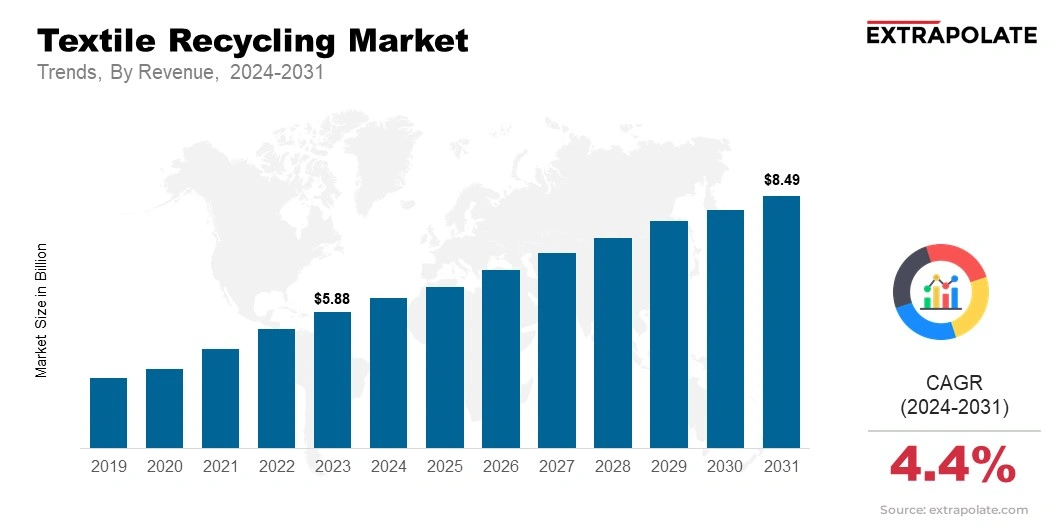
The global Textile Recycling Market size was valued at USD 5.88 billion in 2023 and is projected to grow from USD 6.26 billion in 2024 to USD 8.49 billion by 2031, exhibiting a CAGR of 4.4% during the forecast period.
The global market is undergoing significant expansion, fueled by growing environmental awareness, the need for sustainable practices, and advancements in recycling technologies.
This market encompasses a wide range of processes aimed at recovering and reusing fibers and materials from post-consumer and post-industrial textile waste.
As the fashion industry faces increasing pressure to reduce its environmental footprint, textile recycling is becoming a critical solution for minimizing waste, reducing resource consumption, and curbing pollution.
Driven by changing consumer preferences toward eco-friendly products and the rising adoption of circular economy principles, textile recycling has emerged as a key solution to mitigate the adverse effects of fast fashion.
The market includes several types of recycling methods, including mechanical recycling, chemical recycling, and thermal recycling, each playing a vital role in transforming waste textiles into valuable raw materials.
Technological innovations in textile recycling are enhancing the efficiency of waste processing and expanding the scope of recyclable materials.
For instance, developments in chemical recycling processes allow for the breakdown of complex fibers into their original components, enabling higher-quality fibers to be regenerated.
Additionally, advances in sorting technologies and automation are improving the scalability and sustainability of textile recycling operations.
As sustainability becomes a focal point for brands, retailers, and consumers alike, the market is poised for remarkable growth. Governments and regulatory bodies are also taking action by implementing policies to promote recycling, such as extended producer responsibility programs and regulations requiring manufacturers to take back used garments.
With the increasing demand for eco-friendly fashion products and the continuous improvement in recycling technologies, the market is projected to experience steady growth in the coming years, with major players focusing on innovative and cost-effective solutions to stay competitive.
The market is not only contributing to waste reduction but also creating new economic opportunities, including job creation in recycling facilities and the development of new materials for use in industries such as automotive, construction, and packaging.
As the market continues to mature, its role in shaping a more sustainable and circular fashion industry will be critical in reducing the environmental impact of textile waste worldwide.

Key Market Trends Driving Product Adoption
The textile recycling market is characterized by innovation, sustainability goals, and evolving consumer preferences. Key trends driving market growth include:
- Sustainability Focus: With the increasing emphasis on reducing textile waste, companies and consumers are increasingly turning to recycled textiles to minimize environmental impacts.
- Technological Advancements: Advanced technologies such as chemical recycling, enzymatic recycling, and fiber-to-fiber recycling are enhancing the efficiency and scalability of textile recycling processes.
- Circular Economy Integration: Companies are adopting circular economy principles, where recycled textiles are used as raw materials for new textile production, reducing reliance on virgin fibers.
- Government Regulations: Governments are introducing regulations and policies encouraging textile recycling and the reduction of textile waste, creating a favorable market environment.
- Consumer Awareness: Growing awareness about the environmental impact of fast fashion and the benefits of recycling is driving demand for recycled textiles.
Major Players and their Competitive Positioning
The textile recycling market is home to key players such as Worn Again Technologies, Renewcell, and Teijin Frontier, among others. These companies are at the forefront of adopting innovative recycling techniques, securing collaborations, and expanding their production capacities to meet the rising demand for recycled textiles. Smaller players are also emerging, offering niche recycling solutions and tapping into new market segments.
Consumer Behavior Analysis
Consumers are increasingly motivated to opt for recycled textiles for several reasons:
- Sustainability: Consumers are more conscious of their environmental impact and are seeking products made from recycled materials.
- Cost-Effectiveness: Recycled textiles can often be produced at a lower cost than virgin materials, resulting in cost savings for manufacturers and consumers.
- Fashion and Style: The rise of eco-conscious fashion brands has created an intersection between sustainability and style, making recycled textiles more appealing.
- Quality and Durability: Advances in textile recycling technology have improved the quality and durability of recycled fabrics, further driving consumer adoption.
Pricing Trends
Pricing in the textile recycling market varies depending on factors such as the type of textile being recycled, the recycling process used, and the end product's application. While recycled textiles are typically priced lower than virgin materials, the cost can be higher due to the advanced technologies required for efficient recycling processes. However, the trend of increasing demand for sustainable products is driving price stability and making recycling more competitive.
Growth Factors
Several factors are contributing to the growth of the textile recycling market:
- Environmental Impact: As textile waste continues to increase, recycling offers a sustainable solution to reduce landfill waste and pollution.
- Regulations and Policies: Stringent government regulations around waste management and recycling are driving demand for recycled textiles.
- Technological Advancements: Innovations in recycling technologies are improving the quality and efficiency of textile recycling processes, encouraging investment in the sector.
- Consumer Demand for Sustainable Products: Rising consumer preference for eco-friendly products is prompting brands to adopt recycled materials in their offerings.
Regulatory Landscape
The regulatory environment surrounding textile recycling is evolving, with numerous countries implementing regulations to reduce textile waste and promote the use of recycled materials. These regulations often focus on waste management, recycling targets, and ensuring the sustainability of the textile supply chain. Companies operating in this market must comply with these regulations to maintain consumer trust and ensure their products meet sustainability standards.
Recent Developments
The textile recycling market is constantly evolving, with new developments and innovations being introduced regularly. Some recent developments include:
- Chemical Recycling Innovations: New methods for breaking down textile fibers at the molecular level are enabling the recycling of more complex materials.
- Partnerships and Collaborations: Major fashion brands are partnering with recycling companies to develop closed-loop systems that allow the reuse of textile fibers.
- Consumer-Centric Initiatives: Brands are incorporating textile recycling programs, encouraging consumers to return used clothing for recycling in exchange for discounts or incentives.
Current and Potential Growth Implications
Demand-Supply Analysis
The demand for recycled textiles is increasing steadily due to sustainability awareness and regulatory pressure. However, challenges such as inconsistent supply, technological barriers, and the cost of advanced recycling processes may hinder the supply of recycled textiles.
Gap Analysis
While the market has seen considerable growth, there are areas that need improvement:
- Efficient Recycling Processes: The development of more efficient and cost-effective recycling technologies is crucial for scaling the market.
- Consumer Education: Despite growing awareness, there is still a need to educate consumers about the benefits and availability of recycled textiles.
- Supply Chain Integration: A more cohesive supply chain for recycled textiles needs to be developed to ensure consistent quality and availability of recycled materials.
Top Companies in the Textile Recycling Market
- Worn Again Technologies
- Renewcell
- Teijin Frontier
- Indorama Ventures
- Patagonia
- H&M Group
- Fibersort
- Infinited Fiber Company
- Covestro
- Circular Systems
Textile Recycling Market: Report Snapshot
Segmentation | Details |
By Recycling Method | Mechanical Recycling, Chemical Recycling, Thermal Recycling |
By End Use | Apparel, Home Textiles, Industrial Textiles, Automotive Textiles, Others |
By Application | Fashion and Apparel, Industrial Use, Consumer Goods, Automotive |
By Region | North America, Europe, Asia-Pacific, Latin America, Middle East & Africa |
High-Growth Segments
The following market segments are expected to experience significant growth:
- Mechanical Recycling: Traditional recycling methods are still widely used and continue to expand.
- Chemical Recycling: Emerging as a key innovation for recycling more complex materials, such as blended fabrics.
- Apparel Industry: The demand for sustainable fashion is propelling the use of recycled textiles in clothing.
Major Innovations
Innovation is crucial to the market. Some of the latest advancements include:
- Advanced Recycling Technologies: Improvements in chemical and enzymatic recycling processes.
- Upcycled Fashion: Fashion brands are creating high-quality garments made from recycled textiles, tapping into consumer demand for eco-friendly fashion.
- Fiber-to-Fiber Recycling: The development of technologies that allow for the recycling of fibers back into new textile products.
Potential Growth Opportunities
Companies in the market are presented with various growth opportunities, including:
- Technological Advancements: Investing in new recycling technologies can provide a competitive edge.
- Partnerships with Fashion Brands: Collaborating with major apparel brands to integrate recycled materials into their products.
- Expansion into Emerging Markets: Targeting regions with growing awareness about sustainability, such as Asia-Pacific, offers significant potential for growth.
Kings Research Says:
The textile recycling market is positioned for steady growth, driven by innovation in recycling technologies, increased regulatory support, and a surge in consumer demand for sustainable products. Companies that focus on improving recycling processes, expanding their market reach, and developing new products will be well-positioned to succeed in this evolving industry.
ARE YOU SEEKING COMPREHENSIVE INSIGHT ON VARIOUS
MARKETS?
CONTACT OUR EXPERTS TODAY
Textile Recycling Market Size
- April-2025
- 148
- Global
- retail
Related Research
Activewear Market Size, Share, Growth & Industry Analysis, By Product Type (Athletic Shoes, Sports B
March-2025
Agrobacterium tumefaciens Competent Cells Market Insights 2022, Global Analysis and Forecast to 2030
July-2021
Aluminium Composite Panels (ACP) Market Insights 2022, Global Analysis and Forecast to 2030
July-2021