Smart Toilets Market Size Share Growth & Industry Analysis, By Product Type (Smart Toilets, Bidet Seats, Smart Bathroom Accessories, Others), By Application (Residential, Commercial, Healthcare, Public Infrastructure, Others), By End User (Consumer Electronics, Healthcare, Hospitality, Commercial, Others), and Regional Analysis 2024-2031
Smart Toilets Market: Global Share and Growth Trajectory
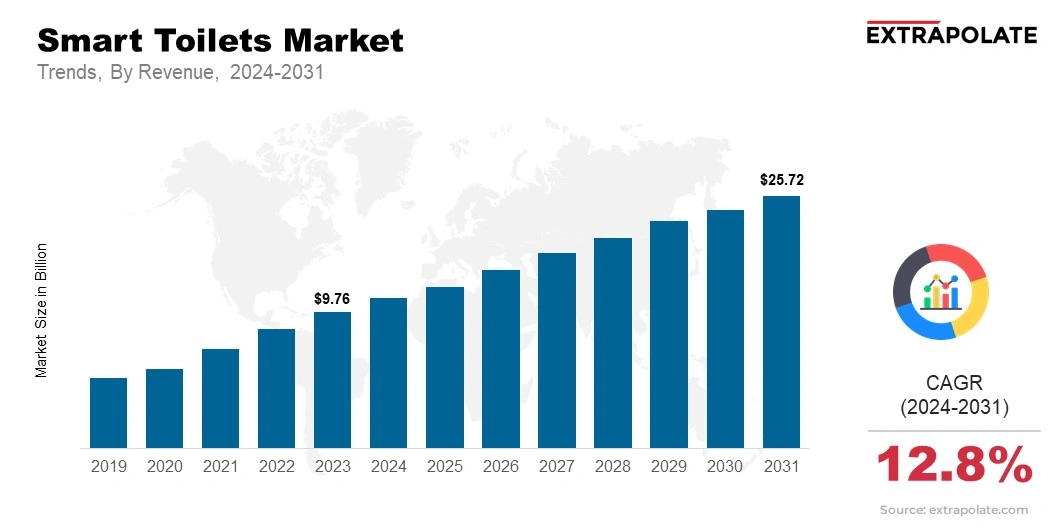
The global Smart Toilets Market size was valued at USD 9.76 billion in 2023 and is projected to grow from USD 11.10 billion in 2024 to USD 25.72 billion by 2031, exhibiting a CAGR of 12.8% during the forecast period.
The global market is witnessing a major upsurge, driven by the rise in demand for comfort, hygiene, and convenience. As urbanization is growing and consumers are becoming more conscious about their health and fitness, there is an increasing interest in futuristic bathroom setups.
Smart toilets, which comprise features like automated flushing, seat warming, bidet functionality, and self-cleaning methods, are becoming more widespread due to their capability to offer a hygienic and exquisite bathroom experience.
Technological innovations in the smart toilets industry have made them accessible to a broader consumer base. These toilets are provided with advanced features like water-saving systems, motion sensors, air purifiers, and remote control functions, which makes them an attractive option for contemporary households and corporate establishments.
Furthermore, the incorporation of IoT (Internet of Things) technology in smart toilets enables a personalization and remote control through smartphones, maximizing user convenience.
The smart toilets market worldwide is witnessing expansion in both mature and developing markets. In developed markets like North America and Europe, the demand for smart toilets is propelled by the rising priority of luxury and relaxation in home upgrades.
In the meantime, in regions such as Asia Pacific, especially Japan and China, the market is influenced by the increase in middle-income groups and a cultural shift toward modern bathroom technologies. The COVID-19 pandemic has also played a role in intensifying the demand for hands-free and hygiene-centric solutions, promoting the use of smart toilets.
The market is expected to maintain its growth, with projections indicating considerable growth in the years to come. Developments in energy efficiency, water conservation, and improved user experience are set to accelerate the market's progress, with smart toilets becoming a prevalent feature in both residential and corporate spaces.
As the industry is evolving, manufacturers are likely to keep advancing with future-driven capabilities, facilitating new opportunities for market development and growth.
Key Market Trends Driving Product Adoption
The smart toilets market is characterized by high-tech developments, an increase in disposable incomes, and changing consumer preferences. Key trends influencing market growth:
Health and Hygiene Benefits: Smart toilets come with features such as water filtration systems, touchless sensors, and health monitoring technology (e.g., temperature, weight, and blood pressure readings), facilitating better hygiene standards and health tracking.
Environmental Sustainability: Sustainable developments like water-saving capabilities, energy-efficient systems, and materials that minimize the environmental impact are serving as an indispensable element in smart toilet design.
Convenience and Luxury: Automatic flushing, self-cleaning systems, remote controls, heated seats, and advanced bidet functions elevate the experiences of users, transforming smart toilets into a symbol of luxury.
Integration with Smart Homes: Smart toilets are being incorporated into the larger smart home ecosystem, enabling effortless control with the help of mobile apps or voice assistants, enhancing convenience and overall user journey.
Major Players and Their Competitive Positioning
The smart toilets market is controlled by key players that are constantly innovating to remain at the forefront of the competition. Major companies include Toto Ltd., Kohler Co., LIXIL Group Corporation, and Panasonic Corporation.
These companies have their focus centered on technologically advanced and sustainable products to provide solutions that align with the demand for luxury and well-being. Emerging entrants with targeted products are enhancing their positing in the competitive market.
Consumer Behavior Analysis
Consumers are progressively opting for smart toilets due to the following reasons:
Health and Hygiene: The rising demand for cleaner environments and personal health monitoring is boosting the demand for smart toilets.
Comfort and Luxury: The added comfort, heated seats, and personalized options attract those looking for a more luxurious bathroom experience.
Eco-consciousness: As eco-consciousness is growing, it is encouraging consumers to choose sustainable and water-saving toilet solutions.
Pricing Trends
The pricing system in the smart toilets market differs greatly, where exclusive models having advanced functionalities attract premium pricing, while more cost-effective models with simple functions are tailored to cost-conscious buyers. As the market matures, a wider spectrum of price points has emerged, balancing affordable options with high-end, technology-packed models.
Growth Factors
Various factors facilitating the growth of the smart toilets market:
Technological Advancements: Advancements like automatic seat opening/closing, integrated bidets, and smart health tracking systems are stimulating curiosity and boosting demand.
Increased Urbanization: With a surge in urbanization, there is an increasing demand for creative, space-efficient, and functional products, specifically in metropolitan areas.
Rising Disposable Incomes: As disposable incomes are rising, especially in developed regions, more consumers are opting for premium products with advanced features and greater comfort.
Aging Population: The growing aging population worldwide is leading to a higher demand for smart toilets, particularly those with health-monitoring capabilities and assistive technologies.
Regulatory Landscape
The regulatory landscape for smart toilets encompasses standards for water conservation, electrical safety, and data privacy for health monitoring devices. Companies must navigate a complex network of local rules, that differ by region, to ensure compliance and strengthen consumer trust.
Recent Developments
The market is rapidly advancing, with recent breakthroughs showcasing new technological developments:
Advanced Health Monitoring: Smart toilets equipped with features that analyze urine or stool composition for health data are becoming increasingly popular.
Improved Water Efficiency: Water-efficient technologies using sensors to adjust flush amounts are becoming commonplace in new models.
Enhanced User Customization: Newer designs bring more options for customization, which include seat temperature, water pressure, and cleaning functions.
Current and Potential Growth Implications
a. Demand-Supply Analysis The demand for smart toilets is growing as consumer awareness and technological developments are rising. Conversely, the supply chain for element, specifically electronic parts and sensors, might face difficulties, which in turn, affects the production timelines.
b. Gap Analysis Despite the growing demand for smart toilets, there are still several untapped areas for growth:
Affordability: Even with the popularity of premium models, more affordable options are required to serve a larger consumer market.
Ease of Use: Enhanced user interfaces and simple remote control settings are necessary for improving the user’s experience.
Durability and Maintenance: Products with durable components and easy-to-maintain features are widely preferred by consumers.
North America, Europe, Asia-Pacific, Middle East & Africa, South America
High Growth Segments
The following segments are expected to grow rapidly:
Smart Toilets: Modern toilets that have self-cleaning features, bidet functions, and built-in health monitoring.
Bidet Seats: Cost-effective substitutes to full smart toilet systems, enhancing both comfort and hygiene.
Smart Bathroom Accessories: Devices such as automatic faucets, smart mirrors, and voice-activated systems that further improve the smart toilet experience.
Major Innovations
In the evolving market, innovation is vital for staying ahead. Key innovations include:
Integrated Health Monitoring: Toilets that assess health conditions, providing consumers with live health data.
Water-Saving Technologies: Smart toilets with cutting-edge sensors to optimize water usage per flush.
Voice Control and Integration: Smart toilets are compatible with voice assistants, providing hands-free control for added ease.
Potential Growth Opportunities
Companies in the market encounter various challenges, such as:
Intense Competition: Competition remains fierce, with both longstanding brands and start-ups pushing for new and innovative solutions.
Technological Advancements: In order to retain their market share, companies must keep pace with rapid technological developments and introduce fresh features.
Consumer Education: Raising consumer awareness about the advantages and features of smart toilets is key to fostering market adoption.
Affordability: The key to market growth lies in providing more affordable choices to ensure accessibility across various consumer demographics.
Kings Research says:
The smart toilets market is projected to witness substantial growth in the upcoming years, fueled by developments in technology, increase in urbanization, and an increasing focus on health, hygiene, and comfort. Addressing challenges such as cost, market competition, and consumer education will enable companies to capitalize on opportunities and thrive in this fast-changing market.
FAQ
The global market is projected to reach USD 25.72 billion by 2031 growing at a CAGR of 12.8% from 2024 to 2031.
With a surge in urbanization, there is an increasing demand for creative, space-efficient, and functional products, specifically in metropolitan areas.
Key players in the market are Toto Ltd., Kohler Co., LIXIL Group Corporation, Panasonic Corporation, Geberit AG, American Standard Brands, Roca Sanitario S.A., Inax Corporation, Duravit AG, BioBidet and Others.
ARE YOU SEEKING COMPREHENSIVE INSIGHT ON VARIOUS
MARKETS? CONTACT OUR EXPERTS TODAY