Interior Design Market Size, Share, Growth & Industry Analysis, By Service Type (Residential, Commercial, Industrial, Hospitality, Others) By Design Style (Modern, Traditional, Minimalist, Contemporary, Others) By End User (Consumers, Businesses, Government, Educational Institutions), and Regional Analysis, 2024-2031
Interior Design Market: Global Share and Growth Trajectory
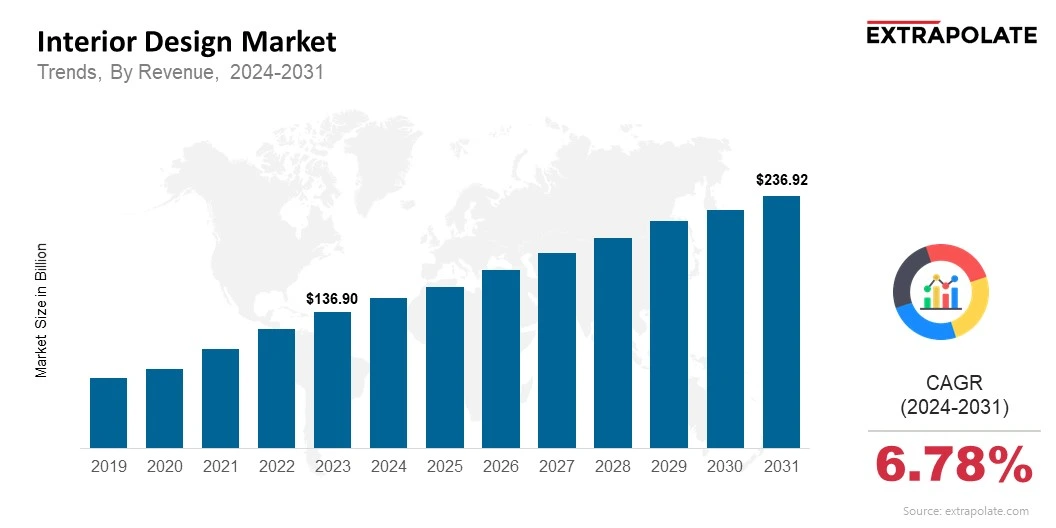
The global Interior Design Market size was valued at USD 136.90 billion in 2023 and is projected to grow from USD 149.59 billion in 2024 to USD 236.92 billion by 2031, exhibiting a CAGR of 6.78% during the forecast period.
The global design market is witnessing remarkable growth, driven by evolving consumer preferences, technological advancements, and an increasing emphasis on sustainability. This sector encompasses a diverse range of services, including residential, commercial, and industrial interior design, with the primary goal of crafting spaces that are both aesthetically pleasing and functional.
As lifestyle trends shift, interior design is becoming a reflection of individual identities, with personalized and innovative spaces at the forefront of design strategies. Technological innovations also play a pivotal role in the market’s growth trajectory. The integration of smart home technologies is transforming the way interiors are designed and utilized.
From automated lighting systems and smart thermostats to security systems and voice-controlled assistants, these technologies enhance the functionality and convenience of interior spaces. Designers are increasingly incorporating these innovations into their projects, creating smart environments that offer improved comfort, energy efficiency, and security.
The residential sector leads the market. Homeowners are spending more on quality design to upgrade their spaces. The commercial sector is also growing fast. COVID-19 changed how offices are used, leading to new design needs. Many firms now follow hybrid work models. This has increased demand for flexible and wellness-based spaces. Designers now focus on comfort and function. Their goal is to help workers stay happy and productive.
The interior design market is growing fast in many areas. Both old and new markets are showing strong signs. North America and Europe lead the space. They see high need for home and office design. Asia-Pacific is rising in this field. China and India are key growth drivers. More people in these regions now live in cities. Many can also spend more on better homes and workspaces.
Key Market Trends Driving Product Adoption
The market is changing fast. Shifts in taste, tech growth, and new design ideas drive this change.
- Sustainability Focus: People want eco-friendly designs. They now prefer reused wood, natural fabrics, and lights that save energy.
- Smart Home Integration: Smart homes are on the rise. This boosts the need for tech-based designs like smart lights and home controls.
- Personalization and Customization: Buyers want styles that match their lives. Custom designs for homes and offices are now in demand.
- Minimalist and Multifunctional Designs: Simple, clean styles are popular. In cities, small spaces need smart, multi-use setups.
- Health and Wellness-Oriented Designs: Wellness matters more in design now. Natural light, green features, and comfy layouts are key trends.
Major Players and their Competitive Positioning
Both smaller boutique businesses and larger, more established organizations are part of the interior design sector. IKEA, CBRE Group, Gensler, and HOK are important participants. These businesses use innovative ways to spur innovation. Smaller businesses are starting to come up with niche services catered to particular markets.
Consumer Behavior Analysis
Consumers are increasingly adopting interior design services for various reasons, including:
- Personalized Spaces: Creating homes and workspaces that reflect individual style, comfort, and personality.
- Functionality: Maximizing space utility, particularly in urban environments, where space is at a premium.
- Health and Well-being: Designing spaces that promote physical and mental health, such as incorporating natural elements and ergonomic furniture.
- Technological Integration: Integrating the latest technologies for comfort, convenience, and energy efficiency.
Pricing Trends
Pricing trends in the interior design market differ based on services, location, and expertise. Premium firms charge higher fees for luxury services. Budget-conscious consumers find affordable options in modular furniture or online tools. The market for mid-range services is growing. Consumers now seek quality design at lower prices.
Regional Insights
The interior design industry is growing rapidly in North America, Europe, and Asia-Pacific. Urban centers are driving demand for residential and commercial services. This growth is fueled by higher incomes, changing lifestyles, and technology. In Asia-Pacific, especially China and India, urbanization and rising wealth are boosting demand. Changing cultural trends are also contributing to this surge.
Growth Factors
Several factors are driving the growth of the market.
- Technological advancements, such as augmented reality (AR) and virtual reality (VR), are changing how consumers interact with designs.
- Urbanization is also contributing to market growth. As urban populations increase, demand for space-efficient design solutions rises.
- Rising disposable incomes are another factor. Growing affluence in emerging markets is driving demand for high-end interior design services.
- Sustainability is gaining importance. Eco-consciousness is fueling demand for sustainable materials and energy-efficient designs.
Regulatory Landscape
Countries and regions have different interior design regulations. Specific guidelines for energy efficiency, building safety, and materials must be adhered to by designers. The industry is also moving toward more sustainable methods as a result of growing environmental laws.
Recent Developments
The interior design market is evolving with new trends and technologies. Recent developments include:
- Smart home technology is influencing design trends. Designers are incorporating smart devices into layouts.
- Sustainability is becoming a priority. Designers are using recycled materials, low-VOC paints, and energy-efficient fixtures.
- Wellness-focused designs are on the rise. Biophilic design elements are being used to promote mental and physical health.
Current and Potential Growth Implications
Demand-Supply Analysis
The demand for interior design services is growing globally. This growth is driven by rising disposable incomes, urbanization, and the desire for personalized spaces. However, the availability of skilled professionals may limit this growth. This issue is particularly notable in developing regions.
Gap Analysis
The interior design market has grown significantly. However, there are areas for improvement.
- Sustainability standards: These regulations need to be more uniform. This will enhance the industry's environmental impact.
- AR and VR technology: These technologies can improve design processes. Widespread adoption of these tools will enhance consumer experiences.
- Affordability: More accessible design services are required for middle-income households.
Top Companies in the Interior Design Market
Interior Design Market: Report Snapshot
Segmentation | Details |
By Service Type | Residential, Commercial, Industrial, Hospitality, Others |
By Design Style | Modern, Traditional, Minimalist, Contemporary, Others |
By End User | Consumers, Businesses, Government, Educational Institutions |
By Region | North America, Europe, Asia-Pacific, Middle East & Africa, South America |
Interior Design Market: High-Growth Segments
The following market segments are expected to grow significantly:
- Residential Interior Design: Demand for home interior design services is rising. People want more personalized spaces.
- Commercial Interior Design: Businesses and office spaces are expanding. This is increasing demand for commercial interior design services.
- Sustainable Interior Design: There is a growing shift towards sustainability. This will drive the demand for eco-friendly, energy-efficient interior design solutions.
Major Innovations
Innovation plays a crucial role in the interior design market. Recent innovations include:
- Smart Furniture- It incorporates technology to enhance functionality and convenience.
- Virtual Reality (VR) and Augmented Reality (AR)- These technologies help consumers visualize their spaces before making design decisions.
- Sustainable Materials- Designers are increasingly using recycled, upcycled, and sustainable materials. This meets the rising demand for eco-friendly solutions.
Interior Design Market: Potential Growth Opportunities
- Businesses in the interior design industry deal with a variety of difficulties.
- One is the necessity of striking a balance between eco-friendly practices and innovation because sustainability criteria are rising.
- Another problem is the development of technology. Sustained growth depends on keeping up with cutting-edge technology like AI, AR/VR, and smart home appliances.
- The market is highly competitive. Businesses need to set themselves apart with creativity, excellence, and outstanding customer service.
Extrapolate Research says:
The global interior design market is poised for substantial growth. This is driven by consumers’ increasing demand for personalized, functional, and sustainable spaces. Companies that can meet these demands, particularly for technological integration and eco-friendly practices, will thrive in the evolving market.
ARE YOU SEEKING COMPREHENSIVE INSIGHT ON VARIOUS
MARKETS?
CONTACT OUR EXPERTS TODAY
Interior Design Market Size
- May-2025
- 148
- Global
- retail
Related Research
Activewear Market Size, Share, Growth & Industry Analysis, By Product Type (Athletic Shoes, Sports B
March-2025
Agrobacterium tumefaciens Competent Cells Market Insights 2022, Global Analysis and Forecast to 2030
July-2021
Aluminium Composite Panels (ACP) Market Insights 2022, Global Analysis and Forecast to 2030
July-2021