Extrapolate Extrapolate
  • 888-328-2189
  • ABOUT US
  • CONTACT US
  • SIGN IN
  • INDUSTRIES
  • BLOGS
  • Home
  • Retail
  • Home appliances market

Home Appliances Market Size, Share, Growth & Industry Analysis, By Product Type (Refrigerators, Washing Machines, Air Conditioners, Ovens, Vacuum Cleaners, Others) By Application (Residential, Commercial (Hotels, Restaurants, Laundries, etc.)) By Distribution Channel (Online, Offline (Retail Stores, Supermarkets, Specialty Stores)), and Regional Analysis, 2024-2031

  • Description
  • Table Of Content
  • Sample Request

Home Appliances Market: Global Share and Growth Trajectory

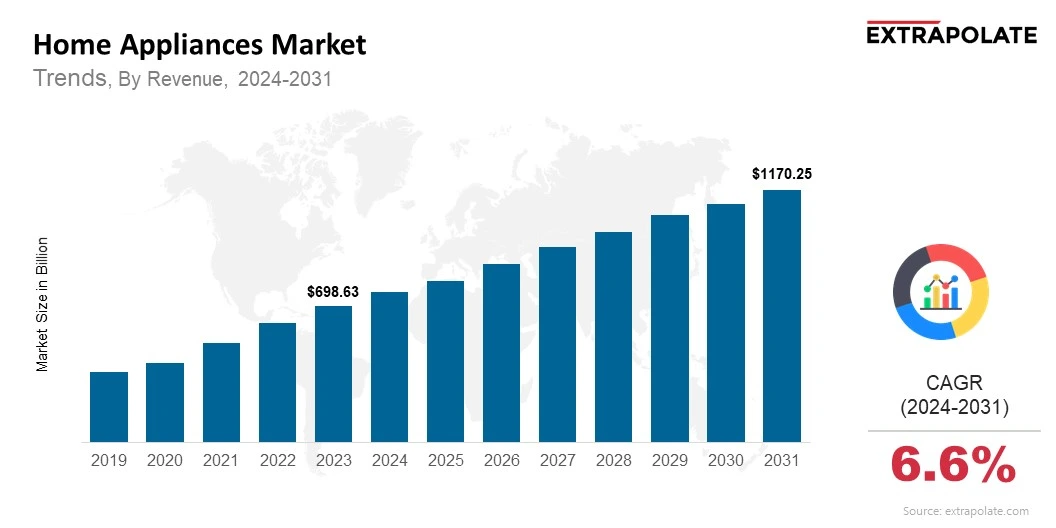
The global Home Appliances Market size was valued at USD 698.63 billion in 2023 and is projected to grow from USD 750.14 billion in 2024 to USD 1170.25 billion by 2031, exhibiting a CAGR of 6.6% during the forecast period.

The global home appliances market is growing steadily and steadily, driven by a mix of technological advancements, changing consumer behaviour and economic growth. From kitchen and laundry essentials to smart devices, home appliances are part of modern living, saving time, energy and convenience. As urbanisation accelerates and household incomes rise – especially in emerging markets – the demand for durable, multi-functional appliances is on the rise.

One of the biggest changes in the industry is the shift to connected appliances. Smart fridges, washing machines and air conditioners that integrate with IoT platforms are no longer a novelty – they’re mainstream. Brands are embedding AI, machine learning and sensor technology into their products to offer predictive maintenance, usage optimisation and remote control.

E-commerce has also changed how consumers shop for appliances. Online platforms provide product comparisons, user reviews and delivery services, resulting in more digital engagement. Offline retail is still important for high-touch products, where consumers can interact and understand the device better.

As awareness of the environment grows, sustainable design, recyclable materials and energy saving technologies are becoming industry standards. All these factors are driving growth in this market. The home appliances market is entering the era of intelligent, sustainable and connected living – driven by consumer demand and technology.

Size, Share & Forecast 2031Key Market Trends Driving Product Adoption

  • Smart Home Integration: Smart homes have impacted the home appliances sector greatly. Consumers are looking for devices that are compatible with platforms like Amazon Alexa, Google Assistant and Apple HomeKit. Appliances like smart refrigerators, ovens, washing machines and robotic vacuum cleaners can now be controlled remotely through smartphones. This connected ecosystem is making household management easier, saving energy and providing real-time feedback for maintenance and usage optimization.
  • Energy Efficiency and Sustainability: Environmental concerns and regulations have forced manufacturers to adopt energy efficient technologies. The emphasis on green appliances is reflected in the popularity of products with Energy Star ratings and inverter technology. Smart sensors and adaptive technologies are further reducing electricity and water consumption. Sustainable product materials and packaging innovations are also gaining traction among eco-conscious consumers.
  • Urbanization and Compact Living Solutions: With urbanization on the rise, especially in Asia-Pacific and Latin America, consumers are living in smaller residential spaces. This trend has led to demand for compact, multi-functional and modular home appliances. Innovations like washer-dryer combos, countertop dishwashers and space saving microwaves are catering to this shift, providing full functionality in limited spaces.
  • Rising Demand for Premium Products: As income levels rise and consumer expectations evolve, there is growing demand for premium appliances with sleek designs, advanced features and smart technology. This is more visible in developed markets like North America and Europe where consumers are willing to invest in high-performance, long lasting appliances that match modern aesthetics and lifestyles.

Major Players and their Competitive Positioning

The home appliances market is highly competitive with many global and regional players offering a wide range of products. Leading companies are focusing on innovation, brand loyalty and extensive distribution networks to maintain their market share. Key players are: Whirlpool Corporation, LG Electronics Inc., Samsung Electronics Co. Ltd., Haier Smart Home Co., Ltd., BSH Hausgeräte GmbH (Bosch), Electrolux AB, Panasonic Corporation, Midea Group, Arçelik A.Åž., Hitachi Appliances, Inc.

These companies are leveraging R&D, strategic acquisitions and partnerships to expand their global presence and meet evolving consumer needs. Continuous product development, sustainability goals and digital transformation are at the heart of their growth strategies.

Consumer Behavior Analysis

  • Preference for Convenience and Time-Saving: Modern consumers value convenience and time. Appliances that make chores easier and reduce human effort—like robotic vacuum cleaners, dishwashers and microwaves—are becoming a part of urban households. This behavior is more pronounced among dual income families and busy professionals.
  • Health and Hygiene Focus: Post pandemic consumer preferences have shifted towards health-centric appliances. Products like air purifiers, water purifiers and steam-clean washing machines are in high demand. Touch-free and antibacterial features are becoming a standard in new designs as hygiene awareness increases.
  • Online Shopping and E-commerce Boom: E-commerce has changed the way we buy appliances. Consumers are comparing features, reading reviews and making informed purchases online. Brands are responding with direct to consumer websites, virtual showrooms and flexible financing options. Flash sales and online only models are influencing consumer behavior.
  • Customization and Personalization: Consumers today want personalized experiences including customizable appliance features, color options and smart home compatibility. Brands offering tailored solutions and modular designs are winning, especially among millennials and Gen Z consumers.

Pricing Trends

Pricing in home appliances varies greatly depending on product type, technology, brand and geography. Price sensitive consumers go for basic models while there is a growing segment willing to pay premium for smart, efficient and stylish appliances.

High end products like built-in refrigerators or washer-dryer combos with AI features command a higher price due to better performance, energy savings and durability. Mid-range and entry level products dominate in developing economies with installment plans and promotions.

Inflation, supply chain disruptions and raw material cost increase have caused price fluctuations. But manufacturers are managing these challenges through cost optimization and product tiering strategies.

Growth Factors

  • Technological Innovation: AI, IoT and advanced sensors are driving product innovation. AI enabled washing machines that detect load size or refrigerators that track expiry dates are a growing intelligence in appliances. Machine learning is enhancing efficiency, personalization and predictive maintenance.
  • Expanding Middle Class: Emerging economies are seeing an increase in disposable income and aspirational consumption. Growing middle class in countries like India, Indonesia and Brazil is driving demand for affordable and reliable home appliances. Urban infrastructure development and electrification projects are supporting this growth.
  • Women’s Workforce Participation: Increasing women participation in workforce is driving the need for time saving appliances. Products that reduce manual household labor are becoming essential. This demographic shift is influencing product design and marketing strategies across key regions.
  • Retail Expansion and Omnichannel Sales: Brands are investing in omnichannel strategies, blending in-store experience with digital convenience. Retail partnerships, franchise outlets and service centers are increasing accessibility. AR/VR features and mobile apps are improving consumer experience and brand engagement.

Regulatory Landscape

Home appliances are governed by various regulations focused on consumer safety, energy efficiency and environmental protection. Key regulations are:

  • Energy Efficiency Standards: Governments worldwide mandate energy labeling and performance benchmarks. Energy Star (U.S.), BEE (India) and EU Energy Label is mandatory for market entry.
  • RoHS and WEEE Directives: European Union enforces RoHS and WEEE directives to minimize environmental impact and ensure safe recycling practices.
  • Safety Certifications: Appliances need to meet safety standards of UL (U.S.), CE (Europe) and BIS (India). These certifications ensure product safety and performance.

Regulations are evolving to accommodate new technologies and sustainability. Manufacturers need to stay compliant while innovating and keeping it affordable.

Recent Developments

  • AI and Voice-Control Integration: LG, Samsung and Whirlpool are embedding AI and voice assistants into their products. This means intuitive control, usage analytics and fault diagnostics for the user.
  • Sustainability: Companies are going green with eco-friendly designs and reducing carbon footprint. This includes recyclable packaging, energy saving technologies and sustainable sourcing of raw materials.
  • Strategic Mergers and Acquisitions: Big players are acquiring smaller companies to strengthen their product portfolio and regional presence. Haier’s acquisition of GE Appliances and Electrolux’s acquisition of Anova are examples.
  • Smart Kitchen Trends: The kitchen is becoming the hub of smart homes. Touchscreen ovens, voice activated coffee machines and fridges with inventory tracking are changing the way we cook.

Current and Potential Growth Implications

Demand-Supply Analysis

Global demand for home appliances is growing, especially in emerging markets. Manufacturers are increasing production and optimizing logistics to meet the demand. However, supply chain challenges like semiconductor shortages and shipping delays are affecting production timelines and prices.

Gap Analysis

Despite growth, there are gaps in rural areas and low income households where affordability, infrastructure and awareness are barriers. Bridging these gaps through budget models, government schemes and educational campaigns is key to inclusive growth..

R&D and product localization can also help address regional needs like voltage variations and water scarcity to reach broader market.

Top Companies in the Home Appliances Market

  • Whirlpool Corporation
  • LG Electronics Inc.
  • Samsung Electronics Co. Ltd.
  • Haier Smart Home Co., Ltd.
  • Electrolux AB
  • BSH Hausgeräte GmbH (Bosch)
  • Panasonic Corporation
  • Midea Group
  • Arçelik A.Åž.
  • Hitachi Appliances, Inc.

Home Appliances Market: Report Snapshot

Segmentation

Details

By Product Type

Refrigerators, Washing Machines, Air Conditioners, Ovens, Vacuum Cleaners, Others

By Application

Residential, Commercial (Hotels, Restaurants, Laundries, etc.)

By Distribution Channel

Online, Offline (Retail Stores, Supermarkets, Specialty Stores)

By Region

North America, Europe, Asia-Pacific, Latin America, Middle East & Africa

Home Appliances Market: High-Growth Segments

  • Smart Appliances: Devices with remote connectivity and self-learning algorithms are gaining fast traction. Smart thermostats, ovens and washers are the future of home living.
  • Air Purifiers and Cleaners: Rising pollution and health awareness is driving strong demand for air treatment appliances, especially in urban areas.
  • Kitchen Appliances: Built-in and multifunctional kitchen appliances are seeing growth due to home cooking trends and premium home renovations.

Major Innovations

  • IoT-Enabled Appliances: From fridges that notify you when groceries run low to ovens that can be preheated remotely, IoT is adding value across product categories.
  • Self-Cleaning Technology: Ovens, dishwashers and washing machines now come with self-cleaning capabilities, making life easier and more hygienic for the user.
  • Energy Optimization Algorithms: AI enabled appliances analyze usage patterns to save energy, reduce bills and support sustainability.

Home Appliances Market: Potential Growth Opportunities

  • Expansion in Rural Markets: Improved electricity access and government led electrification programs in developing countries is a big growth opportunity. Entry level appliances for rural markets can unlock new markets.
  • Smart Cities and Urban Infrastructure: Smart city initiatives are driving adoption of connected appliances especially in residential high rises and gated communities. Integration with smart grids and green building codes will boost appliance demand.
  • Industry Collaborations: Collaborations between appliance brands and tech giants (e.g. Google, Amazon, Microsoft) are advancing voice control, app integration and data analytics. These partnerships will open new avenues for innovation and revenue.

Extrapolate Research says:

The global home appliances market is in the midst of a transformation driven by smart technology, consumer expectations and sustainable innovation. As urban populations grow and life gets faster, demand for intelligent, efficient and healthy appliances will continue to rise. Our research shows brands investing in AI, connectivity and green technology will lead this change. Emerging markets offer opportunities for value driven and flexible solutions. With regulatory changes, environmental awareness and consumer digitalization at the forefront, home appliance players must be agile, local and omnichannel to succeed. Kings Research predicts long term growth driven by innovation, affordability and customer centricity.

FAQ

The global market is projected to reach USD 1170.25 billion by 2031, growing at a CAGR of 6.6% from 2024 to 2031.
The global market was valued at USD 750.14 billion in 2024.
Key players in the market are Whirlpool Corporation, LG Electronics Inc., Samsung Electronics Co. Ltd., Haier Smart Home Co., Ltd., BSH Hausgeräte GmbH (Bosch), Electrolux AB, Panasonic Corporation, Midea Group, Arçelik A.Ş., Hitachi Appliances, Inc.
Key factors that are driving the Home Appliances Market has focus on Brands are investing in omnichannel strategies, blending in-store experience with digital convenience. Retail partnerships, franchise outlets and service centers are increasing accessibility.

ARE YOU SEEKING COMPREHENSIVE INSIGHT ON VARIOUS MARKETS?
CONTACT OUR EXPERTS TODAY

Speak to an Expert
Home appliances market

Home Appliances Market Size

  • June-2025
  • 148
  • Global
  • retail
3499

SELECT AN OPTION

  • 1 User Access
  • PDF Report View
  • Non-Printable
  • 32 Man-hours Analyst Support
  • Post-Sale Support 48 Hours
  • Access upto 5 users
  • PDF Report View
  • Print Available
  • Access to Data Sheet
  • Up to 10% Customization
  • 40 Man-hours Analyst Support
  • Post-Sale Support 72 Hours
  • Annual Update
  • Unlimited User Access
  • Downloadable PDF Report. Data Sheet, Power Point Presentation
  • Print Available
  • Up to 20% Customization
  • 72 Man-hours Analyst Support
  • Post-Sale Support 120 Hours
  • Bi-Annual Update

ENQUIRE NOW REQUEST SAMPLE
Dale Byrne

HAVE A QUESTION?
Samuel will help you find what you are looking for.


Call: 888-328-2189


Related Research

Access Floor Market Insights 2021, Global Analysis and Forecast to 2027

July-2021


Activewear Market Size, Share, Growth & Industry Analysis, By Product Type (Athletic Shoes, Sports B

March-2025


Agrobacterium tumefaciens Competent Cells Market Insights 2022, Global Analysis and Forecast to 2030

July-2021


Alto Cornamuse Market Insights 2022, Global Analysis and Forecast to 2030

July-2021


Aluminium Composite Panels (ACP) Market Insights 2022, Global Analysis and Forecast to 2030

July-2021


Aluminum Alloy Frame Structure Market Insights 2022, Global Analysis and Forecast to 2030

July-2021


Anoscopes Market Insights 2022, Global Analysis and Forecast to 2030

July-2021


Anti-Aging Cosmetics Market Insights 2022, Global Analysis and Forecast to 2030

July-2021


Artifical Yarns Market Insights 2022, Global Analysis and Forecast to 2030

July-2021


Athletic Tape Market Insights 2022, Global Analysis and Forecast to 2030

July-2021


Sample Request

Home Appliances Market Size, Share, Growth & Industry Analysis, By Product Type (Refrigerators, Washing Machines, Air Conditioners, Ovens, Vacuum Cleaners, Others) By Application (Residential, Commercial (Hotels, Restaurants, Laundries, etc.)) By Distribution Channel (Online, Offline (Retail Stores, Supermarkets, Specialty Stores)), and Regional Analysis, 2024-2031

Publisher: Kings Research   |   Date: 2025-06-18   |   No. Of Pages: 148

Send Your Query

Home Appliances Market Size, Share, Growth & Industry Analysis, By Product Type (Refrigerators, Washing Machines, Air Conditioners, Ovens, Vacuum Cleaners, Others) By Application (Residential, Commercial (Hotels, Restaurants, Laundries, etc.)) By Distribution Channel (Online, Offline (Retail Stores, Supermarkets, Specialty Stores)), and Regional Analysis, 2024-2031

Publisher: Kings Research   |   Date: 2025-06-18   |   No. Of Pages: 148
Extrapolate

Extrapolate has a refined network of top publishers across the globe covering markets and micro markets who bring in the power of decision making. Our network of publishers is ranked based on the quality of reports produced along with customer feedback Indexing.

 talk@extrapolate.com

888-328-2189


Connect With Us

twitter logo

Industry

Quick Links

  • About Us
  • Contact Us
  • FAQ
  • Privacy Policy
  • Disclaimer
  • Refund Policy
  • Sitemap


Payment Gateway
Sign up for newsletter and updates


Powered By

Kings Research
© 2025 Kingsresearch. All Rights Reserved.