Semiconductor Manufacturing Equipment Market Size, Share, Growth & Industry Analysis, By Equipment Type (Photolithography, Etching, Deposition, Inspection, Testing, Others), By Application (Consumer Electronics, Automotive, Telecommunications, Industrial Applications, Others), By End User (Semiconductor Foundries, Integrated Device Manufacturers, OSATs, Others), and Regional Analysis, 2024-2031
Semiconductor Manufacturing Equipment Market: Global Share and Growth Trajectory
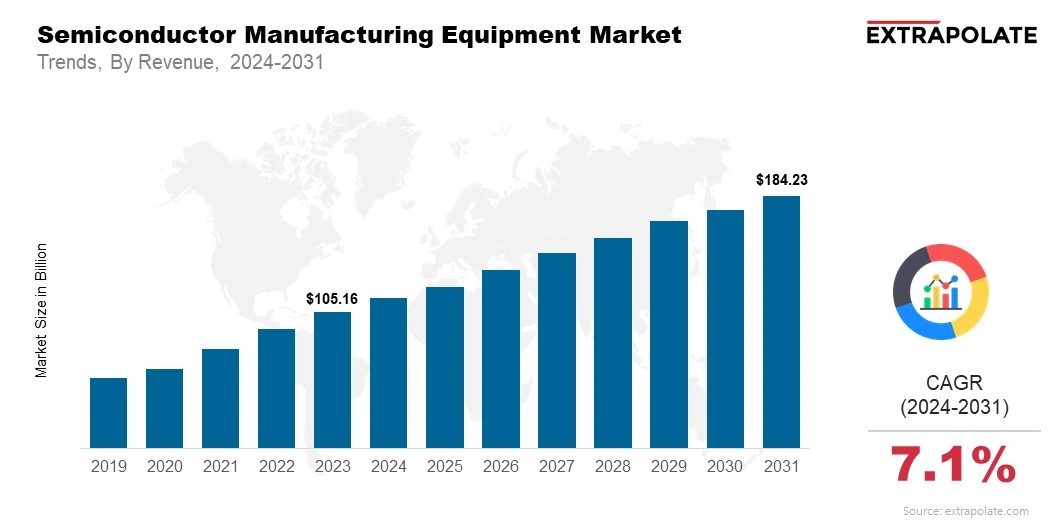
The global Semiconductor Manufacturing Equipment Market size was valued at USD 105.16 billion in 2023 and is projected to grow from USD 113.63 billion in 2024 to USD 184.23 billion by 2031, exhibiting a CAGR of 7.1% during the forecast period.
The global market is witnessing remarkable growth, driven by rapid advancements in technology, the increasing demand for semiconductor devices, and the ongoing expansion of key industries such as consumer electronics, automotive, and telecommunications.
This market encompasses a broad range of specialized equipment used in the production of semiconductors, including photolithography systems, etching machines, chemical vapor deposition (CVD) tools, and inspection and testing equipment.
As the demand for smaller, more powerful, and energy-efficient semiconductor devices continues to rise, the semiconductor manufacturing equipment market is becoming increasingly vital to meeting these evolving needs.
As industries across the globe rely more heavily on semiconductors for everything from mobile phones and laptops to autonomous vehicles and smart homes, the demand for advanced semiconductor manufacturing equipment is accelerating.
Emerging technologies such as 5G, artificial intelligence (AI), and the Internet of Things (IoT) are further fueling this growth, driving the need for highly sophisticated equipment capable of producing the next generation of semiconductor chips.
These advancements require cutting-edge tools that can handle the complexities of producing microchips with smaller geometries, increased performance capabilities, and greater power efficiency.
In addition to consumer electronics, the automotive sector is also playing a key role in the growth of the semiconductor manufacturing equipment market. The rise of electric vehicles (EVs) and the growing demand for smart, connected vehicle technologies are driving the need for advanced semiconductors that are essential for power management, sensor systems, and autonomous driving features.
As automotive manufacturers continue to integrate more advanced semiconductor components into their vehicles, the demand for semiconductor manufacturing equipment will continue to rise.
The global push to strengthen semiconductor manufacturing capabilities, particularly in regions such as North America and Europe, is also contributing to market growth. The need for localized production to ensure supply chain security and reduce dependence on external sources has spurred significant investments in semiconductor fabrication facilities and manufacturing infrastructure.
As semiconductor fabrication becomes increasingly complex, the role of advanced manufacturing equipment will continue to grow, with a focus on automation, precision, and efficiency.
Looking ahead, the semiconductor manufacturing equipment market is expected to experience sustained growth, driven by technological innovations, the expanding range of applications, and the ongoing transformation of key industries worldwide.
![]()
Key Market Trends Driving Product Adoption
The semiconductor manufacturing equipment market is characterized by rapid technological advancements, intense competition, and the growing need for high-performance semiconductors. Key trends driving market growth include:
- Miniaturization and Advanced Packaging: The demand for smaller, more efficient semiconductor chips is driving innovations in photolithography and wafer inspection tools, which allow for precise production at increasingly smaller nodes.
- 5G and IoT Expansion: The rollout of 5G networks and the proliferation of Internet of Things (IoT) devices are leading to increased demand for semiconductor chips, thereby boosting the need for advanced manufacturing equipment.
- Automation and AI Integration: Automation in semiconductor production is on the rise, with AI and machine learning being used to optimize the manufacturing process, enhance yield, and reduce defects.
- Sustainability: Increasing emphasis on energy-efficient semiconductor production processes is pushing for greener manufacturing technologies and environmentally friendly materials.
- R&D Investment: Significant investments in R&D are driving continuous innovation in semiconductor manufacturing technologies, allowing companies to stay ahead in an increasingly competitive market.
Competitive Landscape and Key Players: -
The SME market is dominated by several global leaders, including ASML, Applied Materials, Tokyo Electron, Lam Research, and KLA Corporation. These companies are at the forefront of technological advancements, driving innovations in semiconductor fabrication processes. Smaller players are also emerging, focusing on niche technologies and specialized equipment.
Consumer Behavior Analysis
Key drivers for demand in the SME include:
- Industry Growth: The expanding semiconductor industry, driven by demand from sectors such as automotive, consumer electronics, and telecommunications, is fueling the need for advanced equipment.
- Technological Evolution: Ongoing improvements in chip design push the need for advanced equipment. Producing smaller, more powerful chips demands cutting-edge technology.
- Cost Efficiency: Manufacturers look for equipment that boosts production. Fewer defects mean lower production costs.
Pricing Trends
Pricing trends in the semiconductor manufacturing equipment industry vary depending on the complexity of the technology and the size of the equipment. High-end, advanced tools used for cutting-edge processes like extreme ultraviolet (EUV) lithography command premium prices. However, competition and demand for efficiency are also driving down costs for more standardized equipment in some segments.
According to recent reports, the global semiconductor manufacturing equipment market is expected to grow at a compound annual growth rate (CAGR) of approximately 8-10% over the next five years, with increasing demand for advanced chips for applications in artificial intelligence, 5G, and autonomous vehicles driving this growth.
Growth Factors
Several factors are propelling the growth of the semiconductor manufacturing equipment market:
- Technological Advancements: Photolithography, wafer inspection, and deposition technologies advance. Smaller, faster, and more efficient chips become possible.
- Industry Demand: Next-generation technologies rise. 5G, AI, and autonomous vehicles fuel semiconductor demand. Equipment manufacturers find new opportunities in this surge.
- Geopolitical Factors: Trade policies shift. Semiconductor reshoring gains traction. Supply and demand dynamics fluctuate, bringing both opportunities and challenges for equipment manufacturers.
Regulatory Landscape
Rules for equipment used to make semiconductors are changing. Nations across the globe concentrate on security plus quality measures in semiconductor work. Rules that affect sending items abroad, mainly cutting-edge tech, such as "EUV lithography," impact how semiconductors get supplied globally. Firms need to follow these rules to stay in line and keep problems low.
Recent Developments
The semiconductor manufacturing equipment market is rapidly evolving, with several key developments:
- EUV Lithography Advancements: ASML as well as others, proceeds to improve EUV lithography technologies. This allows the creation of semiconductors on the smallest nodes.
- Automation and AI Integration: Automation and AI are creeping deeper into semiconductor production. Yield improves, defects shrink, and efficiency rises.
- Sustainability Initiatives: Semiconductor makers show increased concentration on energy-efficient methods besides environmentally safe substances within their tools.
- Increased Investment in R&D: Semiconductor equipment makers are pouring funds into R&D. The push for smaller, stronger chips keeps demand rising.
Current and Potential Growth Implications
Demand Supply Analysis
The requirement for sophisticated semiconductor fabrication devices rises consistently. This is because of expanded needs across sectors, for example, fifth generation mobile networks, the Internet of Things and battery-powered automobiles. But disruptions to distribution networks, a lack of parts, in addition to worldwide politics could affect the accessibility of such devices.
Gap Analysis
Despite significant progress, there are still areas for improvement in the market:
- Technological Limitations: Fabrication technologies now have limits. These limits could affect the rate at which the industry develops scaled-down semiconductors.
- Cost Efficiency: Progress marches on, but top-tier equipment stays pricey. Many manufacturers, especially in emerging markets, feel the strain.
- Supply Chain Challenges: Intricate semiconductor equipment and troubles with the worldwide supply network can cause lags in creation and shipment.
Top Companies in the Semiconductor Manufacturing Equipment Market
- ASML
- Applied Materials
- Lam Research
- Tokyo Electron
- KLA Corporation
- ASMI
- Teradyne
Report Snapshot
Segmentation | Details |
By Equipment Type | Photolithography, Etching, Deposition, Inspection, Testing, Others |
By Application | Consumer Electronics, Automotive, Telecommunications, Industrial Applications, Others |
By End User | Semiconductor Foundries, Integrated Device Manufacturers, OSATs, Others |
By Region | North America, Europe, Asia-Pacific, Middle East & Africa, South America |
High Growth Segments
The following market segments are expected to experience significant growth:
- Photolithography Equipment: EUV and DUV lithography keep advancing. Smaller node chips push the need for precision even further.
- Deposition and Etching Equipment: Critical to produce advanced semiconductors.
- Testing and Inspection Equipment: Chips are getting more complex. Precision testing and inspection are becoming more necessary.
Major Innovations
Innovation is key to staying competitive in the market. Some of the latest innovations include:
- Extreme Ultraviolet (EUV) Lithography: Enabling the production of chips at smaller nodes.
- Advanced Etching and Deposition Techniques: Necessary for the fabrication of complex semiconductor architectures.
- AI and Machine Learning: Integrating AI for process optimization and defect detection in manufacturing processes.
Potential Growth Opportunities
Companies in the market face several challenges:
- Technological Advancements: Technology changes often. This demands notable funds are spent on research and development. Staying competitive requires such expenditure.
- Cost Pressure: Balancing cutting-edge innovation with cost efficiency remains a challenge.
- Geopolitical Risks: Global politics and commerce rules can change how goods move also how markets function.
Extrapolate Research Says:
The worldwide market for semiconductor manufacturing is set to expand substantially in future years. This expansion results from progress in technology, greater need from major sectors and more funds devoted to advanced semiconductors. But businesses which handle hurdles successfully as they gain from new prospects will hold a solid status for prolonged accomplishment.
ARE YOU SEEKING COMPREHENSIVE INSIGHT ON VARIOUS
MARKETS?
CONTACT OUR EXPERTS TODAY
Semiconductor Manufacturing Equipment Market Size
- April-2025
- 148
- Global
- machinery-equipment
Related Research
0-Global Market Status and Trend Report 2015-2026
November-2020
2 Side Seal Machines-Global Market Status & Trend Report 2022-2030 Top 20 Countries Data
December-2020
3 Side Seal Machines-Global Market Status & Trend Report 2022-2030 Top 20 Countries Data
December-2020