Modular Homes Market Size, Share, Growth & Industry Analysis, By Product Type (Single-family Modular Homes, Multi-family Modular Homes, Commercial Modular Buildings), By Application (Residential, Commercial, Industrial) By End User (Homeowners, Real Estate Developers, Government, Commercial Enterprises), and Regional Analysis, 2024-2031
Modular Homes Market: Global Share and Growth Trajectory
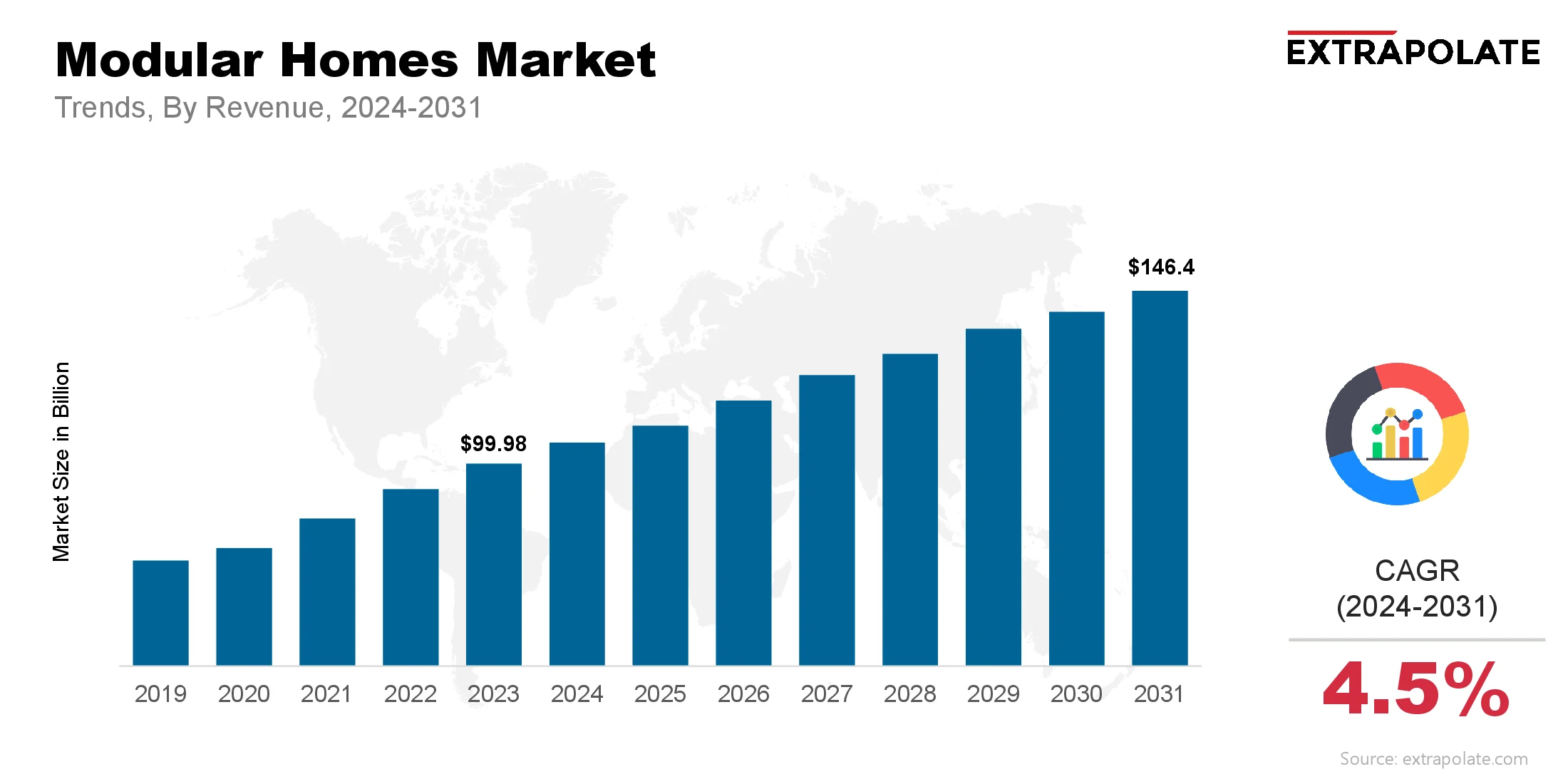
The global modular homes market size was valued at USD 99.98 billion in 2023 and is projected to grow from USD 107.22 billion in 2024 to USD 146.4 billion by 2031, exhibiting a CAGR of 4.5 % during the forecast period.
The global modular homes market is witnessing rapid expansion, fueled by increasing demand for affordable, sustainable, and customizable housing solutions. Modular homes, constructed using prefabricated sections manufactured in a controlled factory environment, offer a modern alternative to traditional on-site building methods.
This market includes a diverse range of home types, from single-family units to multi-story residential complexes, catering to varied consumer needs across urban and rural areas.One of the primary drivers of the modular homes market is the rising awareness around sustainability and energy efficiency. With growing environmental concerns, consumers and governments alike are advocating for eco-friendly construction practices.
Modular homes, often built with minimal waste and optimized material use, align well with these sustainable goals. Additionally, the ability to incorporate green technologies such as solar panels and advanced insulation makes modular homes increasingly attractive for environmentally conscious buyers.
Technological advancements in manufacturing and construction processes are significantly contributing to the market’s growth. Innovations such as 3D modelling, robotics, and automation in prefab assembly lines have enhanced the precision, speed, and quality of modular home production. This has resulted in reduced construction times and lower costs compared to traditional building techniques, making modular homes a cost-effective housing solution for a broad demographic.
Changing consumer preferences are another critical factor shaping the market. The modern homebuyer values flexibility, customization, and quicker delivery times. Modular homes can be tailored to individual tastes and requirements, offering a high degree of personalization while ensuring faster project completion. This appeal has extended beyond residential applications to commercial, educational, and emergency housing sectors.
The modular homes market is also benefiting from supportive government initiatives and favorable policies aimed at addressing housing shortages globally. Many regions are encouraging modular construction as a way to provide affordable and quality housing to underserved populations, especially in areas affected by natural disasters or rapid urbanization.

Key Market Trends Driving Product Adoption
The modular homes market is defined by technological innovation, growing environmental awareness, and evolving consumer preferences. Key trends fueling market expansion include:
- Sustainability and Eco-Friendly Construction: Demand for green materials and energy-efficient homes is rising. This boosts modular home adoption.
- Speed and Efficiency: Modular construction cuts build time. Developers and homeowners value the faster delivery compared to traditional methods.
- Customization and Flexibility: Buyers prefer modular homes with customizable designs. Layouts and finishes can be tailored to individual needs.
- Urbanization and Affordable Housing: Rapid urban growth and housing shortages increase demand. Cost-effective modular solutions are gaining traction.
- Technological Integration: Advanced manufacturing and smart home features improve modular home functionality.
Major Players and their Competitive Positioning
The modular homes market is led by prominent companies such as Clayton Homes, Cavco Industries, and Champion Home Builders, who are continuously innovating to expand their product offerings and market reach. Emerging players are also introducing niche designs and sustainable materials to capture specific consumer segments.
Consumer Behavior Analysis
Consumers are increasingly opting for modular homes due to factors including:
- Affordability: Lower construction and labour costs compared to traditional homes.
- Time Savings: Modular homes have faster construction timelines. This meets urgent housing needs.
- Quality and Durability: Factory-controlled conditions ensure higher quality and reduced defects.
- Environmental Impact: Preference for homes with reduced carbon footprint and waste.
- Design Flexibility: Modular homes can be customized. Consumers tailor them to their tastes and needs.
Pricing Trends
Pricing in the modular homes market varies based on design complexity, materials, location, and customization level. While premium modular homes command higher prices due to upscale finishes and smart features, entry-level options are increasingly available to address affordable housing demands.
Growth Factors
Several factors are driving modular homes market growth:
- Construction Labour Shortages: Rising labour costs and worker shortages affect traditional building. This encourages adoption of modular solutions.
- Environmental Regulations: Stricter building codes are being enforced. They promote eco-friendly modular construction practices.
- Technological Advancements: Automation and precision manufacturing improve quality. These technologies also help reduce costs.
- Government Initiatives: Policies and subsidies support affordable and sustainable housing.
- Changing Lifestyles: More people prefer minimalist and mobile living. Adaptable living spaces are becoming popular.
Regulatory Landscape
The regulatory framework for modular homes varies globally, with specific building codes, zoning laws, and certification requirements influencing market dynamics. Compliance with these regulations is critical for market players to ensure product acceptance and consumer trust.
Recent Developments
The modular homes market continues to innovate, with recent developments including:
- Smart Modular Homes: IoT and home automation are being integrated. This enhances the living experience.
- Sustainable Materials: The use of recycled materials is growing. Renewable and energy-efficient materials are also increasingly adopted.
- Modular High-Rise Buildings: Modular construction is moving into multi-story projects. This expands its application in residential buildings.
- Improved Transportation Logistics: Delivery methods have improved. Modular units are transported more safely and efficiently.
Current and Potential Growth Implications
- Demand Supply Analysis
Demand for modular homes is rising steadily, driven by cost efficiency and sustainability trends. Supply chain challenges such as transportation and material availability remain key considerations. - Gap Analysis
Despite strong growth, areas needing attention include:
- Standardization: The industry requires broader standards. This will improve interoperability and ensure quality.
- Affordability: Continued efforts to lower costs to make modular homes accessible to broader markets.
- Consumer Awareness: Efforts must continue to reduce costs. Making modular homes more accessible is essential.
- Technological Adoption: Education on modular home benefits should increase. This helps overcome traditional biases.
Top Companies in the Modular Homes Market
Some leading companies in this market include:
- Clayton Homes
- Cavco Industries
- Champion Home Builders
- Sekisui House
- Guerdon Modular Buildings
- Blokable
- Plant Prefab
Modular Homes Market: Report Snapshot
Segmentation | Details |
By Product Type | Single-family Modular Homes, Multi-family Modular Homes, Commercial Modular Buildings |
By Application | Residential, Commercial, Industrial |
By End User | Homeowners, Real Estate Developers, Government, Commercial Enterprises |
By Region | North America, Europe, Asia-Pacific, Latin America, Middle East & Africa |
High Growth Segments
Segments expected to see significant growth include:
- Single-family Modular Homes: Popular among first-time homebuyers and retirees.
- Multi-family Modular Homes: Gaining traction in urban housing projects.
- Commercial Modular Buildings: Used for offices, schools, and healthcare facilities.
Major Innovations
Innovation drives competitive advantage in modular homes, with recent advances such as:
- Advanced Prefabrication Techniques: Automation and robotics for precision building.
- Sustainable Building Materials: Cross-laminated timber is applied. Recycled steel and eco-friendly insulation are also used.
- Smart Home Integration: IoT-enabled systems support energy management. They also enhance security.
Potential Growth Opportunities
Challenges and opportunities include:
- Competition: The market faces intense rivalry. Traditional builders and other prefab housing types are key competitors.
- Technological Upgrades: Continuous innovation is necessary. This helps meet evolving consumer expectations.
- Regulatory Compliance: Builders must navigate diverse building codes. Certification processes add complexity.
- Consumer Education: Awareness campaigns are important. They help increase acceptance of modular homes.
- Supply Chain Optimization: Streamlining logistics reduces costs. It also improves delivery timelines.
Extrapolate Research says:
The global modular homes market is set for substantial growth driven by demand for affordable, sustainable, and fast-to-build housing solutions. Market players that leverage technological innovation and address consumer needs will secure strong competitive positions in this evolving landscape.
ARE YOU SEEKING COMPREHENSIVE INSIGHT ON VARIOUS
MARKETS?
CONTACT OUR EXPERTS TODAY
Modular Homes Market Size
- May-2025
- 148
- Global
- machinery-equipment
Related Research
0-Global Market Status and Trend Report 2015-2026
November-2020
2 Side Seal Machines-Global Market Status & Trend Report 2022-2030 Top 20 Countries Data
December-2020
3 Side Seal Machines-Global Market Status & Trend Report 2022-2030 Top 20 Countries Data
December-2020