Modular Construction Market Size, Share, Growth & Industry Analysis, By Type (Permanent Modular, Relocatable Modular), By Application (Residential, Commercial, Industrial), By End User (Developers, Contractors, Government), and Regional Analysis, 2024-2031
Modular Construction Market: Global Share and Direction of Growth
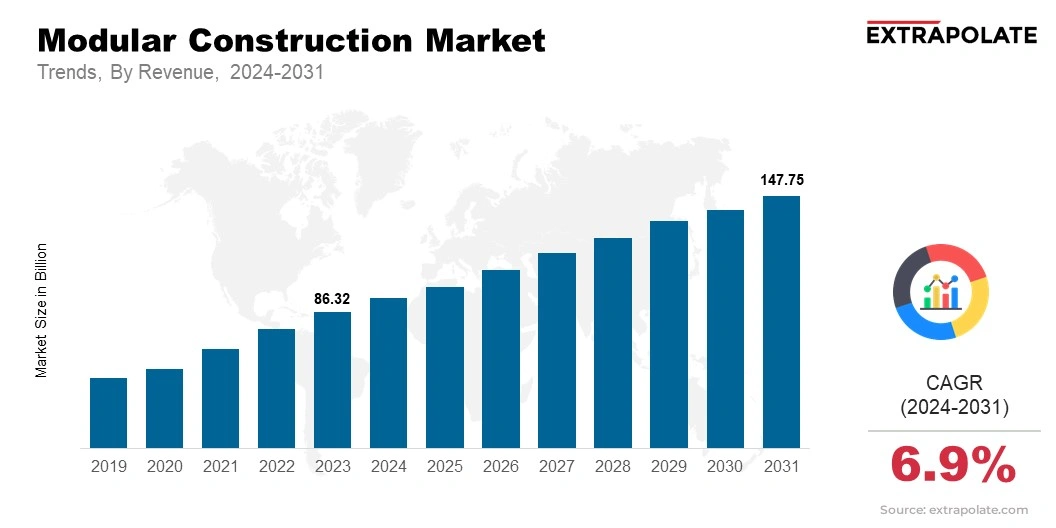
Global Modular Construction Market size was recorded at USD 86.32 billion in 2023, which is estimated to be valued at USD 92.33 billion in 2024 and reach USD 147.75 billion by 2031, growing at a CAGR of 6.9% during the forecast period.
The global modular construction market is set for remarkable scaling up, and is driven by the increasing demand for efficient, cost-effective, and workable construction solutions. Modular construction, which requires prefabricating building sections in a controlled factory environment and then bringing them together on-site, offers various advantages. These include reduced time for construction, cost savings, and decreased environmental impact. Industries seek quicker project delivery and quality control, hence, the use of modular construction techniques is gaining traction across both residential and commercial sectors.

Key Market Trends Directing Product Integration
The modular construction market is registering noticeable growth, spurred on by different trends:
Cost and Speed Efficiency: Modular construction leads to cost savings and speedy completion of construction, due to lesser labor costs and reduced material waste. This makes it an attractive offer for developers who are willing to reduce expenses and meet tight deadlines.
Sustainability and Green Buildings: With more prominence on sustainability, modular construction is securing popularity, as it minimizes energy consumption and lowers carbon emissions with traditional construction methods.
Urbanization and Population Growth: The growth of cities and the demand for more economical housing solutions are boosting the demand for modular construction in residential projects. This trend is most noticeable in developing economies.
Technological Advancements: Advanced technologies such as BIM and robotics have become part of modular construction. These have improved design accuracy, efficiency, and customization.
Government Support: The governments of various countries are more responsive toward the modular construction market with favorable policies, subsidies, and incentives to promote eco-friendly and affordable housing options.
Major Players and their Position in the Competitive Market
The modular construction market is divided into two groups: Large, international corporations and smaller, specialized firms competing for market share. Katerra, Laing O'Rourke, Skanska, and Red Sea Housing Services are leaders who use technological advantages and expand their product portfolios to acquire a greater market share. In addition to that, new players are focusing on regional markets with innovative and customized modular solutions for various construction needs.
Consumer Behavior Analysis
Consumers are increasingly adopting modular construction methods for several reasons, including:
Convenience and Efficiency: Modular construction offers faster project completion times and reduced on-site disruptions. This makes it convenient for residential, commercial, and industrial applications.
Cost-effectiveness: Modular construction is a financially appealing alternative due to the reduced material waste and streamlined production process, which contribute to overall cost savings.
Sustainability: The use of sustainable materials and the ability to recycle components align with consumer preferences for eco-friendly construction solutions.
Customization and Versatility: Modular construction provides flexibility in design and functionality, catering to the diverse needs of consumers across various sectors.
Trends in Pricing
The pricing of modular construction services is competitive and varies based on the size of the project, complexity, and location. Modular construction might be more cost-effective than traditional methods, as it requires fewer labor hours and a shorter construction time. However, the prices of modular construction are affected by material cost, transportation costs, local labor, and market conditions. As the market matures and production rises up, the cost of modular construction decreases, making it more appealing for developers and the builders.
Growth Factors
The following factors are boosting the modular construction market:
- IncreasingDemand for Affordable Housing: Considering the global housing crisis, modular construction is becoming a favorable way of providing affordable housing solutions, especially in urban areas.
- Advances in Technology:Use of technologies like 3D printing and robotics is improving productivity, design capacity, and the modular construction process, which is leading to higher penetration of modular construction.
- Urbanization:The growing need for quick and efficient building solutions, due to rapid urbanization, is contributing to the increasing demand for modular construction in urban areas.
- Government Support:Incentives and subsidies on policy levels, along with funding, encourage the modular construction of buildings, mainly for inexpensive housing projects.
Regulatory Landscape
With the gradually growing modular construction market, governments around the world are carrying out regulations to ensure safety, quality, and sustainability of modular buildings. Some of these include building codes for prefabricated structures, transportation guidelines, and environmental regulations. Key market players must adhere to these standards to maintain competitiveness and consumer trust.
Recent Developments/ Market Highlights
The modular construction market is registering significant developments, including:
- Integrating Technology: The integrationof new technologies like Artificial Intelligence (AI), Machine Learning (ML), and robotics into modular construction has amped up efficiency, reduced costs, and made room for more complex designs.
- ModularConstruction in Emerging Economies: Countries in Asia Pacific, including India and China, are increasingly adopting modular constructions for various applications, ranging from affordable housing to
- Sustainable Initiatives: Modular construction is usedfor green and energy-efficient buildings, using materials that can minimize waste during
- Expanding Globally:Leading companies in the market are expanding their business globally, particularly in regions where the demand for rapid and low-cost construction solutions is high.
Current and Potential Growth Implications
Demand-Supply Analysis: Demand for modular construction is likely to grow by the day. Demand for affordable housing is high in areas with high rates of urbanization. This will boost modular construction solutions, as more companies will enter the market and increase the capacity of production. Despite rapid growth, there are gaps in the market, like:
Gap Analysis: Despite rapid growth, there are gaps in the market, such as:
- LowAwareness: A large number of developers and consumers are unaware of the benefits and abilities of modular construction, which can influence the rate of its overall adoption.
- RegulatoryChallenges: Building codes, regulations, and standards vary from one region to another, which may be challenging for global companies trying to expand.
- Issues in Material Supply: The modular construction market depends on the consistent supply of raw materials, and any interference in the supply chain can influenceproduction and costs.
Top Companies in the Modular Construction Market
- Katerra
- Laing O'Rourke
- Skanska
- Red Sea Housing Services
- Bouygues Construction
- Turner Construction
- Algeco
- Mandarin Construction
- Bechtel Corporation
- Lendlease Corporation
Modular Construction Market: Report Snapshot
Segmentation | Details |
By Type | Permanent Modular, Relocatable Modular |
By Application | Residential, Commercial, Industrial |
By End User | Developers, Contractors, Government, Others |
By Region | North America, Europe, Asia Pacific, Middle East & Africa, South America |
Modular Construction Market: High-growth Segments
The following segments are expected to register the highest growth in the modular construction market:
- Permanent Modular Construction: This segment will experience rapid growth, as it provides long-term cost-savings and sustainability advantages.
- Residential Modular Construction: With rising demand for affordable housing and urban population growth, residential modular construction is projected to register strong growth.
Major Innovations
Innovation is an important driving factor of the modular construction market. Ongoing changes include:
- 3D Printing: 3D printing technologies are making way for more complex, customized designs for modular structures.
- Automation and Robotics: The use of robotics in the manufacturing process is enhancing precision and reducing labor costs.
- Sustainable Materials: Latest modules are integrating new recycled materials, including steeland ecofriendly insulation, to reduce carbon footprint.
Modular Construction Market: New Opportunities for Growth
- Affordable Housing Projects: Modular construction is suitable for affordable housing Through this method, developers can instantly cater to the ever-growing demand for houses.
- UrbanInfrastructure: With the sprawl of urban areas, the demand for modular solutions for building schools, healthcare facilities, and many other critical infrastructure is set to rise.
- EmergingMarkets: In emerging economies, where rapid urbanization and infrastructure development are prevalent, modular construction presents a significant opportunity to address the growing demand for housing and commercial buildings.
Extrapolate Research says:
The need for cost-effective, environmentally friendly, and efficient construction techniques is fueling the global modular construction market. The market is continually shifting, due to technological advancements. Modular construction is emerging as a suitable option to cater to the growing needs of the commercial, industrial, and residential sectors.
ARE YOU SEEKING COMPREHENSIVE INSIGHT ON VARIOUS
MARKETS?
CONTACT OUR EXPERTS TODAY
Modular Construction Market Size
- December-2024
- 148
- Global
- machinery-equipment
Related Research
0-Global Market Status and Trend Report 2015-2026
November-2020
2 Side Seal Machines-Global Market Status & Trend Report 2022-2030 Top 20 Countries Data
December-2020
3 Side Seal Machines-Global Market Status & Trend Report 2022-2030 Top 20 Countries Data
December-2020