Extrapolate Extrapolate
  • 888-328-2189
  • ABOUT US
  • CONTACT US
  • SIGN IN
  • INDUSTRIES
  • BLOGS
  • Home
  • ICT & IoT
  • Smart home market

Smart Home Market Size, Share, Growth & Industry Analysis, By Product Type (Smart Lighting, Smart Thermostats, Security and Access Control, Entertainment Systems, Smart Appliances, Others), By Technology (Wi-Fi, Bluetooth, ZigBee, Z-Wave, Others), By Application (Energy Management, Security, Home Entertainment, Healthcare, Smart Kitchen, Others), By End-User (Residential, Commercial, Industrial), and Regional Analysis, 2024-2031

  • Description
  • Table Of Content
  • Sample Request

Smart Home Market: Global Share and Growth Trajectory

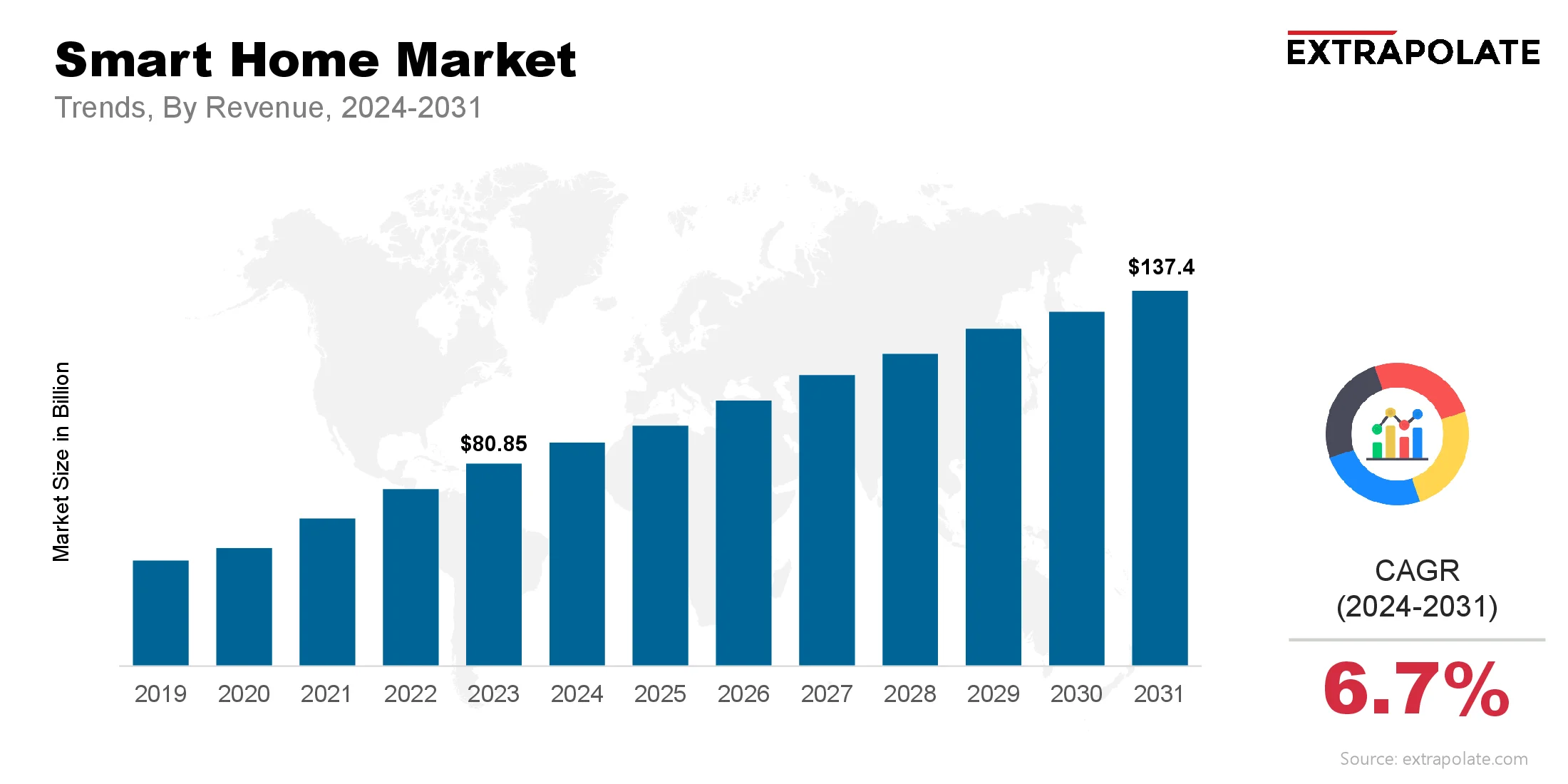
The global Smart Home Market size was valued at USD 80.85 billion in 2023 and is projected to grow from USD 87.03 billion in 2024 to USD 137.46 billion by 2031, exhibiting a CAGR of 6.7% during the forecast period.

The global market is growing rapidly. It is transforming modern living through automation, connectivity, and artificial intelligence. Homeowners are increasingly using smart technologies to improve comfort, convenience, security, and energy efficiency.

These systems allow easy control of lighting, climate, entertainment, and appliances. Users can manage them through mobile apps, voice assistants, and automated routines. This shift is turning traditional homes into smart, connected spaces.

Demand is rising due to fast technological advancements and growing consumer awareness. Affordable smart devices are also becoming widely available. As connectivity improves and devices work better together, the market is gaining momentum.

Smart homes are also becoming more intelligent with AI, machine learning, and IoT. These technologies make systems more responsive and user-friendly. The market is set for strong and steady growth.

One key benefit of smart homes is better control and automation. Smart thermostats, lighting, and security tools help reduce energy use and increase safety. Devices like Google Nest, Amazon Echo, and Ring Doorbell have changed how people interact with their homes.

They offer real-time updates, remote access, and personalized features. With such innovation, smart homes are no longer optional—they are becoming essential.

Smart Home Market Size & Share, By Revenue, 2024-2031

Key Market Trends Driving Product Adoption

Here are the trends that are driving the adoption of smart home technology:

Home Automation:

As consumers want convenience and control, home automation is on the rise. Automated lighting, thermostats, window shades and entertainment systems give a seamless and efficient living experience. Smart home hubs and voice assistants like Alexa, Google Assistant and Siri let you control devices with voice commands or apps.

Energy Efficiency and Sustainability:

 With environmental concerns and rising energy costs, energy efficiency is top of mind. Smart thermostats, energy monitoring plugs and connected HVAC systems help you reduce consumption and monitor your energy use in real time. These technologies support global sustainability goals and give you financial benefits through lower utility bills.

Home Security:

Smart security systems are gaining popularity as consumers are adopting smart cameras, video doorbells, motion sensors and alarm systems. These products offer features like real time alerts, remote monitoring, cloud storage and two way communication. Being able to monitor your home from anywhere is a key driver for adoption.

AI and IoT:

Artificial intelligence and the Internet of Things are making the smart home experience better. AI driven systems learn your habits and preferences and adjust settings automatically. IoT devices talk to each other and create a centralized and harmonized environment. This interconnectedness is making smart homes more valuable and desirable.

Major Players and their Competitive Positioning

The smart home market is highly competitive, with major players continuously innovating to maintain their market presence. These companies are investing in R&D, strategic partnerships, and acquisitions to enhance product portfolios and broaden customer bases.

Key players in the smart home industry include are Amazon.com, Inc., Google LLC (Alphabet Inc.), Apple Inc., Samsung Electronics Co. Ltd., Honeywell International Inc., Schneider Electric SE, LG Electronics Inc., Siemens AG, ABB Ltd., Johnson Controls International plc. And others

These firms are leveraging their technological expertise and global distribution channels to offer comprehensive smart home solutions. Product ecosystems such as Amazon Alexa, Google Nest, and Apple HomeKit are cornerstones of their competitive strategies, enabling seamless device integration and user-friendly experiences.

Consumer Behavior Analysis

Consumer preferences in the smart home market are driven by:

  • Comfort and Convenience: Consumers want convenience and are drawn to tech that makes life easier. Automating tasks, adjusting settings remotely and getting personalized recommendations appeals to tech savvy homeowners looking for a modern lifestyle.
  • Security and Safety: Safety concerns are pushing consumers towards smart surveillance systems. Families and city dwellers in particular love real-time access to home cameras and alerts which gives them a sense of control and security.
  • Tech Familiarity and Trust: As consumers get more familiar with smart tech, adoption rates increase. User friendly apps, widespread smartphone use and integration with popular platforms (like Android and iOS) reduces adoption barriers. Trust in well-known brands also boosts confidence in data privacy and product reliability.
  • Cost-Benefit: While the initial investment in smart devices may seem high, consumers see the long term value in energy savings, insurance discounts and increased property value. Bundled product offerings and incentives from utility providers also improves the cost-benefit ratio.

Pricing

Pricing in the smart home market varies widely depending on functionality, brand and system complexity. Basic smart bulbs or plugs are cheap, while whole home automation systems are more expensive. High end integrated solutions like smart kitchens, HVAC systems and security platforms can cost thousands upfront.

But economies of scale, competition and innovation is driving down prices. DIY installation options, modular devices and cloud based platforms is making smart homes more accessible. Subscription based models for cloud storage and security monitoring also allows consumers to customize features without large capital investment.

Retailers and device manufacturers are bundling smart home products at discounted prices especially during promotional periods like Black Friday or Prime Day to accelerate mass market adoption.

Growth Factors

Several factors are driving the growth of the smart home market:

  • Technology: AI, edge computing, machine learning and voice recognition are driving innovation. Devices are getting more intuitive, responsive and energy efficient. This reduces user effort and increases automation and personalization. In July 2025, Reolink released the Elite Floodlight WiFi, a 4K panoramic, subscription-free smart security camera with on-device AI (“ReoNeura AI”) that supports person recognition (e.g. “man in red hoodie”), adjustable floodlights, virtual fences, and a built-in siren, for around $219.99.
  • IoT Devices: More and more household items are becoming “smart”. The ecosystem of connected devices is expanding. Consumers can now connect their doorbells, appliances, thermostats and TVs to a central hub – creating a smart home that’s seamless and cohesive.
  • 5G and Wi-Fi 6: Fast and low latency networks are enabling real-time device interaction. 5G and Wi-Fi 6 are key to supporting the bandwidth needs of smart homes especially those with multiple devices connected at the same time.
  • Remote Work and Digital Lifestyle: The COVID-19 pandemic forced the shift to remote work and home-based lifestyle and people are spending more on smart home upgrades. Consumers are upgrading their home with smart lighting, entertainment and productivity tools.
  • Government Initiatives and Energy Regulations: Government support for energy efficient housing and sustainability programs is driving smart home technology adoption. Incentives like rebates, tax credits and smart meter installations are fuelling this trend.

Regulatory Landscape

The smart home market is governed by regulatory frameworks that focus on data privacy, consumer safety and interoperability:

  • Data Privacy and Security: Regulations like GDPR in Europe and CCPA in the US dictate how smart home companies can collect, store and use consumer data. Compliance is key to customer trust.
  • Product Certification and Safety Standards: Many regions require product safety and quality standards. UL, FCC, CE and ISO certifications ensure devices meet international electrical and operational safety standards.
  • Interoperability and Open Standards: To give consumers choice and device compatibility, standards like Matter (backed by the Connectivity Standards Alliance) aim to standardise communication protocols across brands and platforms so devices can talk to each other seamlessly.

Recent Developments

Recent smart home highlights:

  • Matter Protocol Launch: 2023 saw the launch of Matter, a universal smart home standard. Apple, Google, Amazon and the Zigbee Alliance have created a standard that means cross brand interoperability so device selection is easier and consumer confidence is higher.
  • AI Powered Home Assistants: Companies are introducing AI driven upgrades to virtual assistants. This includes proactive suggestions, mood based lighting, adaptive security monitoring and predictive appliance maintenance. In January 2025, Lockly announced the Vision Prestige (a smart lock and video doorbell with facial recognition, fingerprint entry, touchscreen display and Apple Home Key support) and the Secure Pro (a UWB-based hands-free smart lock with fingerprint and keypad access), plus the Sightline Pro and Sightline security cameras. These new products mark Lockly’s entry into advanced door-security ecosystems with local AI, touchscreen, and solar-powered recording options, all coming in Q4 2025.
  • Sustainability Focused Devices: Smart home brands are creating energy efficient devices with recyclable materials and reduced carbon footprint. Solar integrated smart appliances and climate responsive control systems are popular with eco conscious consumers.
  • Strategic Partnerships: Big companies are forming strategic partnerships to expand their product ecosystems. Amazon partnered with iRobot and Ring to add to their smart home lineup, while Google has deepened its integrations with third party smart appliance brands.

Current and Future Growth Implications

Demand-Supply Analysis: The market has a robust supply pipeline with products available online and offline. Demand is growing in both developed and emerging markets driven by lifestyle trends and digital transformation.

Gap Analysis: Despite growth there are challenges around ecosystem compatibility, consumer education and price sensitivity in lower income segments. Brands are addressing this by simplifying installation, making interfaces more intuitive and offering entry level products at competitive prices.

Top Companies in the Smart Home Market

  • Amazon.com, Inc.
  • Google LLC (Alphabet Inc.)
  • Apple Inc.
  • Samsung Electronics Co. Ltd.
  • Honeywell International Inc.
  • Schneider Electric SE
  • LG Electronics Inc.
  • Siemens AG
  • ABB Ltd.
  • Johnson Controls International plc

Smart Home Market: Report Snapshot

Segmentation

Details

By Product Type

Smart Lighting, Smart Thermostats, Security and Access Control, Entertainment Systems, Smart Appliances, Others

By Technology

Wi-Fi, Bluetooth, ZigBee, Z-Wave, Others

By Application

Energy Management, Security, Home Entertainment, Healthcare, Smart Kitchen, Others

By End-User

Residential, Commercial, Industrial

By Region

North America, Europe, Asia-Pacific, Latin America, Middle East & Africa

High Growth Segments

Here are the areas that will see growth:

  • Smart Security and Surveillance: Video doorbells, smart locks and AI powered cameras are taking off due to safety concerns.
  • Energy Management Systems: Smart thermostats and automated lighting will see more demand due to cost savings and environmental benefits.
  • Healthcare and Elderly Care Applications: Smart health monitors and emergency alert systems within home automation are growing especially in aging population.

Major Innovations

Recent innovations in smart home:

  • Voice Enabled Automation: Smart home systems with advanced voice AI are enabling hands free, context aware control of devices.
  • Predictive Maintenance: Smart appliances now come with self-diagnostic tools and predictive maintenance alerts, reducing downtime and improving performance.
  • Edge AI and On-Device Processing: New devices are processing data locally instead of relying on cloud only.

Potential Growth Opportunities

Opportunities for growth:

  • Emerging Markets: As internet and urbanization spread, Southeast Asia, Latin America and Africa are huge untapped opportunities for smart home.
  • Affordable Product Lines: Mid-tier and budget friendly product lines for price sensitive consumers to go beyond early adopters.
  • Renewable Energy: Smart homes with solar panels and battery storage systems = sustainable and autonomous living.
  • Elderly and Assisted Living: Smart sensors, emergency detection and remote monitoring is transforming elderly care and assisted living.

Extrapolate Says:

The smart home market is ready for exponential growth as digital lifestyle becomes the norm. With AI, IoT and energy efficiency at its core, the industry is moving from novelty to necessity. Growing security concerns, sustainability priorities and the global shift to connected living will drive demand.

Big players are building robust ecosystems. consumers are embracing seamless intelligent environments. As prices come down and Matter standard enhances interoperability, the smart home is going global – redefining how we live in the digital age.

FAQ

The global market is projected to reach USD 137.46 billion by 2031, growing at a CAGR of 6.7 % from 2024 to 2031.
The global market was valued at USD 80.85 billion in 2024.
Key factors that are driving the Smart Home Are The exponential growth of data generated from IoT devices, social media, and enterprise systems is driving the need for advanced analytics solutions.
Key players in the market are Smart security systems are gaining popularity as consumers are adopting smart cameras, video doorbells, motion sensors and alarm systems and Others.

ARE YOU SEEKING COMPREHENSIVE INSIGHT ON VARIOUS MARKETS?
CONTACT OUR EXPERTS TODAY

Speak to an Expert
Smart home market

Smart Home Market Size

  • August-2025
  • 140
  • Global
  • information-technology-communication-iot
3499

SELECT AN OPTION

  • 1 User Access
  • PDF Report View
  • Non-Printable
  • 32 Man-hours Analyst Support
  • Post-Sale Support 48 Hours
  • Access upto 5 users
  • PDF Report View
  • Print Available
  • Access to Data Sheet
  • Up to 10% Customization
  • 40 Man-hours Analyst Support
  • Post-Sale Support 72 Hours
  • Annual Update
  • Unlimited User Access
  • Downloadable PDF Report. Data Sheet, Power Point Presentation
  • Print Available
  • Up to 20% Customization
  • 72 Man-hours Analyst Support
  • Post-Sale Support 120 Hours
  • Bi-Annual Update

ENQUIRE NOW REQUEST SAMPLE
Dale Byrne

HAVE A QUESTION?
Samuel will help you find what you are looking for.


Call: 888-328-2189


Related Research

2018-2023 Commercial Interior Design Market Size, Share & Trends Analysis Report By Application ( O

March-2021


2018-2023 Industrial Product Design Market Size, Share & Trends Analysis Report By Application ( Tr

March-2021


2D Animation Software Market Size, Share & Trends Analysis Report By Application (Construction Field

March-2021


2D Vision Measuring Systems Market Size, Share & Trends Analysis Report By Application ( Commercial

March-2021


360 Degree Feedback Software Market Size, Share & Trends Analysis Report By Application ( Corporatio

March-2021


3D and 4D Technology Market Size, Share & Trends Analysis Report By Application (Entertainment, Cons

March-2021


3D Animated Films Market Size, Share & Trends Analysis Report By Application ( Children, Adults, Oth

March-2021


3D CAD Design Software Market Size, Share & Trends Analysis Report By Application (Small Business, M

March-2021


3D CAD Software Market Size, Share & Trends Analysis Report By Application ( Manufacturing, Automo

March-2021


3D CAD Software Market Size, Share & Trends Analysis Report By Application (Manufacturing, Automotiv

March-2021


Sample Request

Smart Home Market Size, Share, Growth & Industry Analysis, By Product Type (Smart Lighting, Smart Thermostats, Security and Access Control, Entertainment Systems, Smart Appliances, Others), By Technology (Wi-Fi, Bluetooth, ZigBee, Z-Wave, Others), By Application (Energy Management, Security, Home Entertainment, Healthcare, Smart Kitchen, Others), By End-User (Residential, Commercial, Industrial), and Regional Analysis, 2024-2031

Publisher: Kings Research   |   Date: 2025-08-01   |   No. Of Pages: 140

Send Your Query

Smart Home Market Size, Share, Growth & Industry Analysis, By Product Type (Smart Lighting, Smart Thermostats, Security and Access Control, Entertainment Systems, Smart Appliances, Others), By Technology (Wi-Fi, Bluetooth, ZigBee, Z-Wave, Others), By Application (Energy Management, Security, Home Entertainment, Healthcare, Smart Kitchen, Others), By End-User (Residential, Commercial, Industrial), and Regional Analysis, 2024-2031

Publisher: Kings Research   |   Date: 2025-08-01   |   No. Of Pages: 140
Extrapolate

Extrapolate has a refined network of top publishers across the globe covering markets and micro markets who bring in the power of decision making. Our network of publishers is ranked based on the quality of reports produced along with customer feedback Indexing.

 talk@extrapolate.com

888-328-2189


Connect With Us

twitter logo

Industry

Quick Links

  • About Us
  • Contact Us
  • FAQ
  • Privacy Policy
  • Disclaimer
  • Refund Policy
  • Sitemap


Payment Gateway
Sign up for newsletter and updates


Powered By

Kings Research
© 2025 Kingsresearch. All Rights Reserved.