Dermatoscope Market Size, Share, Growth & Industry Analysis, By Product Type (Handheld, Digital, Hybrid) By Technology (LED, Xenon, Halogen) By Application (Skin Cancer Diagnosis, Warts & Fungal Infections, Scabies, Others) By End User (Hospitals, Dermatology Clinics, Academic & Research Institutes, Others), and Regional Analysis, 2024-2031
Dermatoscope Market: Global Share and Growth Trajectory
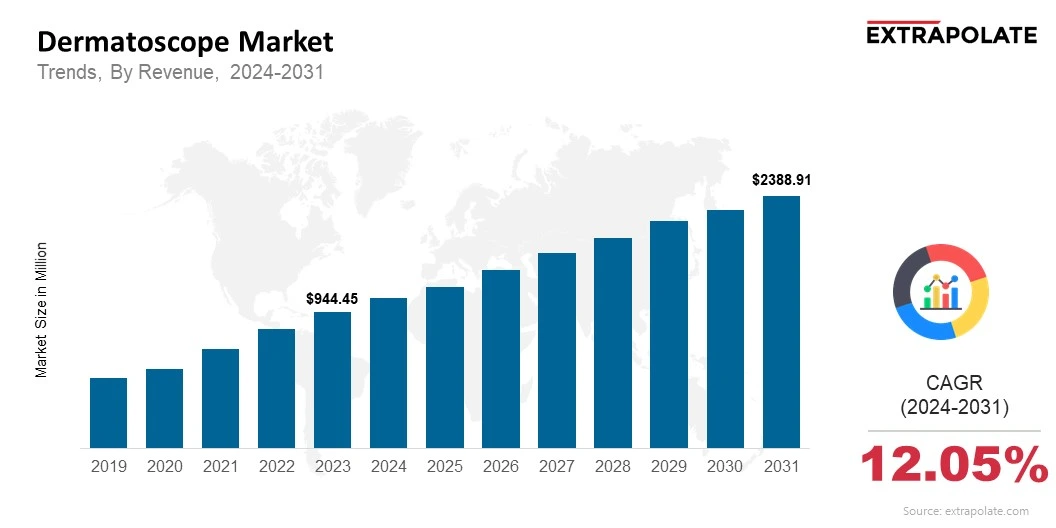
The global Dermatoscope Market size was valued at USD 944.45 Million in 2023 and is projected to grow from USD 1076.94 Million in 2024 to USD 2388.91 Million by 2031, exhibiting a CAGR of 12.05% during the forecast period.
The global dermatoscope market is witnessing steady expansion, fueled by the rising prevalence of skin disorders, growing awareness of early skin cancer detection, and advancements in imaging technology. Dermatoscopes, which are essential tools in dermatology for visualizing subsurface skin structures, are increasingly being adopted in clinical and teledermatology settings.
As healthcare systems emphasize early diagnosis and minimally invasive procedures, dermatoscopes are becoming indispensable in dermatological practice. The global market is experiencing a steady upward trajectory, driven by a combination of rising incidences of skin-related disorders, increasing demand for early skin cancer diagnosis, and significant technological advancements in dermatological imaging.
Dermatoscopes, which are handheld devices used to examine skin lesions and subsurface skin structures, have become critical tools for dermatologists, aiding in the early detection of melanoma and other types of skin cancers. With skin cancer cases on the rise globally—particularly in regions with high UV exposure such as Australia, the United States, and parts of Europe—the need for reliable and non-invasive diagnostic tools is growing rapidly.
This trend is further supported by increased public awareness and proactive health screening initiatives that emphasize the importance of early diagnosis to improve treatment outcomes and reduce healthcare costs.
The integration of advanced technologies such as polarized light, high-definition optics, and digital imaging has transformed conventional dermatoscopy into a more precise and efficient diagnostic procedure. The advent of smartphone-compatible and digital dermatoscopes has further broadened their use, enabling seamless storage, sharing, and comparison of dermoscopic images over time.
This is especially beneficial in teledermatology, where remote consultations have become more prevalent following the COVID-19 pandemic. These digital and portable devices enhance accessibility to quality dermatological assessments, even in remote and underserved regions, contributing to the democratization of skin healthcare services worldwide.
Moreover, the expanding application of dermatoscopes in educational and research settings is creating new growth avenues. Medical professionals, residents, and researchers are increasingly using dermatoscopes to gain a deeper understanding of skin morphology and pathology, enhancing diagnostic accuracy and decision-making.
In addition, the growing geriatric population, which is more prone to skin diseases and malignancies, is adding to the patient pool that requires regular dermatological check-ups, thereby further fueling demand for dermatoscopic devices.
Geographically, North America and Europe currently dominate the dermatoscope market due to well-established healthcare infrastructure, widespread adoption of advanced medical technologies, and favorable reimbursement policies. However, the Asia-Pacific region is expected to witness the highest growth rate during the forecast period, owing to rising healthcare investments, growing awareness of skin health, and the increasing availability of affordable dermatoscopy devices.
Countries such as China, India, and Japan are seeing a surge in demand for dermatological tools, driven by an upsurge in urbanization, pollution-related skin conditions, and an emerging middle-class population with increasing access to healthcare.
Key Market Trends Driving Product Adoption
The dermatoscope market is characterized by continuous innovation, increasing demand for precision diagnostics, and an expanding base of dermatology professionals. Key trends driving market growth include:
- Rising Incidence of Skin Cancer: Rising melanoma and skin cancer cases are driving demand. There is a need for reliable, early diagnostic tools like dermatoscopes.
- Technological Advancements: Polarized light, digital imaging, and smartphone compatibility are improving diagnostics. They also enhance usability.
- Growth in Teledermatology: Remote consultations are growing. Digital dermatoscopes enable high-resolution image capture and sharing for virtual diagnosis.
- Portable and Handheld Devices: Compact, battery-powered models are becoming more popular. They are used in both clinical and field settings.
- Education and Training: The use of dermatoscopes in medical education is increasing. This is boosting demand among new practitioners.
Major Players and their Competitive Positioning
The market includes both established manufacturers and innovative startups. Key players like Heine Optotechnik and DermLite lead through innovation. They also have strong distribution and strategic partnerships. Emerging players are introducing cost-effective and digitally enhanced models to capture untapped segments.
Consumer Behavior Analysis
Dermatoscopes are increasingly adopted by dermatologists, general practitioners, and cosmetic surgeons for various diagnostic and cosmetic procedures. Key consumer motivations include:
- Accurate Skin Lesion Analysis: Accurate skin lesion analysis boosts diagnostic confidence. It also reduces unnecessary biopsies.
- Convenience in Practice: Lightweight, portable devices make usage easier. They simplify routine checkups.
- Digital Integration: Devices compatible with smartphones and EMR systems for easy data sharing and documentation.
- Training and Learning: Used extensively in academic settings for developing diagnostic skills.
Pricing Trends
Dermatoscope pricing varies significantly depending on features, brand, and imaging capabilities. Entry-level handheld models are affordable for broad use. Premium digital and hybrid models cost more due to HD imaging, USB connections, and software features. The market is also seeing growth in mid-range offerings that balance performance and affordability.
Growth Factors
Several factors are propelling the growth of the dermatoscope market:
- Technological Enhancements: Innovations like cross-polarized lighting and AI-assisted diagnosis are boosting demand. Wireless connectivity also plays a key role.
- Increased Awareness of Skin Health: Educational campaigns and screenings are raising awareness. They encourage early skin checks.
- Demand for Non-Invasive Diagnostics: There is a growing demand for non-invasive diagnostics. People prefer early lesion evaluation without surgery.
- Rising Dermatology Workforce: The dermatology workforce is growing. More dermatologists and general practitioners are using dermatoscopes.
- Expansion of Cosmetic Dermatology: Cosmetic dermatology is expanding. Dermatoscopes are used more in skin assessments and aesthetic treatments.
Regulatory Landscape
Dermatoscopes are generally regulated as Class I or II medical devices, depending on the market. Compliance with CE marking in Europe and FDA clearance in the U.S. is crucial. It is required for product commercialization Regulations around digital image handling and patient data privacy are also becoming increasingly important.
Recent Developments
The dermatoscope market is evolving rapidly, with significant advancements in product features and user experience. Recent developments include:
- AI-Powered Image Analysis: AI-powered analysis helps detect and classify lesions. It automates the process.
- Smartphone-Enabled Devices: Smartphone attachments turn phones into dermatoscopes. They offer high-resolution imaging.
- Wireless Connectivity: Bluetooth-enabled models allow smooth data transfer. They provide wireless connectivity.
- Improved Optics: Improved optics offer better magnification and lighting. This results in clearer images.
- Cloud-Based Data Storage: Cloud storage offers secure solutions for patient data. It also supports image analysis.
Current and Potential Growth Implications
Demand Supply Analysis
The demand for dermatoscopes is steadily increasing due to growing skin health awareness and technological evolution. However, supply may be affected by constraints in high-quality optical components and chipsets for digital integration.
Gap Analysis
Despite rapid innovation, several gaps persist in the market:
- Affordability in Emerging Markets: High prices limit access in developing countries.
- Standardization of Digital Data: Need for uniform image formats for cross-platform sharing.
- Integration with EMRs: Seamless compatibility with electronic medical record systems is limited.
- Training and Adoption: Insufficient training on dermoscopy techniques among general practitioners.
Top Companies in the Dermatoscope Market
- Heine Optotechnik
- DermLite (3Gen Inc.)
- Rudolf Riester GmbH
- Canfield Scientific
- FotoFinder Systems GmbH
- Firefly Global
- Opticlar
- AMD Global Telemedicine
- Caliber I.D.
- Welch Allyn
Dermatoscope Market: Report Snapshot
Segmentation | Details |
By Product Type | Handheld, Digital, Hybrid |
By Technology | LED, Xenon, Halogen |
By Application | Skin Cancer Diagnosis, Warts & Fungal Infections, Scabies, Others |
By End User | Hospitals, Dermatology Clinics, Academic & Research Institutes, Others |
By Region | North America, Europe, Asia-Pacific, Middle East & Africa, Latin America |
High Growth Segments
The following market segments are expected to experience notable growth:
- Digital Dermatoscopes: Growing demand for connected, high-resolution diagnostics.
- Smartphone-Compatible Devices: Popular for telemedicine and point-of-care applications.
- Skin Cancer Diagnosis: Largest application area with rising global incidence.
- Dermatology Clinics: Increasing use of dermatoscopes for routine and specialized care.
Major Innovations
Ongoing innovations are transforming the dermatoscope landscape:
- AI Integration: Real-time lesion classification and triaging.
- Augmented Reality: Overlay features for enhanced teaching and diagnostics.
- Cloud-Connected Systems: Centralized image repositories for better case management.
- Modular Attachments: Expandable accessories to enhance functionality.
- Cross-Platform Compatibility: Support for multiple operating systems and EMR tools.
Dermatoscope Market: Potential Growth Opportunities
Key challenges and opportunities in the market include:
- Product Differentiation: Need for unique features to stand out in a competitive market.
- Expanding into Primary Care: Training GPs to use dermatoscopes for early detection.
- Global Expansion: Unlocking potential in emerging markets through low-cost models.
- Educational Content: Developing training programs to improve diagnostic accuracy.
- Sustainability: Increasing interest in eco-friendly, rechargeable models.
Kings Research says:
The global dermatoscope market is on a strong growth path, supported by rising skin health awareness, innovation in diagnostic tools, and increased demand for non-invasive examination. Companies that invest in product development, affordability, and training will be well-positioned to lead in this evolving market.
ARE YOU SEEKING COMPREHENSIVE INSIGHT ON VARIOUS
MARKETS?
CONTACT OUR EXPERTS TODAY
Dermatoscope Market Size
- May-2025
- 140
- Global
- healthcare-medical-devices-biotechnology
Related Research
2022-2030 Global and Regional B-Cell Non-Hodgkin`s Lymphoma (NHL) Treatment Industry Production, Sa
February-2021
2022-2030 Global and Regional Organ Transplant Diagnostics Industry Production, Sales and Consumpti
February-2021
2022-2030 Global and Regional Prostacyclin Drug Industry Production, Sales and Consumption Status a
February-2021
2022-2030 Global and Regional Spinal and Bulbar Muscular Atrophy Treatment Industry Production, Sal
February-2021
2% Chlorhexidine Gluconate (CHG) Cloths-Global Market Status & Trend Report 2022-2030 Top 20 Countri
April-2021
2021-2027 Global and RegioAnal Nasal Gels Industry Production, Sales and Consumption Status and Pros
February-2021
2021-2027 Global and Regional 2019-nCoV Detection Server Industry Production, Sales and Consumption
February-2021
2021-2027 Global and Regional ? Collagen Quantitative Determination Kit Industry Production, Sales a
February-2021
2021-2027 Global and Regional Anti-TNF Monoclonal Antibody Industry Production, Sales and Consumptio
February-2021