Clinical Decision Support (CDS) Market Size, Share, Growth & Industry Analysis, By Technology (AI/ML-Driven, Rule-Based, Hybrid), By Application (Treatment Decision Support, Diagnostic Support, Workflow Optimization, Patient Safety, Others), By End User (Hospitals, Clinics, Healthcare Providers, Pharmaceutical Companies, Others), and Regional Analysis, 2024-2031
Clinical Decision Support (CDS) Market: Global Share and Growth Trajectory
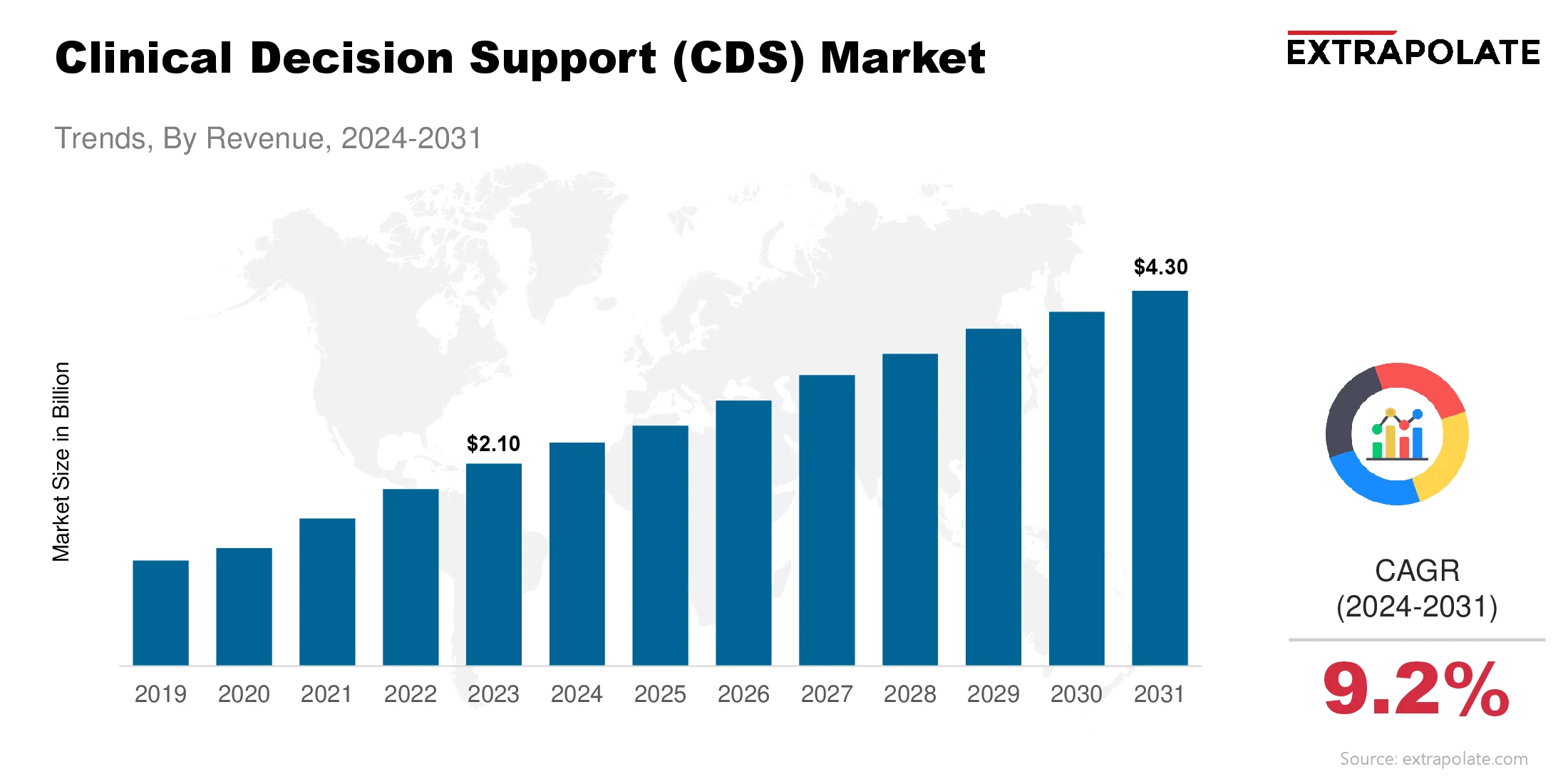
The global Clinical Decision Support (CDS) Market size was valued at USD 2.10 billion in 2023 and is projected to grow from USD 2.3 billion in 2024 to USD 4.30 billion by 2031, exhibiting a CAGR of 9.25% during the forecast period.
The global Clinical Decision Support (CDS) market is growing fast. This rise is due to advances in healthcare technology, the need for better patient outcomes, and the increased use of electronic health records (EHRs). CDS systems help healthcare professionals make informed decisions by offering evidence-based knowledge and patient-specific information. This enhances care quality and reduces errors. These systems can integrate with EHRs, computerized physician order entry (CPOE), and other tech to give real-time insights in clinical workflows.
As the health care sector continues to develop, the need for CDS systems is accelerating. Healthcare organizations, clinics, and hospitals are seeking to streamline processes and enhance safety. The key drivers are to reduce the cost of healthcare, enhance diagnostic precision, and offer tailored treatment. With access to greater medical information, CDS systems enable clinicians to identify significant information and assist in making efficient decisions.
A randomized trial of major size in China, GOLDEN BRIDGE II, demonstrated that the application of clinical decision support system (CDSS) in treatment of acute ischemic stroke significantly improves quality of care and patient outcomes compared to conventional management. These results were presented at the recent 11th European Stroke Organisation Conference in Helsinki, Finland, by the Beijing Tiantan Hospital.
Technological innovations, including machine learning (ML) and artificial intelligence (AI), are accelerating the CDS market even more. Recent developments in large language models (LLMs) facilitate decision-making for clinicians and patients. The LLMs can provide individualized insights into diagnosis, suggest specialists, and assess urgent needs.
They help clinicians optimize diagnoses, with improved patient outcomes and streamlined healthcare delivery. Preventive care and patient-tailored medicine are also key drivers for market expansion, since the CDS systems recognize diseases early on and allow for intervention.
North America leads the CDS market due to high EHR adoption, strong healthcare infrastructure, and government initiatives to enhance outcomes. Meanwhile, Asia-Pacific and Europe are rapidly growing, driven by rising demand for quality healthcare services and chronic disease prevalence. Other regions are also using CDS technology.
For instance, UpToDate is a trusted tool among clinicians in the Middle East, with over 18.6 million topic views in 2021. Clinicians report that it improves the quality of care, helps prevent errors, and saves time. Research from Harvard supports these findings, showing that hospitals using Up-to-date saw better patient outcomes, including shorter hospital stays and reduced mortality rates—saving an estimated 372,000 hospital stays and 11,500 lives per year.
The market is also witnessing cloud-based CDS solutions, providing scalability, flexibility, and cost-efficiency to providers. With increasing demand for digital health solutions, the market for cloud-based CDS is expected to grow exponentially, with new tech advancements driving it, with support from governments and providers focusing on patient-centred care.

Key Market Trends Driving Product Adoption
The CDS market is characterized by rapid innovation, integration with electronic health records (EHR), and rising demand for data-driven healthcare solutions. Key trends driving market growth include:
- AI and Machine Learning: CDS systems increasingly leverage AI and machine learning to provide accurate, real-time decision support, improving diagnostic accuracy and personalized treatment options. Atropos Health, a company translating real-world clinical data into real-world evidence (RWE) for decision-making, is partnering with cures, an artificial intelligence (AI)-powered healthcare data retrieval company, to harness RWE-based insights to support patient care
- Integration with EHR Systems: Seamless integration with existing healthcare infrastructures like EHRs allows for better data sharing, real-time alerts, and efficient decision-making.
- Personalized Medicine: CDS solutions are evolving to support personalized treatment plans based on individual patient data, such as genetic information and medical history.
- Clinical Workflow Optimization: CDS systems are increasingly designed to streamline clinical workflows, reducing administrative burden and improving healthcare provider efficiency.
- Patient Safety Focus: CDS systems are being used to reduce medication errors, improve patient safety, and ensure compliance with clinical guidelines.
Major Players and their Competitive Positioning
The CDS market is dominated by several leading players including Cerner Corporation, Allscripts Healthcare Solutions, IBM Watson Health, and McKesson Corporation. These companies are continuously innovating to stay competitive, focusing on integrating advanced analytics and AI capabilities into their solutions. Additionally, new entrants are emerging, offering specialized CDS tools for specific medical fields.
Becton, Dickinson and Company a leading global medical technology company, has launched a new advanced hemodynamic monitoring platform with predictive, artificial intelligence (AI) based algorithms that can help clinicians proactively address blood pressure instability and optimize blood flow to help avoid potential life-threatening situations during procedures. Its Chemosphere Alta platform advances BD's leadership in smart, connected care technologies that use clinical data and AI to help clinicians improve patient outcomes and optimize clinical workflows.
Consumer Behavior Analysis
Healthcare providers are increasingly adopting CDS systems for several reasons:
- Improved Clinical Outcomes: Enhancing diagnostic accuracy, reducing errors, and recommending the most effective treatments.
- Operational Efficiency: Optimizing workflows, reducing clinician workload, and enhancing overall hospital efficiency.
- Cost Reduction: Minimizing unnecessary tests, procedures, and hospital readmissions through accurate decision support. For example, Multicare Health System, a 13-hospital network used a clinical decision-support system that helps clinical decision-making offering evidence-based options. The system was integrated directly into the electronic health record, appearing as an overlay that physicians could access during their regular clinical work. The new technology achieved a 7.46% total cost-of-care reduction in its first year, translating to an estimated $2.6 million in healthcare waste reduction. Recent data since go-live now suggests an 11% healthcare waste reduction, $81 per-admission waste reduction, and greater than $10 million savings cumulatively
- Regulatory Compliance: Ensuring adherence to clinical guidelines and regulatory standards to improve patient care and avoid legal risks.
Pricing Trends
Pricing trends in the CDS market are influenced by the complexity of the system, the size of the healthcare provider, and the technology involved. Premium pricing is often associated with AI-powered systems, comprehensive integrations with EHRs, and solutions with advanced analytics. However, a growing demand for more affordable and scalable solutions is emerging, especially among smaller healthcare facilities.
Growth Factors
Several factors are driving the growth of the CDS market:
- Technological Advancements: Integration of AI, machine learning, and predictive analytics is enhancing the capabilities of CDS systems.
- Increased Healthcare Digitization: The rising adoption of electronic health records (EHRs) and health information exchanges (HIEs) is enabling the integration of CDS tools. For example, Elsevier, a global leader in health information and data analytics, has announced further enhancements to ClinicalKey AI, the company's leading generative AI-powered clinical decision support solution. The new functionality and integrations with strategic partners aim to transform the way healthcare providers access and utilize actionable insights, enhancing patient care and efficiency directly within the clinician's workflow.
- Aging Population: The growing elderly population and the increasing prevalence of chronic diseases are driving the demand for accurate clinical decision support.
- Regulatory Pressure: Healthcare providers are under increasing pressure to meet regulatory requirements, and CDS systems help ensure compliance with clinical guidelines.
Regulatory Landscape
The regulatory landscape for CDS is evolving, with various countries implementing policies related to data privacy, medical device classification, and clinical decision-making. Companies must navigate these regulations to ensure their solutions are compliant and meet the necessary safety standards.
Recent Developments
The CDS market continues to innovate, with new features and improvements being introduced regularly. Recent developments include:
- AI-Driven Diagnostics: Increasing use of AI to enhance diagnostic capabilities, such as imaging analysis and pathology interpretation.
- Predictive Analytics: New CDS systems are leveraging predictive analytics to forecast patient deterioration and optimize treatment plans.
- Cloud-Based Solutions: The rise of cloud-based CDS platforms is offering scalability and remote access for healthcare providers.
- Integration with IoT: Increasing integration of CDS systems with medical devices and wearable technologies for real-time monitoring.
Current and Potential Growth Implications
- Demand Supply Analysis The demand for CDS solutions is steadily increasing due to advancements in healthcare technology and the rising need for decision support in clinical environments. However, supply chain disruptions and integration challenges may impact the availability of certain systems.
- Gap Analysis While the CDS market has seen significant progress, areas for improvement include:
- Interoperability: Greater standardization and interoperability are needed for seamless data sharing across different healthcare systems.
- Data Privacy and Security: Ensuring the protection of patient data in compliance with regulations like HIPAA remains a challenge.
- User Experience: Making CDS tools more intuitive and user-friendly for healthcare providers to minimize training time and enhance adoption.
- Affordability: There is a growing need for more cost-effective CDS solutions, especially for smaller healthcare organizations.
Top Companies in the Clinical Decision Support (CDS) Market
Some of the top companies in the CDS market include:
- Cerner Corporation
- Allscripts Healthcare Solutions
- IBM Watson Health
- McKesson Corporation
- Epic Systems Corporation
- Siemens Healthiness
- GE Healthcare
- Medtronic
- Meditech
- Athenahealth
Clinical Decision Support (CDS) Market: Report Snapshot
Segmentation | Details |
By Technology | AI/ML-Driven, Rule-Based, Hybrid |
By Application | Treatment Decision Support, Diagnostic Support, Workflow Optimization, Patient Safety, Others |
By End User | Hospitals, Clinics, Healthcare Providers, Pharmaceutical Companies, Others |
By Region | North America, Europe, Asia-Pacific, Latin America, Middle East & Africa |
High Growth Segments
The following market segments are expected to experience significant growth:
- AI/ML-Driven Solutions: Offering advanced predictive capabilities and enhanced decision-making.
- Treatment Decision Support: Facilitating personalized treatment recommendations based on patient data.
- Diagnostic Support: Enhancing diagnostic accuracy and helping clinicians make faster, more informed decisions.
Major Innovations
Innovation is key to staying competitive in the CDS market. Some of the latest innovations include:
- Predictive Analytics: Leveraging data to predict patient outcomes and recommend the best treatment plans.
- Cloud Integration: Enabling easier data sharing and access to decision support tools across healthcare settings.
- Wearable Integration: Incorporating real-time data from medical devices and wearables into decision-making.
Potential Growth Opportunities
Companies in the CDS market face several challenges:
- Data Privacy and Security Concerns: Ensuring that patient data is protected and compliant with healthcare regulations.
- Integration with EHR Systems: Seamlessly integrating CDS tools with existing healthcare infrastructures.
- Training and Adoption: Overcoming resistance to new technology and ensuring proper training for healthcare providers.
- Market Competition: Balancing innovation with affordability while competing with established players and emerging startups.
Extrapolate Research says:
The global CDS market is poised for robust growth, driven by technological advancements, the need for improved patient outcomes, and increasing regulatory pressure. Companies that can innovate and address the challenges surrounding interoperability, data privacy, and user experience will be well-positioned to succeed in this dynamic market.
ARE YOU SEEKING COMPREHENSIVE INSIGHT ON VARIOUS
MARKETS?
CONTACT OUR EXPERTS TODAY
Clinical Decision Support
- May-2025
- 148
- Global
- healthcare-medical-devices-biotechnology
Related Research
2022-2030 Global and Regional B-Cell Non-Hodgkin`s Lymphoma (NHL) Treatment Industry Production, Sa
February-2021
2022-2030 Global and Regional Organ Transplant Diagnostics Industry Production, Sales and Consumpti
February-2021
2022-2030 Global and Regional Prostacyclin Drug Industry Production, Sales and Consumption Status a
February-2021
2022-2030 Global and Regional Spinal and Bulbar Muscular Atrophy Treatment Industry Production, Sal
February-2021
2% Chlorhexidine Gluconate (CHG) Cloths-Global Market Status & Trend Report 2022-2030 Top 20 Countri
April-2021
2021-2027 Global and RegioAnal Nasal Gels Industry Production, Sales and Consumption Status and Pros
February-2021
2021-2027 Global and Regional 2019-nCoV Detection Server Industry Production, Sales and Consumption
February-2021
2021-2027 Global and Regional ? Collagen Quantitative Determination Kit Industry Production, Sales a
February-2021
2021-2027 Global and Regional Anti-TNF Monoclonal Antibody Industry Production, Sales and Consumptio
February-2021