Castration Resistant Prostate Cancer (CRPC) Therapeutics Market Size, Share, Growth & Industry Analysis, By Therapy Type (Hormonal Therapy, Chemotherapy, Immunotherapy, Radiotherapy) By Drug Delivery Method (Oral, Injectable), and Regional Analysis, 2025-2032
Market Definition
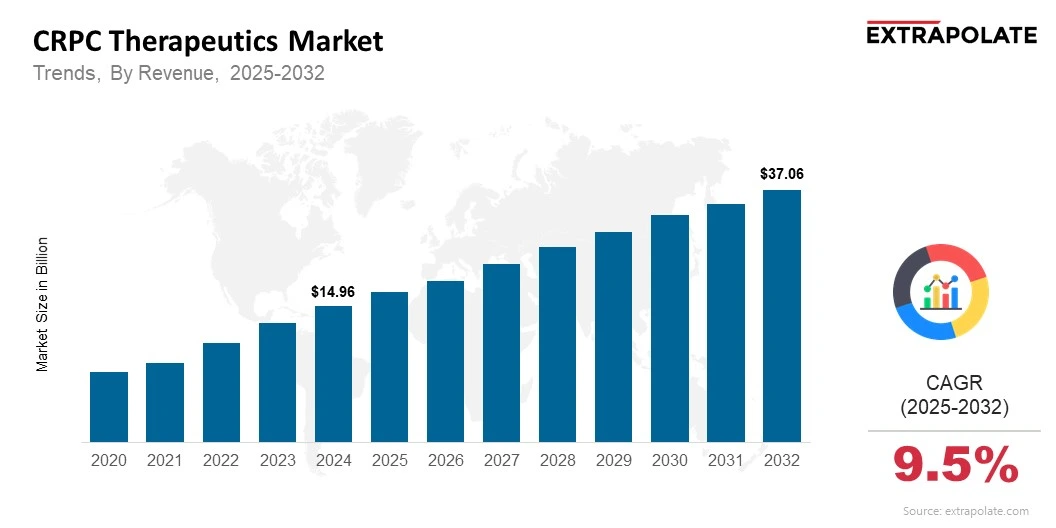
The global Castration resistant prostate cancer (CRPC) Therapeutics Market size was valued at USD 12.84 billion in 2023 and is projected to grow from USD 14.96 billion in 2024 to USD 37.06 billion by 2032, exhibiting a CAGR of 9.5% during the forecast period.
The global castration resistant prostate cancer (CRPC) Therapeutics market includes the development, manufacturing and commercialization of many different treatments for advanced prostate cancer. CRPC is prostate cancer that continues to grow despite androgen deprivation therapy (ADT) which reduces testosterone levels. This market includes hormonal therapies, chemotherapy, immunotherapies and targeted drugs to manage the disease in later stages and improve patient outcomes. The market is seeing continuous innovation and new agents and combinations being introduced to address hormone resistance.

Key Insights
- The global CRPC therapeutics market was valued at $14.96 billion in 2024.
- It will reach $37.06 billion by 2032, growing at a CAGR of around 9.5% from 2025 to 2034.
- North America will be the largest region by 2034, driven by its advanced healthcare infrastructure and investment in cancer research.
- By therapy type, hormonal therapy was the largest segment in 2024 due to its established efficacy.
- By drug delivery method, oral therapy was the largest segment in 2024 due to convenience and high patient compliance.
- Increasing prevalence of advanced prostate cancer and global aging population are key drivers.
- A big trend in the industry is the fast growing adoption of radioligand therapies that target specific cancer cells with precision, a new treatment modality.
Market Summary Financials
The CRPC therapeutics market is growing substantially, with massive growth expected over the next 10 years. The market was around USD 12.84 billion in 2023. It was USD 14.96 billion in 2024 and will be around USD 37.06 billion by 2032. The growth is driven by a 9.5% CAGR from 2025 to 2034, driven by changing treatment paradigms and new product innovation.
Detailed Analysis Content
Key Market Trends
The CRPC therapeutics market is undergoing a big change, driven by several trends. The industry is moving from traditional chemo to more targeted and personalized treatments. Next gen hormonal therapies like androgen receptor (AR) inhibitors are emerging as a key differentiator. Combination therapies that target multiple cancer pathways to overcome resistance and improve outcomes are gaining focus. Radioligand therapies (RLTs) that deliver radiation directly to tumor cells are being developed and used more.
Major Players
The competitive landscape is dominated by a mix of large pharmaceutical companies and innovative biotech firms.
- Johnson & Johnson
- Astellas Pharma Inc.
- Bayer AG
- Pfizer, Inc.
- AstraZeneca
- Novartis
- Merck & Co.
- Sanofi S.A.
- Dendreon Corporation
- AbbVie, Inc.
Consumer Behavior
Patient decisions in the CRPC market are not limited to survival extension. Patients value their quality of life. Key considerations are treatment related side effects like cognitive impairment, fatigue and pain. The emphasis on quality of life is driving demand for therapies that offer better efficacy with a manageable side effect profile.
Pricing Trends
Cost of CRPC treatments is a big factor in the market. Novel therapies, especially targeted drugs and immunotherapies are expensive and can be a financial burden for patients and healthcare systems. The market is also under pressure from the growing impact of biosimilars and generics on established blockbusters which can lead to a decline in pricing for older therapies.
Growth Factors
Several key drivers are propelling the growth of the CRPC therapeutics market. The main driver is the increasing global incidence and prevalence of prostate cancer which leads to more patients progressing to the castration resistant stage. The aging global population is another big driver as prostate cancer incidence increases with age. Also, advancements in diagnostic technologies, increasing awareness of the disease and a robust pipeline of new drugs are driving the market.
Regulatory Landscape
Market access for new treatments is determined by the regulatory environment. The US FDA and European Commission have approved new drugs that have changed the treatment landscape. The FDA approved sipuleucel-T, cabazitaxel and abiraterone acetate for mCRPC. Regulatory bodies are now focusing on the next generation of targeted therapies and combination regimens, as seen in recent IND clearances for AB001, a radioligand therapy.
Recent Developments
- Mergers & Acquisitions: In June 2024, AstraZeneca acquired Fusion Pharmaceuticals to strengthen its oncology portfolio with radio conjugates. In May 2023, Novartis acquired Mariana Oncology to expand its radioligand therapy (RLT) presence.
- Drug Approvals: In August 2023, Johnson & Johnson got FDA approval for AKEEGA, the first dual-action tablet for BRCA-positive mCRPC.
- Research & Clinical Trials: FDA greenlit a phase 1 trial of AB001 radioligand therapy for mCRPC in September 2025. A study in Oncogene identified two proteins, TBX-2 and LSD-1, that may be responsible for drug resistance in prostate cancer, a finding that could lead to new treatment options.
Demand-Supply Analysis
High and growing demand driven by rising CRPC cases. Dynamic supply with new drugs entering the market to meet demand. However, high cost of developing these advanced therapies and complex regulatory process creates a bottleneck in the supply chain. The balance is shifting towards more innovative, targeted therapies which are in high demand by patients and clinicians.
Gap Analysis
Despite the progress, there are still unmet needs in the CRPC therapeutics market. One big gap is the development of therapies that can overcome drug resistance which is a common challenge in treating CRPC. There is also a need for treatments that can delay or prevent progression to metastatic state and improve overall quality of life for patients. Patient preference is for therapies with fewer and less severe side effects, especially cognitive impairment. The market needs more R&D focused on creating effective and tolerable long term treatment options.
Market Segmentation
Segmentation Category | Details |
By Therapy Type | Hormonal Therapy, Chemotherapy, Immunotherapy, Radiotherapy |
By Drug Delivery Method | Oral, Injectable |
By Region | North America, Europe, Asia Pacific, Latin America, Middle East & Africa |
High-Growth Segments
The highest growth potential is seen in segments that offer more precise and personalized treatment options. Radioligand therapy, a sub-segment of radiotherapy, is a high-growth area due to its targeted approach and promising clinical results. The hormonal therapy segment, specifically next-generation AR inhibitors, is also poised for continued growth as these therapies become a standard of care.
Major Innovations
Biggest innovations are around more targeted and less toxic treatment modalities.
- Radioligand Therapies (RLTs): These are the biggest innovation, using radioactive isotopes to deliver targeted radiation to cancer cells that express prostate-specific membrane antigen (PSMA).
- PARP Inhibitors: These targeted therapies, like Lynparza (olaparib), are working in patients with specific genetic mutations, like BRCA.
- Combination Therapies: Combining different classes of drugs, like PARP inhibitors with radioligands, is the key to improving efficacy and overcoming resistance.
Growth Opportunities
- Precision and Personalized Medicine: Integrating genomic profiling to tailor treatment to individual tumor characteristics is a big growth opportunity.
- Emerging Markets: As healthcare infrastructure improves in regions like Asia-Pacific, there is a huge market for CRPC therapeutics.
- Biomarker-Guided Therapies: Developing new drugs that target specific biomarkers will lead to better treatments and better patient outcomes.
Extrapolate Says
The demand for novel treatments for a disease that is becoming more prevalent and aggressive is driving the CRPC market's rapid and noticeable growth. According to our analysis, the market's future lies in the rapidly expanding fields of targeted drugs and radioligand therapies, even though standard hormonal therapies serve as the market's base. The business is at a turning point, as a new generation of individualized, less harmful medicines is required to overcome resistance and enhance quality of life. Industry leaders will be those businesses that can innovate in this field and create treatments that not only prolong life but also reduce negative effects.
The market has a significant opportunity to fulfill the unmet needs and alter the worldwide standard of care for patients with CRPC as a result of the shift to precision medicine and combination medications.
ARE YOU SEEKING COMPREHENSIVE INSIGHT ON VARIOUS
MARKETS?
CONTACT OUR EXPERTS TODAY
Castration Resistant Prostate Cancer
- September-2025
- 148
- Global
- healthcare-medical-devices-biotechnology
Related Research
2022-2030 Global and Regional B-Cell Non-Hodgkin`s Lymphoma (NHL) Treatment Industry Production, Sa
February-2021
2022-2030 Global and Regional Organ Transplant Diagnostics Industry Production, Sales and Consumpti
February-2021
2022-2030 Global and Regional Prostacyclin Drug Industry Production, Sales and Consumption Status a
February-2021
2022-2030 Global and Regional Spinal and Bulbar Muscular Atrophy Treatment Industry Production, Sal
February-2021
2% Chlorhexidine Gluconate (CHG) Cloths-Global Market Status & Trend Report 2022-2030 Top 20 Countri
April-2021
2021-2027 Global and RegioAnal Nasal Gels Industry Production, Sales and Consumption Status and Pros
February-2021
2021-2027 Global and Regional 2019-nCoV Detection Server Industry Production, Sales and Consumption
February-2021
2021-2027 Global and Regional ? Collagen Quantitative Determination Kit Industry Production, Sales a
February-2021
2021-2027 Global and Regional Anti-TNF Monoclonal Antibody Industry Production, Sales and Consumptio
February-2021