Ayurvedic Market Size, Share, Growth & Industry Analysis, By Product Type (Personal Care Products, Health Supplements, Medicinal Products, Others), By Application (Beauty and Skin Care, Hair Care, Weight Management, Digestive Health, Pain Relief, Others), By Distribution Channel (Online Retail, Supermarkets, Pharmacies, Specialty Stores, Others), and Regional Analysis, 2024-2031
Ayurvedic Market: Global Share and Growth Trajectory
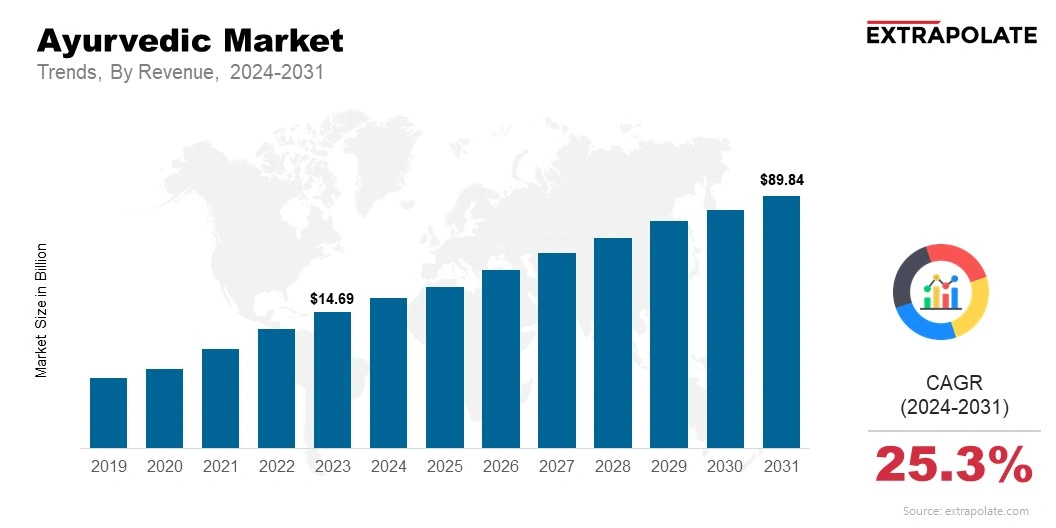
The global Ayurvedic Market size was valued at USD 14.69 billion in 2023 and is projected to grow from USD 18.55 billion in 2024 to USD 89.84 billion by 2031, exhibiting a CAGR of 25.3% during the forecast period.
The global Ayurvedic market is experiencing remarkable growth, driven by increasing consumer interest in natural and holistic health solutions, growing awareness of wellness, and the rising adoption of traditional remedies. Ayurveda, one of the world’s oldest systems of medicine, continues to gain traction due to its emphasis on balancing the mind, body, and spirit through natural ingredients. This market includes a wide range of products such as herbal medicines, dietary supplements, personal care products, and skincare, all formulated using plant-based ingredients and traditional techniques.
As consumers increasingly seek alternatives to conventional pharmaceuticals and synthetic products, the demand for Ayurvedic remedies is witnessing a sharp rise. The growing trend of preventive healthcare, combined with an increase in lifestyle-related diseases such as stress, obesity, and diabetes, has propelled the global market. Consumers are becoming more health-conscious, favoring natural ingredients that are perceived to have fewer side effects. Moreover, the expansion of Ayurveda’s reach, especially in the beauty and skincare industry, is contributing to its growing market share as Ayurvedic formulations are considered more beneficial and gentler for the skin.
The market is also benefiting from technological advancements, such as the digitalization of Ayurvedic consultations and the rise of e-commerce platforms selling Ayurvedic products globally. Additionally, innovations in product formulations and research into the efficacy of Ayurvedic treatments are improving the quality and availability of these products. Increasing governmental and regulatory support for natural health products, along with growing recognition of Ayurveda as an effective and sustainable form of healthcare, further fuel the market’s growth.
Asia-Pacific leads the Ayurveda market. India and China are key regions. Ayurvedic practices have deep roots there. The market grows quickly in North America and Europe. Rising consumer awareness and demand for organic products drive this. Holistic health practices are also gaining acceptance. Ayurveda's popularity grows, and the market expands globally. Its future looks promising. Continuous innovation and a shift to a holistic health approach drive this.
Key Market Trends Driving Product Adoption
Several key trends are shaping the Ayurvedic market, including:
• Rising Health Consciousness: Consumers seek natural, chemical-free alternatives. This drives the adoption of Ayurvedic products.
• Integration with Modern Medicine: Ayurveda integrates with modern healthcare systems. Many people seek complementary treatments for natural healing.
• Demand for Organic and Plant-Based Products: The preference for organic, plant-based, and vegan products rises. This boosts demand for Ayurvedic health supplements, skincare, and hair care.
• Digital Transformation in Distribution: The shift to online shopping grows. E-commerce platforms help Ayurvedic manufacturers reach a global audience.
Major Players and their Competitive Positioning
The Ayurvedic market is fragmented, with many small and large players meeting the demand for natural and organic products. Key players include Dabur India Ltd., Himalaya Drug Company, Patanjali Ayurved, Baidyanath, and Zandu. These companies are expanding product portfolios, improving quality, and entering new markets through partnerships, acquisitions, and collaborations. To stay competitive, many leverage modern technology for product development and align with consumer preferences for organic, eco-friendly solutions.
Consumer Behavior Analysis
Consumer demand for Ayurvedic products is driven by several factors, including:
• Natural and Chemical-Free Solutions: Consumers worry about synthetic chemicals in pharmaceuticals and cosmetics. They are turning to Ayurvedic products for their natural, non-toxic properties.
• Holistic Wellness Approach: Many consumers are attracted to Ayurveda. They see it as a holistic approach to both physical and mental health.
• Awareness and Education: More information on Ayurveda’s health benefits is available. Endorsements from wellness influencers drive awareness and adoption of Ayurvedic products.
Pricing Trends
Pricing in the Ayurvedic market varies. It depends on ingredient quality, packaging, and brand positioning. Traditional Ayurvedic products are priced competitively. Premium products with organic, rare, or ethically sourced ingredients cost more. Ayurvedic products are marketed as luxury wellness items. This is common in personal care. It allows companies to charge a premium for high-end products.
Growth Factors
The growth of the Ayurvedic market is driven by several factors, including:
• Increasing Health Consciousness: Ayurveda gains global popularity. It is viewed as complementary and alternative medicine.
• Global Acceptance of Ayurveda: Ayurveda gains popularity worldwide. It is seen as complementary and alternative medicine.
• Rising Demand for Personal Care Products: Ayurvedic skincare, hair care, and wellness products rise in adoption. Demand for sustainable, natural beauty solutions grows.
• Government Support for Traditional Medicine: Many governments promote Ayurveda. India leads the way. They offer incentives for development. This fuels market growth.
Regulatory Landscape
The regulatory landscape for Ayurveda is evolving. It aims to ensure product quality, safety, and efficacy. In India, the Ministry of AYUSH regulates Ayurvedic products. It ensures they meet high standards of safety and effectiveness. Many countries have implemented regulations to ensure the authenticity and quality of Ayurvedic products. There's a growing focus on organic certifications and ethically sourced ingredients.
Recent Developments
Recent developments in the Ayurvedic market include:
• Product Innovation: Companies innovate product lines. They combine Ayurvedic formulas with modern science. This improves efficacy. It appeals to a wider consumer base.
• Expansion into New Markets: Ayurvedic companies expand internationally. They focus on North America, Europe, and Asia-Pacific. Consumer demand for natural wellness products grows.
Current and Potential Growth Implications
Demand-Supply Analysis
The demand for Ayurvedic products is rising globally. This is especially true in countries like India, the U.S., and Europe, where consumers seek alternative health solutions. The supply of high-quality Ayurvedic ingredients can be limited. This is especially true for rare herbs and plants. It can impact production capacity and pricing of certain products.
Gap Analysis
While the Ayurvedic market is growing, there are gaps that need to be addressed:
• Standardization and Quality Control: Standardized practices are needed. Stringent quality control measures will ensure the safety and efficacy of Ayurvedic products worldwide.
• Research and Clinical Trials: More clinical trials and scientific studies are needed. These will substantiate the health benefits of Ayurvedic products. This will help build consumer confidence and gain regulatory approval in new markets.
• Lack of Awareness in Certain Markets: Ayurveda is well-established in India and Asia. Western markets need more awareness and education about Ayurvedic products.
Top Companies in the Ayurvedic Market
• Dabur India Ltd.
• Himalaya Drug Company
• Patanjali Ayurved
• Baidyanath
• Zandu
• The Ayurvedic Pharmacy
• Kerala Ayurveda
• Charak Pharma
• Organic India
• Pura Ayurveda
Report Snapshot
Segmentation | Details |
By Product Type | Personal Care Products, Health Supplements, Medicinal Products, Others |
By Application | Beauty and Skin Care, Hair Care, Weight Management, Digestive Health, Pain Relief, Others |
By Distribution Channel | Online Retail, Supermarkets, Pharmacies, Specialty Stores, Others |
By Region | North America, Europe, Asia-Pacific, Latin America, Middle East & Africa |
High Growth Segments
The following segments are expected to drive significant growth:
• Health Supplements: The demand for Ayurvedic health supplements-all-Natural- the areas of immunity, digestion, and stress management- was rising rapidly.
• Personal Care Products: Ayurvedic merchandise promises to dominate natural healthcare as people opt for herbal beauty therapies with the objective of avoiding chemical cosmetics.
• Medicinal Products: The surge in the appeal of Ayurveda-based medicine is becoming apparent, especially for a consumer group that perceives the power of these alternative natural remedies to cure a host of common ailments.
Major Innovations
The Ayurvedic market is witnessing a surge in innovation, with key developments in:
• Product Formulation: Businesses concentrate on improving product formulas. This is achieved through a combination of established Ayurvedic components plus current technology.
• Sustainability Practices: Investment in sustainable sourcing and eco-friendly packaging is growing. This targets environmentally conscious consumers.
• Digital Wellness Platforms: Ayurvedic wellness apps and platforms offer personalized recommendations. They also provide easy access to Ayurvedic products.
Potential Growth Opportunities
The Ayurvedic market offers several growth opportunities:
• Global Expansion: Natural and organic products are gaining acceptance in Western markets. This creates a big chance for Ayurvedic companies to grow globally.
• Targeting Niche Segments: Ayurvedic solutions developed for particular health issues like stress management, beauty treatments along with weight reduction can cause the market to grow more.
• Sustainability Focus: Consumers now prefer eco-friendly products. Ayurvedic companies can tap this trend with sustainable ingredients and packaging
Extrapolate Research says:
The market will grow because buyers want natural, plant-based health items. Businesses that prioritize improvement, item quality along with growth in global areas will likely gain the most from chances in this quickly growing area.
ARE YOU SEEKING COMPREHENSIVE INSIGHT ON VARIOUS
MARKETS?
CONTACT OUR EXPERTS TODAY
Ayurvedic Market Size
- April-2025
- 148
- Global
- healthcare-medical-devices-biotechnology
Related Research
2022-2030 Global and Regional B-Cell Non-Hodgkin`s Lymphoma (NHL) Treatment Industry Production, Sa
February-2021
2022-2030 Global and Regional Organ Transplant Diagnostics Industry Production, Sales and Consumpti
February-2021
2022-2030 Global and Regional Prostacyclin Drug Industry Production, Sales and Consumption Status a
February-2021
2022-2030 Global and Regional Spinal and Bulbar Muscular Atrophy Treatment Industry Production, Sal
February-2021
2% Chlorhexidine Gluconate (CHG) Cloths-Global Market Status & Trend Report 2022-2030 Top 20 Countri
April-2021
2021-2027 Global and RegioAnal Nasal Gels Industry Production, Sales and Consumption Status and Pros
February-2021
2021-2027 Global and Regional 2019-nCoV Detection Server Industry Production, Sales and Consumption
February-2021
2021-2027 Global and Regional ? Collagen Quantitative Determination Kit Industry Production, Sales a
February-2021
2021-2027 Global and Regional Anti-TNF Monoclonal Antibody Industry Production, Sales and Consumptio
February-2021