Extrapolate Extrapolate
  • 888-328-2189
  • ABOUT US
  • CONTACT US
  • SIGN IN
  • INDUSTRIES
  • BLOGS
  • Home
  • Energy and Power
  • White coal market

White Coal Market Size, Share, Growth & Industry Analysis, By Product Type (Biomass Briquettes, Agro Waste Briquettes, Wood-based White Coal, Others) By Application (Industrial Boilers, Power Plants, Commercial Heating, Residential Heating) By End-User (Manufacturing, Agriculture, Energy Utilities, Residential, Commercial), and Regional Analysis, 2024-2031

  • Description
  • Table Of Content
  • Sample Request

White Coal Market: Global Share and Growth Trajectory

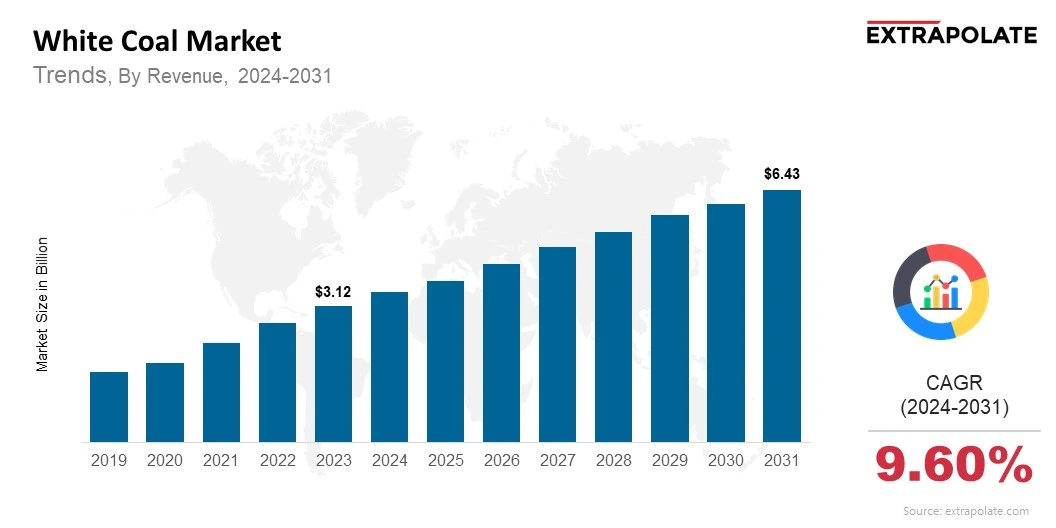
The global White Coal Market size was valued at USD 3.12 billion in 2023 and is projected to grow from USD 3.38 billion in 2024 to USD 6.43 billion by 2031, exhibiting a CAGR of 9.60% during the forecast period.

The global white coal market is charting a promising path, driven by growing environmental awareness and the global push toward renewable energy. White coal, a clean-burning biofuel derived from agricultural and forestry waste such as husks, sawdust, and groundnut shells, is gaining popularity as an eco-friendly alternative to traditional fossil fuels. Its production not only utilizes biomass waste but also contributes to reducing carbon emissions and environmental degradation.

As a result, industries are increasingly adopting white coal to meet sustainability goals and comply with stringent emission norms. Key sectors including cement, brick kilns, textile manufacturing, and thermal power generation are steadily shifting toward white coal due to its high energy efficiency, low ash content, and ability to be used in conventional fuel systems without extensive modifications.

Moreover, its affordability and easy availability in agrarian economies make it a viable energy solution, especially for small and medium-sized enterprises. The market's upward growth is further supported by favorable government policies, incentives for biomass-based energy projects, and investments in renewable energy infrastructure. Countries like India, Brazil, and several Southeast Asian nations are emerging as major producers and consumers of white coal, fueled by robust agricultural output and increasing rural participation in clean energy initiatives.

In addition, rising concerns over air pollution and energy security are prompting governments and industries to diversify their fuel sources. This shift is enhancing the appeal of white coal as a reliable and sustainable alternative. With technological advancements in briquetting and biomass conversion, the global white coal market is expected to witness steady growth and innovation, making it a significant contributor to the global transition toward green energy.

Size, Share & Forecast 2031Key Market Trends Driving Product Adoption

Several pivotal trends are fueling the global adoption of white coal across various industrial domains:

  • Renewable Energy Push and Sustainability Goals: The white coal market is gaining traction in response to the growing global emphasis on decarbonization and clean energy. Countries are accelerating their transition to renewable sources to meet international climate targets such as the Paris Agreement and the UN Sustainable Development Goals (SDGs). White coal, being a carbon-neutral fuel derived from biomass waste, aligns well with these objectives. Its ability to reduce dependency on fossil fuels makes it an integral part of the green energy mix.
  • Abundance of Agricultural Waste and Biomass Resources: In agricultural economies, massive volumes of residues such as groundnut shells, sawdust, bagasse, rice husks, cotton stalks, and wheat husks go unused. These by-products serve as the primary raw materials for producing white coal. With improved technologies for biomass collection and briquetting, these wastes are being repurposed into high-efficiency biofuels, creating value for rural communities and enhancing energy security.
  • Rise in Industrial Fuel Demand: Industrial fuel users are facing mounting pressure to reduce carbon footprints while maintaining efficient operations. White coal serves as an attractive alternative to coal due to its similar combustion characteristics but lower emissions profile. As industries move toward eco-compliance and energy diversification, the demand for white coal is surging, particularly in the cement, chemical, and paper sectors.
  • Government Incentives and Policies: Supportive regulations and incentives are also driving market growth. Many governments provide subsidies, tax benefits, and carbon credits to manufacturers and users of biomass fuels. For instance, in India, the Ministry of New and Renewable Energy (MNRE) actively promotes biomass-based energy solutions. These policy frameworks are strengthening the supply chain and making white coal production economically viable.

Major Players and Their Competitive Positioning

The white coal market has both established and new players. They work on green fuels and better briquetting methods. Prominent companies in the space include- Ronak Agrotech Engineering, Ecostan India Pvt. Ltd., JK Bioenergy, Lehra Fuel Tech Pvt Ltd., Jay Khodiyar Machine Tools, Radhe Engineering Co., Rico Biotech, Biomass Briquette Systems LLC, Global Agrotech Engineering, Real Tech Engineering, RUF Maschinenbau GmbH & Co. KG, WEIMA Maschinenbau GmbH, C.F. Nielsen A/S, GEMCO Energy Machinery Co., Ltd., BP Recyclingsystems GmbH

These companies are actively innovating in briquetting machinery, expanding production capacities, and partnering with regional distributors to improve market reach. Some also integrate backward into biomass collection and forward into direct supply to industrial consumers.

Consumer Behavior Analysis

Consumer behavior in the white coal market is influenced by a combination of economic, environmental, and regulatory factors:

  • Preference for Green Energy Solutions: Consumers, particularly industrial users, are becoming more environmentally conscious. They are increasingly inclined to use cleaner fuel sources to meet internal sustainability goals and regulatory standards. White coal combines eco benefits and cost savings, making it ideal for fuel-heavy operations.
  • Awareness and Education: Rising awareness of fossil fuel impacts is driving interest in renewables. Government and NGO efforts are also educating rural and industrial users on white coal benefits.
  • Operational Compatibility: One of the key factors behind the adoption of white coal is its compatibility with existing coal-fired boilers and furnaces. This ease of integration without major modifications significantly enhances its appeal among manufacturers and large-scale users.
  • Cost Dynamics: White coal’s cost edge over diesel, lignite, and furnace oil drives adoption. Despite biomass supply shifts, cleaner combustion and lower carbon costs offer long-term savings.

Pricing Trends

The pricing of white coal varies based on factors such as raw material availability, production region, calorific value, and transportation logistics. Typically, white coal is priced between $80 to $150 per metric ton. Seasonal fluctuations in agricultural residue output can influence supply levels and pricing. However, advances in briquetting technology and the development of regional production hubs are helping stabilize costs.

Moreover, as carbon pricing mechanisms become more prevalent globally, the cost advantage of white coal is likely to grow. Companies that utilize renewable fuels may benefit from carbon credit trading, further enhancing the financial feasibility of switching to white coal.

Growth Factors

Multiple factors contribute to the expanding scope of the white coal market:

  • Environmental Concerns: Rising concerns over deforestation, pollution, and emissions are boosting interest in sustainable energy. White coal’s clean combustion profile makes it a strong alternative across sectors.
  • Technological Advancements: Advances in briquetting tech have made white coal production more efficient and scalable. New systems like moisture-free drying and multi-residue machines boost quality and versatility.
  • Energy Security: White coal production enables energy self-reliance, particularly in agricultural regions. By turning locally available biomass into fuel, communities can reduce dependence on imported fossil fuels and enhance rural energy access.
  • Industrial Shift Toward Decarbonization: Industries are facing growing expectations to decarbonize their operations. White coal presents a relatively simple and cost-effective decarbonization pathway compared to alternatives like solar or hydrogen, which often require significant capital investments.

Regulatory Landscape

Regulations are playing a central role in shaping the white coal market:

  • Subsidies and Support Programs: Countries like India, Brazil, and parts of Southeast Asia provide financial incentives for biomass-based energy projects.
  • Emissions Norms: Tightening emissions regulations in industrial sectors compel businesses to explore low-carbon fuels like white coal.
  • Carbon Trading and Offsetting: With the expansion of global carbon markets, using renewable fuels such as white coal helps companies earn carbon credits or reduce penalties.
  • Renewable Energy Mandates: National and regional governments are mandating certain percentages of renewable energy usage in industrial applications, encouraging the adoption of biofuels.

Recent Developments

  • Introduction of Multi-Residue Briquetting Machines: New equipment enables manufacturers to process a broader range of biomass inputs, enhancing flexibility and supply chain resilience.
  • Export Growth: White coal demand is rising in Europe and East Asia. Stricter emissions norms in these regions are driving biomass fuel imports.
  • Waste-to-Energy Initiatives: Urban and rural municipalities are partnering with white coal producers. These collaborations convert agro-waste to biofuel, cut landfill use, and boost energy access.
  • Increased R&D Funding: Increased R&D funding is improving white coal’s calorific efficiency and combustion. Governments and private players are driving this push.

Current and Potential Growth Implications

Demand-Supply Analysis

The demand for white coal is steadily outpacing supply in many regions, particularly where biomass feedstock is abundant. However, challenges such as collection inefficiencies, lack of organized supply chains, and seasonal raw material availability affect the consistency of production. Investment in storage and transportation infrastructure is critical to meet growing demand.

Gap Analysis

Despite the promising outlook, the white coal market faces barriers, especially in developing countries. Limited access to high-efficiency briquetting technology, lack of financing for small producers, and insufficient awareness among industrial consumers are key gaps. Bridging these will require policy interventions and public-private partnerships.

Top Companies in the White Coal Market

  • Ronak Agrotech Engineering
  • Ecostan India Pvt. Ltd.
  • JK Bioenergy
  • Jay Khodiyar Machine Tools
  • Lehra Fuel Tech Pvt. Ltd.
  • Radhe Engineering Co.
  • Rico Biotech
  • Biomass Briquette Systems LLC
  • Global Agrotech Engineering
  • Real Tech Engineering

These companies lead the market with strong technological capabilities, supply chain expertise, and product customization for industry-specific needs.

White Coal Market: Report Snapshot

Segmentation

Details

By Product Type

Biomass Briquettes, Agro Waste Briquettes, Wood-based White Coal, Others

By Application

Industrial Boilers, Power Plants, Commercial Heating, Residential Heating

By End-User

Manufacturing, Agriculture, Energy Utilities, Residential, Commercial

By Region

North America, Europe, Asia-Pacific, Latin America, Middle East & Africa

White Coal Market: High-Growth Segments

  • Biomass Briquettes: The segment is witnessing strong growth due to easy raw material availability and government incentives.
  • Industrial Boilers: Heavy demand from manufacturing industries for cleaner combustion options is propelling this segment.
  • Asia-Pacific Region: Countries like India, China, and Indonesia are leading in white coal adoption due to vast agricultural economies and supportive policy frameworks.

Major Innovations

  • Automated Briquetting Plants: These reduce labor costs, improve throughput, and enhance product uniformity.
  • AI-Enabled Process Monitoring: Some advanced white coal facilities are adopting AI for real-time monitoring of moisture, density, and calorific value.
  • Hybrid Fuel Systems: Innovations allowing dual use of white coal with other fuels to balance cost and performance are gaining ground.

White Coal Market: Potential Growth Opportunities

  • Expansion into Emerging Economies: As infrastructure and awareness improve, Sub-Saharan Africa and parts of Latin America present untapped markets.
  • Integration with Carbon Offset Programs: White coal can be positioned as a carbon-neutral fuel for carbon-conscious industries and ESG-driven investments.
  • Collaborations with Municipal Waste Programs: Partnering with urban governments to manage organic waste and convert it into white coal is a scalable opportunity.

Kings Research Says:

The white coal market is poised for steady expansion over the forecast period. With escalating environmental concerns, rising fossil fuel prices, and increasing focus on sustainable development, white coal offers a viable bioenergy alternative. Supported by technological innovation, favorable policies, and growing industrial demand, the market is set to thrive. As infrastructure and supply chains mature, white coal could become a cornerstone of clean energy strategies globally.

FAQ

The global market is projected to reach USD 6.43 billion by 2031, growing at a CAGR of 9.60% from 2024 to 2031.
The global market was valued at USD 3.38 billion in 2024.
Key players in the market are Ronak Agrotech Engineering, Ecostan India Pvt. Ltd., JK Bioenergy, Lehra Fuel Tech Pvt Ltd., Jay Khodiyar Machine Tools, Radhe Engineering Co., Rico Biotech, Biomass Briquette Systems LLC, Global Agrotech Engineering, Real Tech Engineering, RUF Maschinenbau GmbH & Co. KG, WEIMA Maschinenbau GmbH, C.F. Nielsen A/S, GEMCO Energy Machinery Co., Ltd., BP Recyclingsystems GmbH
Key factors that are driving the White Coal Market growth include Environmental Concerns Rising concerns over deforestation, pollution, and emissions are boosting interest in sustainable energy. White coal’s clean combustion profile makes it a strong alternative across sectors.

ARE YOU SEEKING COMPREHENSIVE INSIGHT ON VARIOUS MARKETS?
CONTACT OUR EXPERTS TODAY

Speak to an Expert
White coal market

White Coal Market Size

  • June-2025
  • 148
  • Global
  • energy-and-power
3499

SELECT AN OPTION

  • 1 User Access
  • PDF Report View
  • Non-Printable
  • 32 Man-hours Analyst Support
  • Post-Sale Support 48 Hours
  • Access upto 5 users
  • PDF Report View
  • Print Available
  • Access to Data Sheet
  • Up to 10% Customization
  • 40 Man-hours Analyst Support
  • Post-Sale Support 72 Hours
  • Annual Update
  • Unlimited User Access
  • Downloadable PDF Report. Data Sheet, Power Point Presentation
  • Print Available
  • Up to 20% Customization
  • 72 Man-hours Analyst Support
  • Post-Sale Support 120 Hours
  • Bi-Annual Update

ENQUIRE NOW REQUEST SAMPLE
Dale Byrne

HAVE A QUESTION?
Samuel will help you find what you are looking for.


Call: 888-328-2189


Related Research

Organic Rankine Cycle Market Size, Share, Growth & Industry Analysis, By Application (Solar Thermal

February-2023


Air Electrode Battery Market Size, Share, Growth & Industry Analysis, By Product (Zinc-Air Batteries

September-2024


Battery Recycling Market Size, Share, Growth & Industry Analysis, By Battery Chemistry (Lead-Acid, L

August-2025


Biodiesel Market By Feedstock (Soybean, Rapeseed, Palm, Palm, Poultry, Tallow, White Grease, and Oth

January-2023


Biomass Boiler Market Size, Share, Growth & Industry Analysis, By Product Type (Fully Automated Boil

August-2025


Biomass Power Generation Market Size, Share, Growth & Industry Analysis, By Feedstock (Woody Biomass

August-2025


Biomethane Market by Application (Automotive, Power Generation, and Others), Production Method (Ferm

February-2023


Cable Entry Systems and Components Market Size, Share, Growth & Industry Analysis, By Product Type (

February-2025


Carbon Capture and Storage Market Size, Share, and COVID-19 Impact Analysis, By Capture Source (Chem

August-2025


Diesel Market Size, Share, Growth & Industry Analysis, By Application (Transportation (On-road, Off-

April-2025


Sample Request

White Coal Market Size, Share, Growth & Industry Analysis, By Product Type (Biomass Briquettes, Agro Waste Briquettes, Wood-based White Coal, Others) By Application (Industrial Boilers, Power Plants, Commercial Heating, Residential Heating) By End-User (Manufacturing, Agriculture, Energy Utilities, Residential, Commercial), and Regional Analysis, 2024-2031

Publisher: Kings Research   |   Date: 2025-06-12   |   No. Of Pages: 148

Send Your Query

White Coal Market Size, Share, Growth & Industry Analysis, By Product Type (Biomass Briquettes, Agro Waste Briquettes, Wood-based White Coal, Others) By Application (Industrial Boilers, Power Plants, Commercial Heating, Residential Heating) By End-User (Manufacturing, Agriculture, Energy Utilities, Residential, Commercial), and Regional Analysis, 2024-2031

Publisher: Kings Research   |   Date: 2025-06-12   |   No. Of Pages: 148
Extrapolate

Extrapolate has a refined network of top publishers across the globe covering markets and micro markets who bring in the power of decision making. Our network of publishers is ranked based on the quality of reports produced along with customer feedback Indexing.

 talk@extrapolate.com

888-328-2189


Connect With Us

twitter logo

Industry

Quick Links

  • About Us
  • Contact Us
  • FAQ
  • Privacy Policy
  • Disclaimer
  • Refund Policy
  • Sitemap


Payment Gateway
Sign up for newsletter and updates


Powered By

Kings Research
© 2025 Kingsresearch. All Rights Reserved.