Proton Exchange Membrane Fuel Cells Market Size, Share, Growth & Industry Analysis, By Type (Stationary, Transport, Portable), By Component (Membrane Electrode Assembly (MEA), Catalyst, Gas Diffusion Layer, Bipolar Plates), By Application (Automotive, Power Generation, Telecommunication, Material Handling), and Regional Analysis, 2024-2031
Proton Exchange Membrane Fuel Cells Market: Global Share and Growth Trajectory
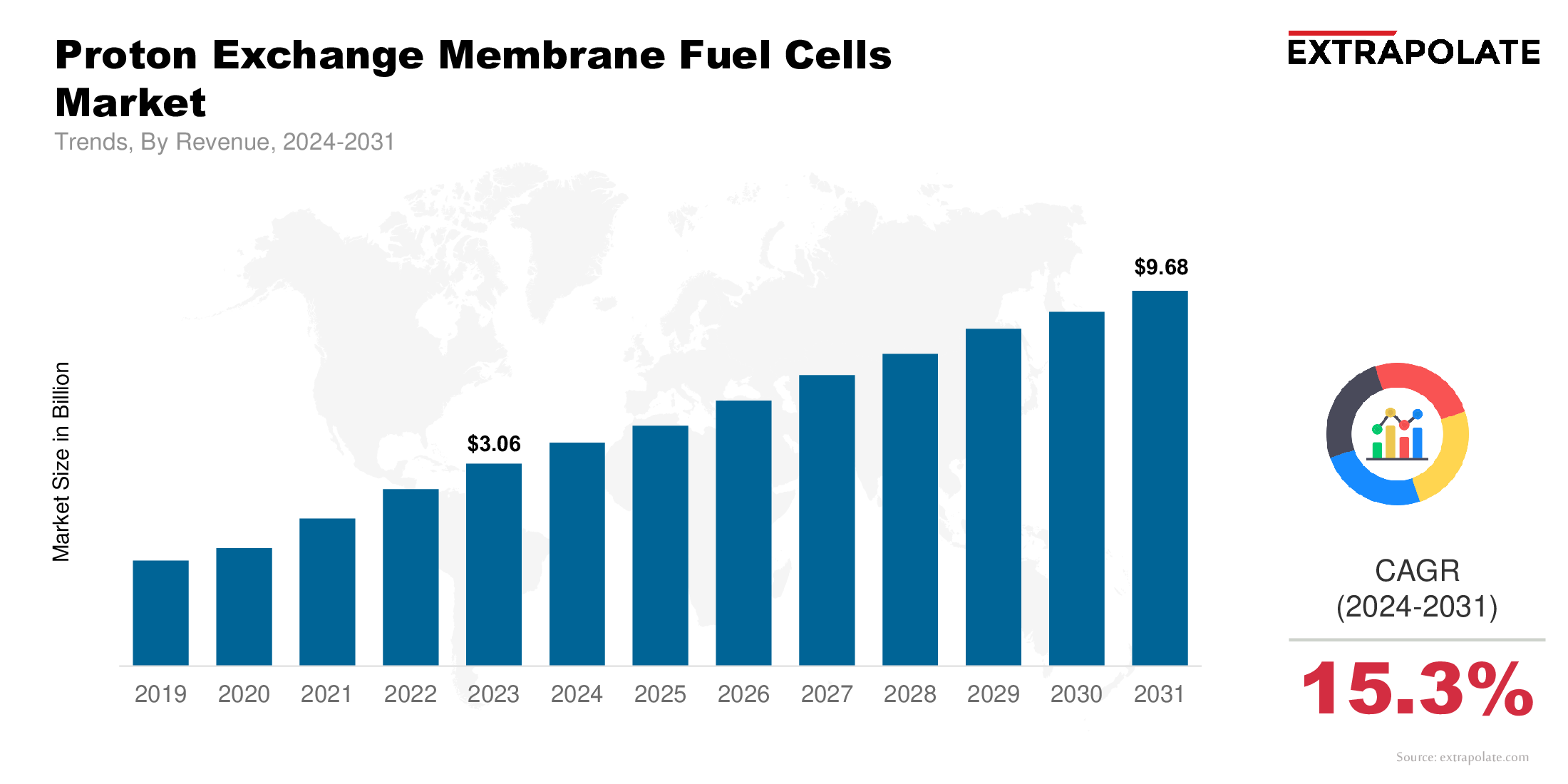
The global Proton Exchange Membrane Fuel Cells Market size was valued at USD 3.06 billion in 2023 and is projected to grow from USD 3.56 billion in 2024 to USD 9.68 billion by 2031, exhibiting a CAGR of 15.3 % during the forecast period.
The global market is on fire and it’s all about the need for clean and efficient energy. Proton Exchange Membrane Fuel Cellss are being adopted in transportation, stationary power and portable power applications due to high power density, low operating temperature and zero emission profile. These fuel cells use a proton conducting polymer membrane and hydrogen fuel to generate electricity and emit only water and heat as byproducts making them one of the cleanest power source available.
This growth is largely driven by environmental regulations, increasing energy demand and government initiatives on green hydrogen and decarbonization. Technological improvements in membrane durability, catalyst efficiency and fuel cell stack design have also made Proton Exchange Membrane Fuel Cellss commercially viable. As the world goes green, Proton Exchange Membrane Fuel Cells will be the backbone of the hydrogen economy.
One of the biggest impact of Proton Exchange Membrane Fuel Cells is in the transportation sector. These fuel cells are changing mobility by enabling zero emission vehicles that can refuel faster and go longer than battery electric alternatives. Automotive giants and startups are adopting Proton Exchange Membrane Fuel Cells, especially in heavy duty and commercial vehicles. Meanwhile, stationary Proton Exchange Membrane Fuel Cells systems are gaining traction for backup power, distributed generation and microgrids – driving growth across multiple segments.

Key Market Trends Driving Product Adoption
Several pivotal trends are shaping the adoption and commercialization of Proton Exchange Membrane Fuel Cells technology:
- Zero-Emission Transportation
Transportation is changing, and emissions need to be reduced. Governments and industries are investing in hydrogen fuel cell vehicles (FCVs) as an alternative to internal combustion engines. Proton Exchange Membrane Fuel Cellss with fast refueling and long range are perfect for heavy duty trucks, buses, trains and marine vessels. This is driving large scale Proton Exchange Membrane Fuel Cells deployment in fleet and public transit.
- Fuel Cell Technological Advancements
Catalysts, bipolar plates and membrane electrode assemblies are innovating fast. Nanomaterials and non-platinum group metals (PGMs) are reducing dependence on expensive catalysts, while polymer electrolyte membranes are improving durability under high humidity and temperature. This is enabling wider deployment across commercial and residential.
- Government Incentives and Policy Support
Many countries are supporting the hydrogen economy through regulations, subsidies and funding for hydrogen infrastructure. For example, the EU’s Hydrogen Strategy and US Inflation Reduction Act has provisions for hydrogen fuel production and Proton Exchange Membrane Fuel Cells adoption. This is driving demand and reducing the barriers for early stage technology.
- Green Hydrogen
The surge in renewable energy projects is driving green hydrogen production, a critical input for Proton Exchange Membrane Fuel Cellss. Electrolysis powered by solar or wind energy can produce clean hydrogen at scale, enabling sustainable fuel cell operation. This is making Proton Exchange Membrane Fuel Cellss a key technology to achieve carbon neutral targets.
Major Players and their Competitive Positioning
The Proton Exchange Membrane Fuel Cells industry is highly competitive and fast moving. Key players are improving fuel cell stack efficiency, reducing cost and expanding strategic partnerships to strengthen their global presence. Major players are Ballard Power Systems Inc., Plug Power Inc., Bloom Energy Corporation, Cummins Inc., Doosan Fuel Cell Co., Ltd., Hydrogenics (a subsidiary of Cummins), Panasonic Corporation, Toshiba Energy Systems & Solutions Corporation, Nedstack Fuel Cell Technology B.V., SFC Energy AG and others.
These companies are leading the charge in deploying Proton Exchange Membrane Fuel Cellss for transportation, industrial power systems, and residential applications. By investing in R&D and forming alliances with automakers and utilities, they aim to scale up Proton Exchange Membrane Fuel Cells technology for widespread adoption.
Consumer Behavior Analysis
Consumer behavior in the Proton Exchange Membrane Fuel Cells market is evolving as environmental awareness increases and green technologies become more accessible:
Environmental Awareness and Sustainability: End-users are choosing Proton Exchange Membrane Fuel Cells solutions for environmental benefits. From municipal transit agencies deploying hydrogen buses to corporations adopting zero-emission forklifts, stakeholders are driven by sustainability goals and ESG targets.
- Demand for Reliable and Off-Grid Power: In areas where grid reliability is an issue, consumers are turning to Proton Exchange Membrane Fuel Cellss for backup and off-grid power. Residential, commercial and critical infrastructure are using Proton Exchange Membrane Fuel Cellss to ensure power continuity, especially during natural disasters or peak load periods.
- Corporate Adoption for Material Handling: Enterprises are adopting Proton Exchange Membrane Fuel Cells forklifts and material handling equipment, especially in logistics and warehousing. These fuel cells provide longer operating hours and faster refuelling than battery operated systems, increasing productivity and reducing downtime.
- Growing Acceptance in Automotive Sector: With more hydrogen refuelling stations available, consumers are showing more interest in fuel cell electric vehicles (FCEVs). Automakers are responding with new models and expanding their dealership networks, which in turn is educating buyers and building confidence in Proton Exchange Membrane Fuel Cells powered transportation.
Pricing
The cost of Proton Exchange Membrane Fuel Cells systems is a big consideration. Prices are influenced by stack size, power output, catalyst materials and economies of scale. As of recent estimates, Proton Exchange Membrane Fuel Cells costs have fallen by over 60% in the last decade due to improved manufacturing processes and reduced platinum content.
But upfront capital costs for Proton Exchange Membrane Fuel Cells systems are still higher than battery or internal combustion counterparts. However, government subsidies, reduced total cost of ownership and performance improvements are making Proton Exchange Membrane Fuel Cellss more economical. And leasing models and power as a service offerings are allowing users to bypass large capital expenditure and adopt fuel cells through operational expenditure models.
Growth Factors
Several drivers are accelerating the growth of the market:
- Decarbonization Initiatives: Governments worldwide are setting net-zero emission targets, and are investing in hydrogen and fuel cell technology. Proton Exchange Membrane Fuel Cellss are key to decarbonising sectors where battery solutions don’t work – long haul transportation and industrial heat processes.
- Hydrogen Infrastructure Expansion: As the hydrogen economy grows, investment in fuelling stations, large scale Proton Exchange Membrane Fuel Cells deployment, especially in mobility and logistics.
- Fuel Cell Integration with Renewable Energy: Proton Exchange Membrane Fuel Cellss are gaining momentum in hybrid energy systems that combine wind, solar and hydrogen storage. These configurations provide reliable, emission free power, especially in remote or off-grid areas. As renewable capacity grows, Proton Exchange Membrane Fuel Cellss will be the essential component of resilient and decentralised energy systems.
- Fuel Cell Manufacturing Advancements: Automated manufacturing, stack modularization and 3D printing are improving production efficiency and reducing cost per kW. This is allowing fuel cell suppliers to meet growing global demand while increasing customisation and scalability.
Regulatory Landscape
Proton Exchange Membrane Fuel Cellss must comply with a multitude of international, national and regional regulations to ensure safety, performance and environmental standards. Regulatory bodies and guidelines include:
- ISO/IEC 62282 Series: This international standard outlines testing procedures, safety protocols and performance metrics for stationary, portable and transport Proton Exchange Membrane Fuel Cellss.
- U.S. Department of Energy (DOE): The DOE provides performance targets, safety testing frameworks and funding initiatives to accelerate Proton Exchange Membrane Fuel Cells adoption.
- European Union Directives: CE marking and EU Hydrogen Strategy compliance is key to market access in Europe.
- National Codes (e.g., NFPA 2 in the U.S.): These govern the safe handling, storage and distribution of hydrogen fuel used in Proton Exchange Membrane Fuel Cellss.
These regulations ensure safe integration of Proton Exchange Membrane Fuel Cellss into public infrastructure, transport systems and commercial buildings and encourage technological innovation through structured guidelines.
Recent Developments
Significant developments in the market include:
- Hydrogen Refueling Networks: Japan, Germany and South Korea are rapidly expanding hydrogen refueling infrastructure to support Proton Exchange Membrane Fuel Cells-powered transport fleets..
- Automotive Launches: Toyota, Hyundai and Honda have launched next-gen FCEVs with higher power densities, longer driving ranges and lower production costs.
- Stationary Power Installations: Bloom Energy and Doosan Fuel Cell are deploying Proton Exchange Membrane Fuel Cells systems in data centers, hospitals and telecom towers, delivering resilient and emission-free power.
- Collaborative R&D: Global partnerships between fuel cell developers, academic institutions and government labs are yielding breakthroughs in membrane durability and cost reduction.
These developments are shaping the future of Proton Exchange Membrane Fuel Cells deployment and reinforcing their role in achieving energy transition goals.
Current and Potential Growth Implications
a. Demand-Supply Analysis
Growing demand from transport, industrial and residential sectors is driving Proton Exchange Membrane Fuel Cells production. But supply chain constraints on rare materials and hydrogen distribution are temporary hurdles. Efforts are underway to diversify supply sources and localise production to meet global demand.
b. Gap Analysis
A big gap in hydrogen infrastructure is limiting Proton Exchange Membrane Fuel Cells adoption. And high upfront costs are deterring small and medium enterprises. Bridging these gaps requires continued public-private investment and focused policy initiatives to reduce total cost of ownership and access.
Top Companies in the Proton Exchange Membrane Fuel Cells Market
Leading market participants include:
- Ballard Power Systems Inc.
- Plug Power Inc.
- Bloom Energy Corporation
- Doosan Fuel Cell Co., Ltd.
- Cummins Inc.
- Toyota Motor Corporation (Fuel Cell Division)
- Panasonic Corporation
- Toshiba Energy Systems & Solutions Corporation
- Nedstack Fuel Cell Technology B.V.
- SFC Energy AG
Proton Exchange Membrane Fuel Cells Market: Report Snapshot
Segmentation | Details |
By Type | Stationary, Transport, Portable |
By Component | Membrane Electrode Assembly (MEA), Catalyst, Gas Diffusion Layer, Bipolar Plates |
By Application | Automotive, Power Generation, Telecommunication, Material Handling |
By Region | North America, Europe, Asia-Pacific, Latin America, Middle East & Africa |
High Growth Segments
- Transportation: Fuel cell electric vehicles and freight transport.
- Stationary Power: Backup and off-grid power for telecom, hospitals and commercial buildings.
- Portable Power: Consumer electronics and military applications.
Major Innovations
- Platinum-Free Catalysts: R&D to reduce platinum dependence.
- Advanced Membranes: Hydrocarbon-based membranes for higher temp and durability.
- Stack Modularization: Compact, scalable stacks for flexible applications across sectors.
Potential Growth Opportunities
- Emerging Markets: Asia-Pacific and Latin America urbanization and industrialization.
- Hydrogen-Powered Rail and Marine: Non-road transport modes like hydrogen-powered trains and vessels.
- Fuel Cell Microgrids: Proton Exchange Membrane Fuel Cellss in resilient microgrid systems for disaster-prone and off-grid regions.
Extrapolate Research says:
The global Proton Exchange Membrane Fuel Cells market stands at the forefront of the clean energy revolution. As the world decarbonizes and builds a sustainable energy future, Proton Exchange Membrane Fuel Cellss are the key to low-carbon transportation, grid independence and energy resilience. With technology advancements, policy support and green hydrogen proliferation, the stage is set for Proton Exchange Membrane Fuel Cellss to go mainstream. Companies that invest in innovation, cost reduction and ecosystem development will lead this transformation and shape the hydrogen economy of tomorrow.
ARE YOU SEEKING COMPREHENSIVE INSIGHT ON VARIOUS
MARKETS?
CONTACT OUR EXPERTS TODAY
Proton Exchange Membrane Fuel Cells Market
- June-2025
- 148
- Global
- energy-and-power
Related Research
Organic Rankine Cycle Market Size, Share, Growth & Industry Analysis, By Application (Solar Thermal
February-2023
Air Electrode Battery Market Size, Share, Growth & Industry Analysis, By Product (Zinc-Air Batteries
September-2024
Battery Recycling Market Size, Share, Growth & Industry Analysis, By Battery Chemistry (Lead-Acid, L
August-2025
Biodiesel Market By Feedstock (Soybean, Rapeseed, Palm, Palm, Poultry, Tallow, White Grease, and Oth
January-2023
Biomass Boiler Market Size, Share, Growth & Industry Analysis, By Product Type (Fully Automated Boil
August-2025
Biomass Power Generation Market Size, Share, Growth & Industry Analysis, By Feedstock (Woody Biomass
August-2025
Biomethane Market by Application (Automotive, Power Generation, and Others), Production Method (Ferm
February-2023
Cable Entry Systems and Components Market Size, Share, Growth & Industry Analysis, By Product Type (
February-2025
Carbon Capture and Storage Market Size, Share, and COVID-19 Impact Analysis, By Capture Source (Chem
August-2025
Diesel Market Size, Share, Growth & Industry Analysis, By Application (Transportation (On-road, Off-
April-2025