Global GIL Transmission System Market Size, Share, Growth & Industry Analysis, By Product Type (Gas Insulated Transmission Lines, Hybrid Transmission Systems), By Application (Offshore Wind Farms, Urban Power Networks, High-Voltage Transmission, Industrial Applications), By End User (Utility Companies, Renewable Energy Providers, Industrial End Users), and Regional Analysis, 2024-2031
GIL Transmission System Market: Global Share and Growth Trajectory
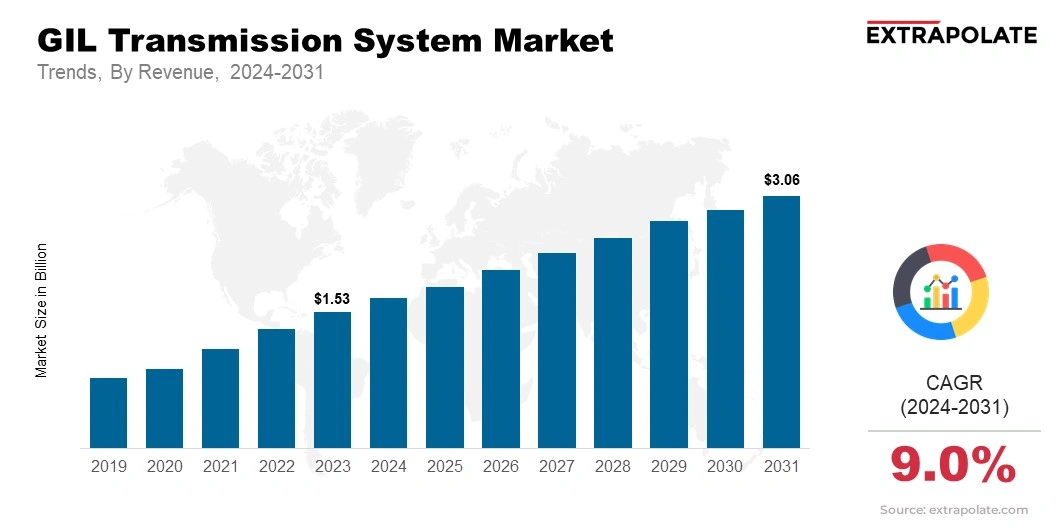
The global GIL Transmission System Market size was valued at USD 1.53 billion in 2023 and is projected to grow from USD 1.68 billion in 2024 to USD 3.06 billion by 2031, exhibiting a CAGR of 9% during the forecast period.
The global GIL (Gas Insulated Line) transmission system market is growing at a high pace. There is a rising demand for reliable, efficient, and green power transmission solutions. This is driving the market toward growth. GIL systems use a gas-insulated medium to transmit electrical power. They are a preferred alternative to overhead lines. They have high performance, a compact design, and better safety. These systems are vital in crowded urban areas. Space is limited in these areas, therefore, under-ground solutions such as GIL work ideally.
The demand for GIL transmission systems is rising. There is a growing need for efficient power distribution networks, especially in rapidly urbanizing, industrializing, emerging economies. These systems are widely used in high-voltage power transmission. They offer improved insulation, less electromagnetic interference, and greater reliability. These advantages make them ideal for critical infrastructure projects. As countries modernize power grids and shift to renewable energy, GIL systems are being integrated into smart grids. This is improving energy efficiency.
Advancements in gas-insulated transmission technology are key to shaping the market. Better, greener gas-insulated systems are cutting costs. They are also boosting performance and lifespan. Also, GIL systems are getting cheaper. Economies of scale and new manufacturing methods are making them accessible to more industries.
The rise of wind and solar energy is affecting the GIL transmission system market. As the need to integrate renewable energy into the power grid grows, GIL systems offer a reliable, flexible solution. They connect remote renewable energy sources to the main transmission network. GIL can transmit power over long distances with minimal loss. So, it is vital for energy sustainability goals.
The GIL transmission system market should grow as global infrastructure projects expand and demand for sustainable power rises. GIL technology will be key to the future of energy transmission. It can meet the changing needs of modern power grids and ensure reliable power delivery.
Key Market Trends Driving Product Adoption
The GIL transmission system market has three key traits. It has tech innovation, eco-friendliness, and a rising demand for efficient energy solutions. Key trends driving market growth include:
- Technological Advancements: GIL systems are now better due to new materials and engineering. They are more efficient, reliable, and cost-effective. Hybrid systems that combine GIL with overhead lines are creating new opportunities for utility companies.
- Urbanization and Infrastructure Development: Densely populated urban areas need compact, reliable transmission systems. So, there is a push for GIL. It has a big advantage over traditional, open-air lines.
- Renewable Energy Integration: GIL systems are vital for renewable energy transmission, especially in offshore wind projects. They can handle high-voltage currents with minimal space.
- Environmental Considerations: The push for green energy is raising demand for GIL systems. They are more sustainable and eco-friendly than traditional transmission systems.
Major Players and their Competitive Positioning
A few major players dominate the GIL transmission system market. They are Siemens, ABB, Schneider Electric, and General Electric. These companies are using their tech and service networks to stay competitive. Smaller players and regional providers are entering the market. They offer innovative solutions for specific geographical needs.
Consumer Behavior Analysis
Utility companies and industries are increasingly adopting GIL systems for several reasons, including:
- Efficient Energy Transmission: GIL systems have a high power density. This makes them ideal for areas with little space for overhead lines.
- Safety and Reliability: GIL systems have an enclosed design. It ensures higher safety and reliability in disaster-prone areas.
- Sustainability: A growing focus on sustainability views GIL systems as a greener alternative to traditional power transmission solutions. Their compactness and eco-friendliness are the major reasons for the same.
Pricing Trends
GIL transmission system market prices depend on the system's size, capacity, and complexity. High-capacity GIL systems for long-distance and offshore wind use are costly. Smaller, localized systems are more cost-effective. As technology improves and production rises, GIL system costs should likely fall. This will make them more accessible to more industries and regions.
According to market projections, the GIL transmission system market is expected to grow at a Compound Annual Growth Rate (CAGR) of approximately 8.3% between 2023 and 2031, with the market size expected to reach USD 4.6 billion by 2031.
Growth Factors
Several factors are driving the growth of the GIL transmission system market:
- Urbanization: Rapid urbanization and a rising demand for electricity in cities are increasing the need for space-efficient, reliable power transmission solutions like GIL.
- Renewable Energy Integration: GIL systems are key to connecting offshore wind farms to the national grid.
- Tech Advancements: New GIL systems are more efficient and cost-effective. This makes them more attractive to utilities and industries.
- Global Power Grid Expansion: The growth and upgrade of power grids worldwide, especially in emerging markets, are driving the adoption of GIL systems.
Regulatory Landscape
Countries are tightening environmental rules on power transmission. The policies governing the GIL transmission systems market are changing as a result. Companies must comply with these rules. They ensure the safety, reliability, and sustainability of their GIL systems. Also, energy market deregulation in some areas is creating new opportunities for GIL adoption.
Recent Developments/ Market Highlights
The GIL transmission system market is evolving. New technologies and applications are being introduced regularly. Some recent developments include:
- Offshore Wind Integration: More GIL systems are being used to transmit power from offshore wind farms to onshore grids.
- Hybrid Systems: Develop hybrid transmission systems that combine GIL and overhead lines for better flexibility.
- Smart Grid Integration: Connect GIL systems with smart grids to boost energy efficiency and management.
- Increased Investment: To modernize power and meet sustainability goals, governments and utilities are investing more in GIL systems.
Current and Potential Growth Implications
Demand-Supply Analysis
Demand for GIL systems is rising. This is due to urbanization and the use of renewable energy. However, supply chain issues may affect the availability of GIL systems in the short term. These include raw material shortages and complex manufacturing processes.
Gap Analysis Despite significant advancements, there are areas where further improvements are needed:
- Cost Reduction: While GIL systems are efficient, they are still costly compared to traditional power transmission lines. Companies are focusing on reducing manufacturing and installation costs.
- Standardization: The lack of standardization across GIL systems can limit their widespread adoption. Standard protocols and technologies are needed to ensure interoperability between systems.
- Capacity Optimization: Further improvements in capacity handling and the ability to transmit higher voltages over longer distances will enhance the viability of GIL systems for large-scale projects.
Top Companies in the GIL Transmission System Market
Some of the top companies in the GIL transmission system market include:
- Siemens
- ABB
- Schneider Electric
- General Electric
- NKT Group
- Prysmian Group
- Fujikura Ltd.
- Sumitomo Electric Industries
- Hitachi Ltd.
GIL Transmission System Market: Report Snapshot
Segmentation | Details |
By Product Type | Gas Insulated Transmission Lines, Hybrid Transmission Systems |
By Application | Offshore Wind Farms, Urban Power Networks, High-Voltage Transmission, Industrial Applications |
By End User | Utility Companies, Renewable Energy Providers, Industrial End Users |
By Region | North America, Europe, Asia-Pacific, Middle East & Africa, South America |
GIL Transmission System Market: High Growth Segments
The following market segments are expected to experience significant growth:
- Offshore Wind Farms: As renewable energy investments increase, GIL systems will be key in transmitting energy from offshore wind projects.
- Urban Power Networks: GIL systems will continue to be a preferred choice for power transmission in crowded urban environments.
- High-Voltage Transmission: With the demand for high-capacity transmission solutions, GIL systems will see growing adoption in high-voltage power networks.
Major Innovations
Innovation is key to staying competitive in the GIL transmission system market. Some of the latest innovations include:
- Hybrid Transmission Systems: Combining GIL with traditional power lines for enhanced flexibility and reliability.
- Smart Grid Integration: GIL systems integrated with smart grid technology for real-time monitoring and control.
- Advanced Insulation Materials: Improved insulation materials to enhance system reliability and performance.
GIL Transmission System Market: Potential Growth Opportunities
The GIL transmission system market faces several challenges:
- High Capital Expenditure: The initial cost of GIL systems remains high compared to traditional transmission lines.
- Technological Advancements: Continuous innovation is required to keep pace with evolving energy transmission needs.
- Regulatory and Environmental Standards: Companies must navigate the complex regulatory environment and ensure compliance with environmental standards.
Kings Research says:
The global GIL transmission system market is set for substantial growth, driven by technological advancements, renewable energy integration, and increasing demand for efficient urban power transmission. Companies that can address the challenges and leverage the opportunities in this sector will be well-positioned for success in the evolving energy landscape.
ARE YOU SEEKING COMPREHENSIVE INSIGHT ON VARIOUS
MARKETS?
CONTACT OUR EXPERTS TODAY
Global GIL Transmission System Market Size
- January-2025
- 149
- Global
- energy-and-power
Related Research
Organic Rankine Cycle Market Size, Share, Growth & Industry Analysis, By Application (Solar Thermal
February-2023
Air Electrode Battery Market Size, Share, Growth & Industry Analysis, By Product (Zinc-Air Batteries
September-2024
Battery Recycling Market Size, Share, Growth & Industry Analysis, By Battery Chemistry (Lead-Acid, L
August-2025
Biodiesel Market By Feedstock (Soybean, Rapeseed, Palm, Palm, Poultry, Tallow, White Grease, and Oth
January-2023
Biomass Boiler Market Size, Share, Growth & Industry Analysis, By Product Type (Fully Automated Boil
August-2025
Biomass Power Generation Market Size, Share, Growth & Industry Analysis, By Feedstock (Woody Biomass
August-2025
Biomethane Market by Application (Automotive, Power Generation, and Others), Production Method (Ferm
February-2023
Cable Entry Systems and Components Market Size, Share, Growth & Industry Analysis, By Product Type (
February-2025
Carbon Capture and Storage Market Size, Share, and COVID-19 Impact Analysis, By Capture Source (Chem
August-2025
Diesel Market Size, Share, Growth & Industry Analysis, By Application (Transportation (On-road, Off-
April-2025