Diesel Market Size, Share, Growth & Industry Analysis, By Application (Transportation (On-road, Off-road), Power Generation, Industrial), By Type (Diesel Fuel, Biodiesel, Synthetic Diesel), and Regional Analysis, 2024-2031
Diesel Market: Global Share and Growth Trajectory
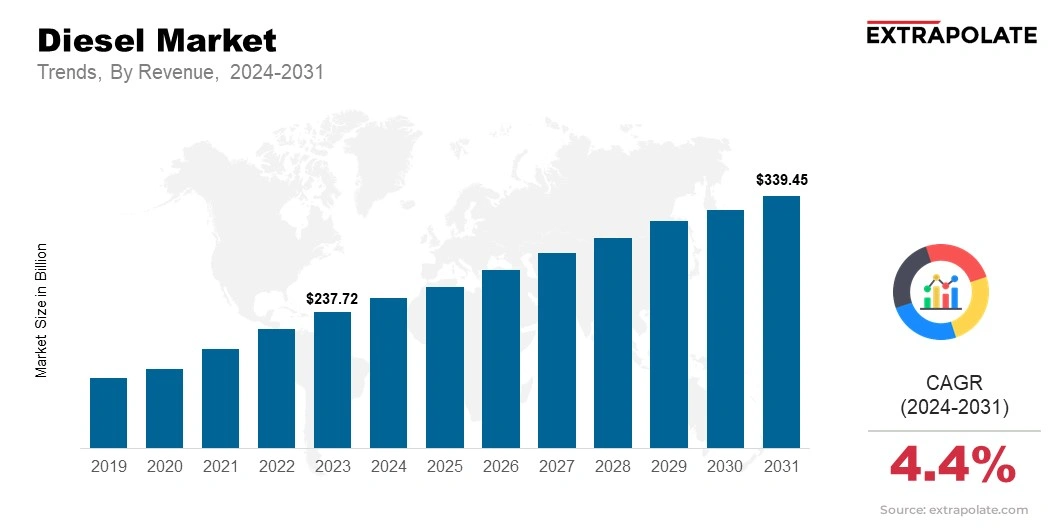
The global Diesel Market size was valued at USD 237.72 billion in 2023 and is projected to grow from USD 250.37 billion in 2024 to USD 339.45 billion by 2031, exhibiting a CAGR of 4.4% during the forecast period.
The global market is experiencing steady growth, driven by increasing demand for diesel-powered vehicles, industrial applications, and transportation.
Diesel fuel, known for its higher energy density and efficiency compared to gasoline, is widely used in commercial vehicles, heavy-duty trucks, and machinery, as well as in power generation and agricultural sectors.
As diesel engines continue to dominate the transportation and logistics industries due to their fuel efficiency and longer engine life, the demand for diesel is expected to remain robust in the coming years.
Technological advancements in engine designs, including the development of cleaner and more efficient diesel engines, are contributing to the growth of the market.
In response to stricter environmental regulations, the diesel industry has also made significant strides in reducing emissions through innovations such as selective catalytic reduction (SCR) and diesel particulate filters (DPF).
These developments have helped mitigate the environmental impact of diesel engines while maintaining their performance and reliability.
The diesel market is benefiting from the increasing demand for freight and goods transportation, particularly in emerging economies where infrastructure development and urbanization are accelerating.
Additionally, diesel fuel remains a preferred option for power generation in remote areas and regions with limited access to other energy sources.
With the continued growth of the global economy and the expansion of industrial and transportation activities, diesel consumption is expected to rise, particularly in sectors such as construction, mining, and agriculture.
As the market for diesel continues to evolve, a growing emphasis on sustainability and regulatory compliance is driving innovation in fuel efficiency and emissions reduction technologies.
Alternative fuels and electric vehicles may challenge diesel long-term. However, diesel’s vital role in heavy-duty tasks and global trade keeps it important. The market is expected to grow steadily, driven by technological advancements, increasing demand from emerging markets, and ongoing improvements in diesel engine performance and environmental sustainability.

Key Market Trends Driving Product Adoption
The diesel market is characterized by several significant trends that are propelling product adoption across various industries:
- Transportation and Logistics Growth: Diesel is the top choice for heavy-duty trucks and freight. It powers large engines efficiently for long distances.
- Industrial Demand: Diesel powers many industrial machines, equipment, and generators. It is crucial for construction, mining, and agriculture.
- Technological Advancements in Engine Efficiency: Modern diesel engines are more fuel-efficient. Advances like turbocharging, direct injection, and better emission controls make them greener.
- Power Generation: Diesel generators remain a vital resource for both backup power besides for supplying power independent of the electricity grid. This is especially true in certain areas. For example in regions where electricity access seems restricted or undependable, they provide energy - but some downsides exist.
Major Players and their Competitive Positioning
The diesel market is highly competitive, with key players such as ExxonMobil, Chevron, BP, Royal Dutch Shell, and TotalEnergies holding significant market shares. These companies dominate the market through strategic investments in refinery infrastructure, distribution networks, and R&D for developing cleaner, more efficient diesel products. Smaller players and regional suppliers also play a vital role in meeting localized demand, particularly in developing economies.
Consumer Behavior Analysis
The adoption of diesel fuel is primarily driven by its economic benefits and performance characteristics. Key factors influencing consumer behavior include:
- Cost Efficiency: Diesel engines provide improved fuel economy besides extended service life than gasoline engines. Diesel fuel becomes a valuable option for users in commerce and manufacturing.
- Performance and Reliability: Diesel engines are strong and long-lasting. They work well in tasks needing high torque and long hours, like trucks and construction gear.
- Environmental Considerations: Diesel engines possess elevated fuel efficiency - however, worries regarding their effect on the environment, like emissions of nitrogen oxide and particulates, encourage progress toward technologies that pollute less - these technologies strive to reduce pollution.
Pricing Trends
The pricing of diesel fuel is largely influenced by crude oil prices, refining costs, and geopolitical factors. Diesel tends to be more expensive than gasoline due to its higher refining costs, but it is still considered more economical in terms of energy output per gallon. Additionally, market fluctuations due to supply-demand dynamics and seasonal changes also impact diesel prices.
Growth Factors
Several key factors are contributing to the growth of the diesel market:
- Growing Transportation Demand: Transportation services are in higher demand. This drives diesel fuel use, particularly in logistics and freight.
- Industrialization and Urbanization: Industrial growth is rising. The demand for construction and agricultural machinery in emerging markets is boosting diesel engine and generator needs.
- Power Shortages in Developing Regions: Diesel generators have popularity in regions that have unstable electrical systems, because of this, they function as significant reserve energy.
Regulatory Landscape
The regulatory landscape for the diesel market is shaped by various environmental policies and emission regulations, particularly in developed regions. Governments worldwide are implementing stricter emission standards for diesel engines, encouraging the development of cleaner fuels and technologies. The introduction of low-sulfur diesel and advancements in emission control technologies such as selective catalytic reduction (SCR) and diesel particulate filters (DPF) are helping the market transition toward more sustainable solutions.
Recent Developments
The diesel market is continuously evolving, with key developments including:
- Cleaner Diesel Fuels: The adoption of ultra-low sulfur diesel (ULSD) and bio-diesel blends is growing, driven by stricter environmental regulations and consumer demand for cleaner fuels.
- Hybrid and Electric Alternatives: Heightened rivalry exists with hybrid besides electric systems, especially inside auto manufacturing and this affects the diesel market. Diesel keeps its lead in demanding jobs and travel over extended distances.
- Technological Improvements: Engine tech advancements, like high-efficiency turbocharged diesel engines, are helping market growth. Better fuel injection systems also add to this rise.
Current and Potential Growth Implications
Demand-Supply Analysis:
Global diesel demand will likely increase in the short-to-medium term. Industrial growth and transportation needs are key drivers. The long-term outlook faces challenges. Growing electric vehicle adoption and stricter emission standards could impact demand.
Gap Analysis:
Key challenges include:
- Environmental Regulations: Stricter emission standards are pushing cleaner diesel technology development. However, this may raise operational costs.
- Price Volatility: Diesel prices fluctuate with global crude oil costs. These variations can affect market stability.
Top Companies in the Diesel Market
- ExxonMobil
- Chevron
- BP
- Royal Dutch Shell
- TotalEnergies
- Phillips 66
- Valero Energy
- Marathon Petroleum
Diesel Market: Report Snapshot
Segmentation | Details |
By Application | Transportation (On-road, Off-road), Power Generation, Industrial |
By Type | Diesel Fuel, Biodiesel, Synthetic Diesel |
By Region | North America, Europe, Asia-Pacific, Middle East & Africa, South America |
High-Growth Segments
Certain segments within the market are poised for significant growth, including:
- Biodiesel: The shift toward renewable fuels is driving biodiesel demand. It offers a cleaner alternative to traditional diesel.
- Power Generation: Diesel generators will continue to be in demand. Regions facing power supply challenges will drive this need.
Major Innovations
Innovation remains a key driver in the market, with major innovations including:
- Advanced Diesel Engines: The construction of more powerful and economical engines which meet emission control requirements.
- Fuel Additives: Diesel fuel additives received new formulas. They bolster how well engines operate plus curtail discharges. They lengthen how long engines function.
Potential Growth Opportunities
The diesel market presents several growth opportunities, including:
- Emerging Markets: Diesel fuel usage to go up a lot as more countries industrialize and are catching up with better transportation infrastructure.
- Technological Advancements: New developments with less polluting, efficient diesel fuels besides engines present chances for market expansion. These fuels permit a better use of current tech - but that doesn't impede the development of future innovations.
- Biodiesel and Synthetic Fuels: Rising interest in renewable diesel creates opportunities for market players. Diversifying offerings can meet the growing demand for sustainable fuel solutions.
Kings Research Says:
The diesel market expects regular growth. It comes from continuing industrial expansion, transport requirements and electricity production needs. But environmental worries plus an increase in electric cars can alter the market's path. Companies that adopt progress in cleaner fuels and updated engine designs are ready to flourish in this shifting market - they position themselves for success.
ARE YOU SEEKING COMPREHENSIVE INSIGHT ON VARIOUS
MARKETS?
CONTACT OUR EXPERTS TODAY
Diesel Market Size
- April-2025
- 148
- Global
- energy-and-power
Related Research
Organic Rankine Cycle Market Size, Share, Growth & Industry Analysis, By Application (Solar Thermal
February-2023
Air Electrode Battery Market Size, Share, Growth & Industry Analysis, By Product (Zinc-Air Batteries
September-2024
Battery Recycling Market Size, Share, Growth & Industry Analysis, By Battery Chemistry (Lead-Acid, L
August-2025
Biodiesel Market By Feedstock (Soybean, Rapeseed, Palm, Palm, Poultry, Tallow, White Grease, and Oth
January-2023
Biomass Boiler Market Size, Share, Growth & Industry Analysis, By Product Type (Fully Automated Boil
August-2025
Biomass Power Generation Market Size, Share, Growth & Industry Analysis, By Feedstock (Woody Biomass
August-2025
Biomethane Market by Application (Automotive, Power Generation, and Others), Production Method (Ferm
February-2023
Cable Entry Systems and Components Market Size, Share, Growth & Industry Analysis, By Product Type (
February-2025
Carbon Capture and Storage Market Size, Share, and COVID-19 Impact Analysis, By Capture Source (Chem
August-2025
Diesel Market Size, Share, Growth & Industry Analysis, By Application (Transportation (On-road, Off-
April-2025