Glue Laminated Timber Market Size, Share, Growth & Industry Analysis, By Product Type (Softwood GLT, Hardwood GLT, Hybrid GLT) By Application (Residential, Commercial, Industrial, Others) By End-User (Architects, Builders, Contractors, Government), and Regional Analysis, 2024-2031
Glue Laminated Timber Market: Global Share and Growth Trajectory
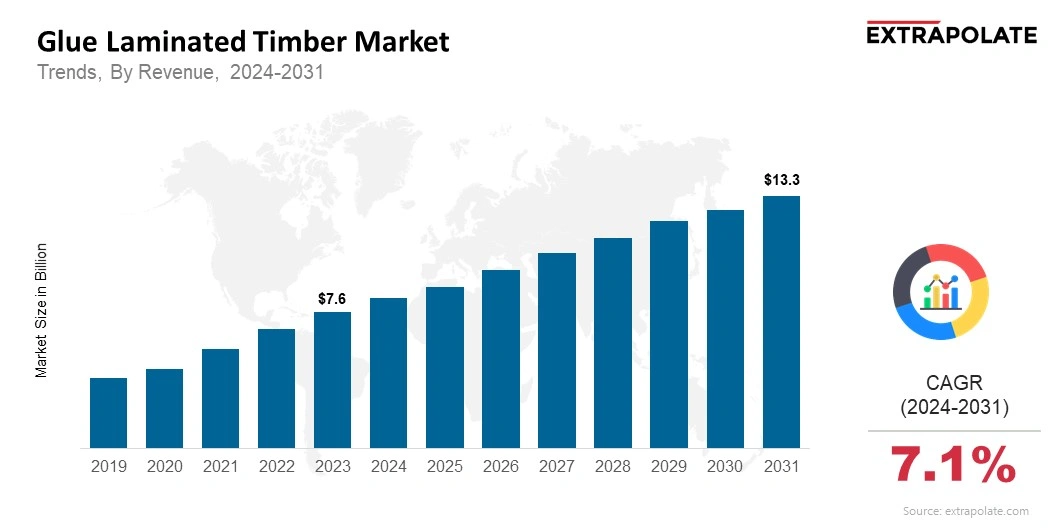
The global Glue Laminated Timber Market size was valued at USD 7.6 billion in 2023 and is projected to grow from USD 8.2 billion in 2024 to USD 13.3 billion by 2031, exhibiting a CAGR of 7.1% during the forecast period.
The global Glue Laminated Timber (glulam) Market is experie0ncing robust growth, driven by the increasing demand for sustainable building materials, advancements in wood engineering, and rising construction activities worldwide. Glue laminated timber is a versatile, eco-friendly alternative to traditional building materials, offering superior strength, durability, and aesthetic appeal for both residential and commercial structures. As the construction industry moves toward more sustainable practices, the demand for glulam is steadily increasing, particularly in regions focused on green building and energy-efficient construction.
The glulam market includes various types of products, such as beams, columns, and arches, used in a wide range of applications, including bridges, buildings, and other structural elements. The adoption of glulam is further spurred by its flexibility in design, as it can be customized to meet specific load-bearing requirements, making it an attractive choice for architects and engineers. Additionally, glulam is increasingly being used in large-scale infrastructure projects, such as sports arenas and convention centers, due to its ability to span large distances and support heavy loads without compromising structural integrity.
Advancements in wood technology and manufacturing processes are also contributing to the market’s growth. Innovations such as improved adhesive bonding systems, enhanced durability treatments, and better quality control have expanded the range of applications for glulam and increased its acceptance across the construction industry. Moreover, the growing use of glulam in the creation of modern, sustainable, and aesthetically pleasing buildings is further driving its popularity, particularly in regions like North America and Europe.
Environmental sustainability is another significant factor influencing the demand for glulam. The construction industry’s shift toward green building practices has led to the increased adoption of renewable and low-carbon materials. Glulam, being a renewable resource with a low environmental footprint, is a preferred choice for builders and developers seeking to meet sustainability targets. The low-carbon nature of glulam, combined with its recyclability, makes it an attractive alternative to steel and concrete, materials traditionally associated with high energy consumption and greenhouse gas emissions.
Regionally, Europe and North America dominate the glulam market, with the increasing number of eco-friendly construction projects and favorable government policies promoting sustainable construction materials. However, the Asia-Pacific region is emerging as a significant market for glulam, driven by rapid urbanization, infrastructural development, and growing awareness of sustainable building practices.
Key Market Trends Driving Product Adoption
Several key trends are shaping the growth of the Glue Laminated Timber market:
- Sustainability in Construction: Sustainability is becoming a central focus in construction. The demand for eco-friendly materials like GLT is rising. Glulam is a renewable resource. It reduces carbon footprint, making it an attractive alternative to traditional materials.
- Advancements in Manufacturing Technologies: New technologies in GLT production have improved its strength, design flexibility, and cost-efficiency. This has led to increased use in large-scale construction projects.
- Rise in Modular Construction: Modular construction is growing. It allows for prefabricated, cost-effective building solutions. This has positively impacted the GLT market. GLT’s ease of transport and assembly makes it ideal for modular buildings.
- Growing Urbanization: Global urbanization is increasing, especially in emerging markets. There is rising demand for new, sustainable buildings. GLT's use in residential, commercial, and institutional structures is growing. Cities are seeking innovative ways to build sustainably.
Major Players and Their Competitive Positioning
The Glue Laminated Timber market is driven by key players. They are involved in the production and supply of Glulam products. Leading companies in the market include UPM-Kymmene Corporation, Structurlam, Binderholz GmbH, and Pfeifer Group. These companies expand production capacities. They adopt innovative technologies and maintain strong supply chains to meet rising demand for GLT in construction.
Consumer Behavior Analysis
Key consumers in the GLT market include architects, construction companies, real estate developers, and the government. Architects and designers are specifying GLT more. Its aesthetic appeal, structural integrity, and sustainability credentials are key reasons. Construction companies are turning to GLT. It is a cost-effective, lightweight alternative to steel and concrete. This is especially true in green building projects. Government and institutional initiatives promote sustainable materials. This accelerates the adoption of Glulam.
Pricing Trends
Pricing for Glue Laminated Timber varies. Factors include material quality, production scale, and geographic region. GLT is generally more affordable than traditional materials. Steel and concrete are typically more expensive. GLT has a higher upfront cost than conventional timber. However, its strength and durability make it cost-effective in the long term. This offers considerable value in construction projects. As demand for GLT grows, manufacturing technologies will improve. This is expected to lower production costs. GLT will become an even more cost-competitive option in the market.
Regional Market Insights
The Glue Laminated Timber market is experiencing significant growth across various regions. Europe currently leads the market, with countries like Sweden, Germany, and Austria being prominent producers of GLT. The demand for Glulam in Europe is driven by strong sustainability regulations and the focus on green building certifications like LEED and BREEAM. North America is also seeing increasing demand, particularly in the United States and Canada, where the trend toward eco-friendly construction materials is growing. The Asia-Pacific region is expected to witness the fastest growth, driven by rapid urbanization and increased construction activity in countries like China, India, and Japan.
Growth Factors
Several factors are contributing to the growth of the Glue Laminated Timber market:
- Sustainability Initiatives: The focus on reducing carbon emissions is increasing. It is driving the demand for GLT. Glulam is made from renewable timber. This helps reduce the carbon footprint of building projects.
- Energy Efficiency in Buildings: GLT has natural insulation properties. These contribute to the energy efficiency of buildings. It makes GLT attractive for energy-efficient residential and commercial buildings.
- Construction Industry Growth: Global construction industry growth is ongoing. This is especially true in developing regions. It is creating demand for innovative and cost-effective materials like GLT. Glulam can be used in many applications. It ranges from large commercial buildings to smaller residential structures. This is propelling its adoption.
- Supportive Government Regulations: Governments worldwide are enforcing regulations. They promote sustainable materials in construction. Tax incentives, subsidies, and green building regulations are boosting demand for Glue Laminated Timber.
Regulatory Landscape
The Glue Laminated Timber (GLT) market faces regulations on safety, environmental impact, and building codes. Guidelines from the International Building Code (IBC) and Eurocode 5 govern GLT use in construction. Certification programs like FSC and PEFC ensure sustainable sourcing of timber. As sustainability regulations tighten, the demand for GLT as an eco-friendly building material is expected to grow.
Recent Developments
Recent developments in the Glue Laminated Timber market include:
- Technological Advancements: Companies are investing in new manufacturing processes. These aim to improve the strength, quality, and versatility of GLT. These innovations are making GLT more accessible. It can now be used in larger, more complex structures.
- Increased Adoption in Residential and Commercial Construction: Growing interest now in GLT so as to be utilized in projects ranging from single-family homes to gigantic office buildings. The material is highly versatile, strong, aesthetically appealing. Ideally suitable for both residential and commercial applications.
- Focus on Green Certifications: GLT manufacturers are focusing on sustainability. They are pursuing green certification to meet the demand for eco-friendly materials. This trend will accelerate acceptance of Glulam in green building projects.
Current and Potential Growth Implications
- Demand-Supply Analysis: The demand for eco-friendly materials is growing. This is driving the supply of Glue Laminated Timber. Manufacturers are scaling up production to meet demand. Technological advancements are improving cost-efficiency and strength.
- Gap Analysis: The GLT market is growing. However, some regions still have limited awareness of its benefits. Education and marketing efforts can increase Glulam adoption. This will create new growth opportunities in these regions.
Top Companies in the Glue Laminated Timber Market
- UPM-Kymmene Corporation
- Structurlam
- Binderholz GmbH
- Pfeifer Group
- BSW Timber Ltd.
- Nordic Structures
- Katerra Inc.
- Mayr-Melnhof Holz
- Stora Enso
- Lignum
Report Snapshot
Segmentation | Details |
By Product Type | Softwood GLT, Hardwood GLT, Hybrid GLT |
By Application | Residential, Commercial, Industrial, Others |
By End-User | Architects, Builders, Contractors, Government |
By Region | North America, Europe, Asia-Pacific, Latin America, Middle East & Africa |
High Growth Segments
The following segments are expected to experience significant growth:
- Commercial Construction: Businesses and office spaces seek sustainable materials. This is expected to increase demand for GLT in commercial buildings
- Residential Construction: Sustainable housing and energy-efficient buildings are growing trends. The residential construction sector offers strong growth for GLT.
Major Innovations
Innovation in the Glue Laminated Timber market includes:
- Improved Manufacturing Techniques: New manufacturing processes are developing. They increase the strength and versatility of GLT. This enables its use in larger and more complex structures.
- Green Building Certifications: Manufacturers are focusing on certifications. These ensure the timber in GLT is sustainably sourced. This increases its appeal to eco-conscious consumers and developers.
Potential Growth Opportunities
The Glue Laminated Timber market presents numerous growth opportunities, including:
- Growth in Emerging Markets: Construction activity is increasing in Asia-Pacific and Latin America. This is driving demand for sustainable materials like GLT.
- Sustainability-driven Demand: Tougher environmental regulations mean an expected rise in the need for materials like GLT in building. This situation produces future business possibilities in the market.
- Modular Construction: Modular and prefabricated methods are rising. They offer growth for GLT. GLT is easy to transport and assemble. It suits these methods.
Kings Research says:
The Glue Laminated Timber market will likely continue to grow. This is because of more people wanting construction resources that are sustainable and do not harm the environment. Businesses that concentrate on new ideas, make production better along with take advantage of increased green building will do well in this changing market.
ARE YOU SEEKING COMPREHENSIVE INSIGHT ON VARIOUS
MARKETS?
CONTACT OUR EXPERTS TODAY
Glue Laminated Timber Market Size
- April-2025
- 148
- Global
- chemicals-and-advanced-materials
Related Research
Carbohydrases Market Size, Share & Trends Analysis Report By Application (Food and beverages, Anima
January-2021
1,2,3,4-Tetrahydroquinaldine Reagent (CAS 1780-19-4) -Global Market Status & Trend Report 2022-2030
August-2021
1,2,3,4-Tetrahydroquinaldine Reagent (CAS 1780-19-4) -Global Market Status and Trend Report 2022-203
August-2021
1,2,3,4-Tetrahydroquinoline Reagent (CAS 635-46-1)-Global Market Status & Trend Report 2022-2030 Top
August-2021
1,2,3,4-Tetrahydroquinoline Reagent (CAS 635-46-1)-Global Market Status and Trend Report 2022-2030
August-2021