Functional Textile Finishing Agents Market Size, Share, Growth & Industry Analysis, By Product Type (Water Repellents, Flame Retardants, Antimicrobial Agents, Wrinkle Resistance, UV Protection, Others) By Application (Apparel, Home Textiles, Technical Textiles, Automotive, Healthcare, Others) By End User (Textile Manufacturers, Apparel Brands, Industrial Users, Healthcare Providers), and Regional Analysis, 2024-2031
Functional Textile Finishing Agents Market: Global Share and Growth Trajectory
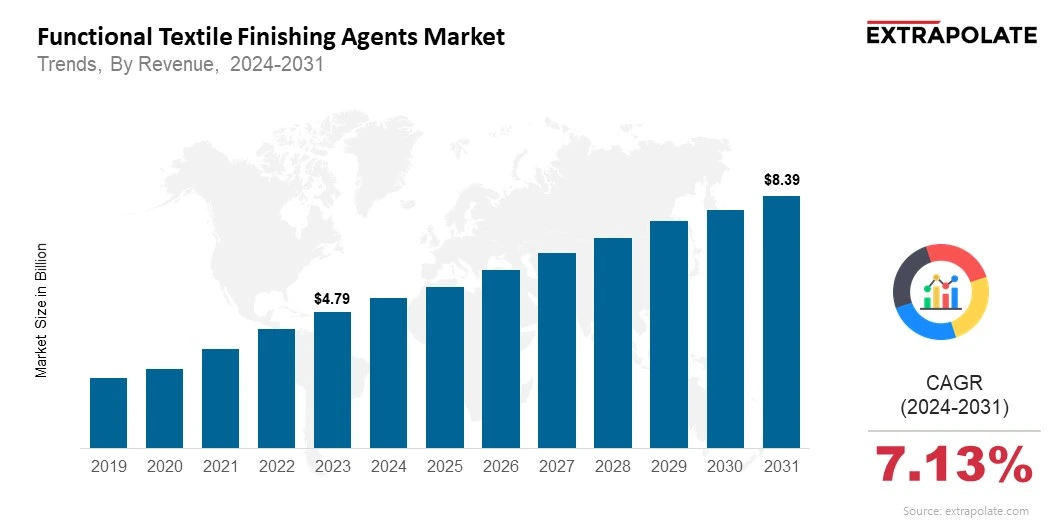
The global Functional Textile Finishing Agents Market size was valued at USD 4.79 billion in 2023 and is projected to grow from USD 5.17 billion in 2024 to USD 8.39 billion by 2031, exhibiting a CAGR of 7.13% during the forecast period.
The global functional textile finishing agents market is witnessing significant expansion, fueled by growing demand for enhanced textile properties, sustainability trends, and evolving consumer preferences. These agents play a critical role in imparting additional functionalities to textiles, such as water repellency, wrinkle resistance, flame retardancy, antimicrobial protection, and UV protection.
As consumers increasingly seek high-performance fabrics for various applications—including apparel, home textiles, automotive interiors, and industrial uses—the market for functional textile finishing agents continues to gain momentum.
Advancements in textile chemistry and finishing technologies have enabled manufacturers to develop innovative and eco-friendly finishing agents that meet stringent environmental regulations.
The rising awareness about sustainable fashion and the growing emphasis on reducing chemical waste have propelled the adoption of bio-based and biodegradable finishing agents. Moreover, the rapid growth of the technical textiles sector, especially in automotive, healthcare, and construction industries, has further amplified demand for specialized finishing agents that enhance durability and functionality.
The market landscape is characterized by continuous research and development activities, aimed at producing versatile and multi-functional finishes. These agents not only improve fabric aesthetics and performance but also extend the lifecycle of textile products, catering to the needs of both manufacturers and end-users.
Additionally, the increasing prevalence of smart textiles, which integrate electronic components with functional finishes, is opening new avenues for growth in this sector.
Geographically, Asia-Pacific leads the functional textile finishing agents market with major textile hubs. Rising incomes and research investments also drive growth. North America and Europe also hold substantial shares due to their stringent regulatory frameworks. Consumer demand for premium functional textiles also enhance market share. Key players focus on partnerships, mergers, and acquisitions. These moves expand product portfolios. They also increase global reach. Digitalization is growing in textile processing. Chemical and textile companies are collaborating more. These trends will boost market growth.
Key Market Trends Driving Product Adoption
The functional textile finishing agents market sees constant innovation. It faces stricter environmental rules and changing end-user needs. Key trends fueling market growth include:
• Sustainability and Eco-Friendly Solutions: Sustainability drives growth. Bio-based and non-toxic agents meet regulations and consumer demand for green products.
• Multi-Functionality: Multi-functionality is rising. Agents now combine features like antimicrobial and water-repellent properties.
• Advanced Application Techniques: Advanced application techniques are adopted. Technologies like plasma treatment and nanotechnology improve agent adhesion and effectiveness.
• Customization and Specialty Finishes: Customization and specialty finishes grow in demand. Industries like automotive, healthcare, and sportswear want tailored solutions.
• Regulatory Compliance: Regulatory compliance affects formulations. Global chemical safety and emission standards keep evolving.
Major Players and their Competitive Positioning
The market is dominated by leading chemical and textile finishing companies like Archroma, Huntsman Corporation, Clariant, and BASF. These players are investing heavily in R&D to develop innovative, sustainable finishing agents while also expanding their geographic reach. Smaller niche players are emerging with specialty products aimed at high-performance textiles.
Consumer Behavior Analysis
Textile manufacturers and end-users are increasingly adopting functional finishing agents due to:
• Performance Enhancement: Textile manufacturers and end-users adopt functional finishing agents more often. These agents improve durability, comfort, and add features like UV protection and odor control.
• Sustainability Goals: They focus on sustainability goals. This meets environmental standards and consumer demand for eco-friendly textiles.
• Cost Efficiency: Cost efficiency drives adoption. Longer-lasting fabrics cut down on replacements and overall costs.
• Market Differentiation: Market differentiation is key. Unique textile properties help brands compete in apparel and technical textile markets.
Pricing Trends
Pricing varies based on the complexity of the finishing agent, volume, and application technology. Eco-friendly and multi-functional agents generally command premium prices, while basic agents are positioned for cost-sensitive markets. Volume discounts and strategic partnerships influence pricing strategies.
According to industry forecasts, the functional textile finishing agents market is expected to grow at a CAGR of approximately 8-10% from 2023 to 2028, driven by demand in emerging economies and stricter environmental regulations in developed regions.
Growth Factors
Several factors underpin the market expansion:
• Technological Advancements: Innovations in chemistry and application methods leading to improved agent efficacy.
• Growing Technical Textile Segment: Increased use of functional textiles in automotive, healthcare, and protective clothing sectors.
• Environmental Regulations: Rising regulatory pressure to reduce hazardous chemical use in textile processing.
• Consumer Awareness: Demand for textiles with enhanced comfort, hygiene, and protection properties.
Regulatory Landscape
The regulatory environment is evolving with global emphasis on reducing hazardous substances in textile finishing. Standards like REACH, OEKO-TEX, and Bluesign guide product development to ensure safety, sustainability, and compliance.
Recent Developments
Key recent trends include:
• Introduction of Bio-Based Finishing Agents: These agents reduce reliance on petrochemical-derived products. They support sustainability efforts.
• Nanotechnology Integration: Nanotechnology enables durable and ultra-thin functional coatings. This improves product performance.
• Water-Based Finishes: Water-based finishes help lower VOC emissions. They improve the environmental footprint.
• Enhanced Flame Retardant Solutions: Meeting strict fire safety norms. Applicable for industrial and home textiles.
Current and Potential Growth Implications
Demand Supply Analysis
Demand is growing steadily, driven by increased use of functional textiles. Supply chain challenges such as raw material availability and price volatility of chemicals may affect the market dynamics.
Gap Analysis
Despite growth, challenges remain:
• Scalability of Eco-Friendly Solutions: Need for affordable large-scale production of green finishing agents.
• Performance vs. Sustainability Trade-Off: Balancing functionality with environmental impact.
• Standardization Issues: Lack of universal testing and certification methods for finished textiles.
• Cost Barriers: High costs of specialty agents limit adoption in low-margin textile segments.
Top Companies in the Functional Textile Finishing Agents Market
• Archroma
• Huntsman Corporation
• Clariant
• BASF
• Dow Chemical Company
• CHT Group
• Pulcra Chemicals
• Stahl Holdings
• Eternal Materials
• Nouryon
Functional Textile Finishing Agents Market: Report Snapshot
Segmentation | Details |
By Product Type | Water Repellents, Flame Retardants, Antimicrobial Agents, Wrinkle Resistance, UV Protection, Others |
By Application | Apparel, Home Textiles, Technical Textiles, Automotive, Healthcare, Others |
By End User | Textile Manufacturers, Apparel Brands, Industrial Users, Healthcare Providers |
By Region | North America, Europe, Asia-Pacific, Middle East & Africa, South America |
Functional Textile Finishing Agents Market: High-Growth Segments
Segments poised for significant growth include:
• Antimicrobial Finishes: Antimicrobial finishes fight germs. They are driven by health and hygiene needs.
• Water-Repellent Finishes: Water-repellent finishes protect outdoor clothes. They are popular in sports apparel too.
• Flame Retardants: Increasing safety regulations in industrial applications.
Major Innovations
Innovation continues to be a key differentiator:
• Bio-Based and Sustainable Chemicals: Offering effective yet eco-friendly alternatives.
• Nanotechnology: Nanotechnology boosts fabric durability. It also improves material compatibility.
• Smart Finishes: Smart finishes use textiles that react to changes. They adapt to heat, light, or moisture.
Functional Textile Finishing Agents Market: Potential Growth Opportunities
Challenges and opportunities include:
• Strict Regulatory Compliance: Companies must meet global environmental standards. Safety rules also need attention. Alignment with both is key for market entry and growth.
• R&D Investment: Developing cost-effective and sustainable finishing agents.
• Market Penetration in Emerging Economies: Expanding applications in rapidly growing textile sectors.
• Collaborations and Partnerships: To accelerate innovation and distribution.
Kings Research says:
The global functional textile finishing agents market is growing steadily. Sustainability, performance needs, and tech innovations are driving this trend. Companies that invest in eco-friendly solutions and advanced finishing technologies will gain a competitive edge in this dynamic market.
ARE YOU SEEKING COMPREHENSIVE INSIGHT ON VARIOUS
MARKETS?
CONTACT OUR EXPERTS TODAY
Functional Textile Finishing Agents Market Size
- May-2025
- 148
- Global
- chemicals-and-advanced-materials
Related Research
Carbohydrases Market Size, Share & Trends Analysis Report By Application (Food and beverages, Anima
January-2021
1,2,3,4-Tetrahydroquinaldine Reagent (CAS 1780-19-4) -Global Market Status & Trend Report 2022-2030
August-2021
1,2,3,4-Tetrahydroquinaldine Reagent (CAS 1780-19-4) -Global Market Status and Trend Report 2022-203
August-2021
1,2,3,4-Tetrahydroquinoline Reagent (CAS 635-46-1)-Global Market Status & Trend Report 2022-2030 Top
August-2021
1,2,3,4-Tetrahydroquinoline Reagent (CAS 635-46-1)-Global Market Status and Trend Report 2022-2030
August-2021