Sport Utility Vehicles Market Size, Share, Growth & Industry Analysis, By Vehicle Type (Compact SUVs, Midsize SUVs, Full-size SUVs, Luxury SUVs), By Fuel Type (Petrol, Diesel, Electric, Hybrid), By End User (Individual Consumers, Fleet Operators, Leasing Companies), and Regional Analysis, 2024-2031
Sport Utility Vehicles (SUVs) Market: Global Share and Growth Trajectory
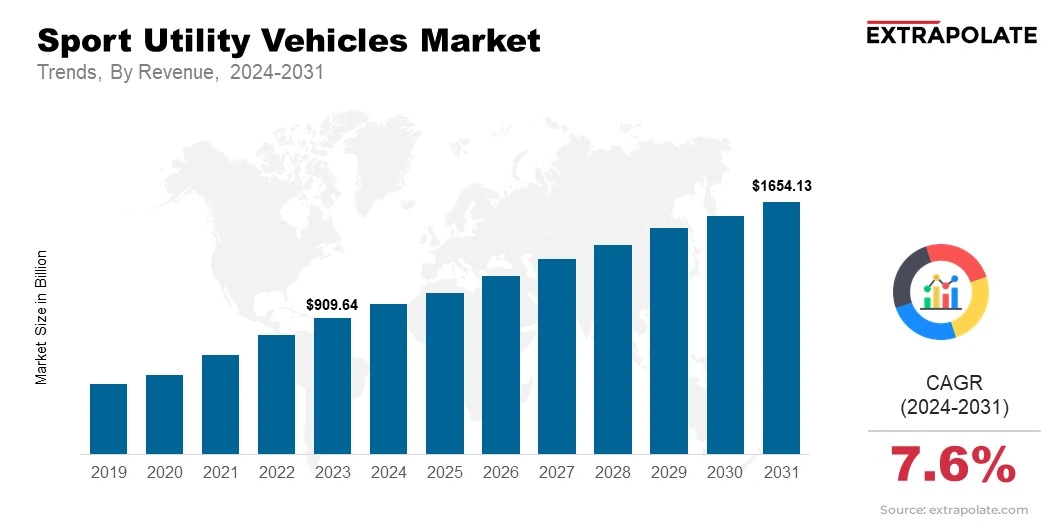
The global Sport Utility Vehicles Market size was valued at USD 909.64 billion in 2023 and is projected to grow from USD 987.45 billion in 2024 to USD 1654.13 billion by 2031, exhibiting a CAGR of 7.6% during the forecast period.
The global sport utility vehicles (SUVs) market is experiencing significant growth, driven by rising consumer preference for vehicles that offer a combination of luxury, performance, and practicality.
The increasing demand for SUVs can be attributed to factors such as enhanced safety features, superior driving comfort, advanced technology, and the ability to handle diverse terrains.
This market includes various vehicle categories such as compact, mid-size, and full-size SUVs, catering to a wide range of consumer needs across different demographics and regions.
The shift in consumer preferences towards SUVs over traditional sedans is largely fueled by their versatility, higher ground clearance, and spacious interiors, making them ideal for both urban commuting and outdoor adventures.
In addition, technological advancements in SUV models, such as improved fuel efficiency, autonomous driving features, and infotainment systems, have further amplified their appeal. As automakers continue to introduce new models with enhanced features and performance, the global SUV market is witnessing accelerated growth.
Rising disposable incomes in emerging markets drive SUV demand. Urbanization and changing lifestyles boost this trend, especially in Asia Pacific and Latin America. The growing preference for electric SUVs is driving the market. Their environmental benefits and government incentives are key factors.
Key Market Trends Driving Product Adoption
The SUVs market is marked by rapid innovation and significant competition, with key trends influencing its growth:
Rising Preference for Versatility: Consumers often choose SUVs. These vehicles have versatility. They combine off-road features and provide comfort for daily travel - this makes them a good option for many.
Focus on Safety Features: Safety features, like ADAS, lane-keeping assist, and emergency braking, are now standard in SUVs. This makes them appealing to safety-conscious consumers.
Technological Advancements: Smart infotainment systems, connectivity, and electrification options boost interest. Hybrid and electric SUVs drive this demand.
Environmental Consciousness: Environmental awareness grows. Consumers turn to fuel-efficient or electric SUVs to lower carbon footprints.
Demand for Luxury SUVs: Rising disposable income in emerging economies drives demand. High-end, luxury SUVs with premium features and advanced technology see increased interest.
Major Players and Their Competitive Positioning
The SUV market is led by top global manufacturers. Toyota, Ford, Volkswagen, Honda, and BMW dominate the space. These companies lead in innovation. They develop technologically advanced SUVs to meet diverse consumer preferences. Smaller, regional players emerge. They provide cost-effective alternatives in the SUV market.
Consumer Behavior Analysis
Consumers are opting for SUVs for various reasons, including:
Comfort and Space: Comfort, ample seating, and cargo space are top priorities. Consumers seek these for family trips and long journeys.
Performance and Safety: Consumers want better road handling, off-road abilities, and enhanced safety. This is pushing SUV sales.
Luxury and Style: Luxury, prestige, and style attract many consumers. High-end SUVs draw strong appeal because of these factors.
Fuel Efficiency and Sustainability: Fuel prices rise. Environmental concerns grow. Demand for fuel-efficient and hybrid/electric SUVs increases.
Pricing Trends
SUV pricing varies greatly. Brand, model, features, and fuel type play a role. Luxury SUVs come with a premium price, thanks to high-end features, tech, and performance. Compact and entry-level SUVs are more affordable. They cater to budget-conscious consumers seeking versatile and practical vehicles.
Growth Factors
Several factors are contributing to the growth of the SUVs market:
Rising Urbanization: Urbanization grows. More middle-class consumers with higher purchasing power drive SUV sales.
Technological Advancements: Better manufacturing techniques emerge. Electrified powertrains and advanced safety tech boost consumer confidence in SUVs.
Expanding Product Offerings: SUV models expand across price ranges. The introduction of electric SUVs attracts a wider range of consumers.
Government Regulations and Incentives: Governments roll out subsidies and incentives. This pushes manufacturers to make more electric and hybrid SUVs.
Regulatory Landscape
Governments are tightening emissions standards and encouraging eco-friendly SUV alternatives. Incentives for electric and hybrid vehicles are driving the growth of eco-friendly SUVs in many regions.
Recent Developments
The SUVs market is rapidly evolving, with key developments including:
Electric and Hybrid SUVs: Many automakers invest in electric and hybrid SUVs. This meets the growing demand for eco-friendly vehicles.
Autonomous Driving Technologies: More automakers are adding autonomous driving tech to premium SUVs. This enhances convenience and safety.
Luxury SUV Launches: Audi, Mercedes-Benz, and Range Rover have launched new luxury SUVs for affluent consumers.
Current and Potential Growth Implications
Demand-Supply Analysis
SUV demand keeps rising. This is especially true in emerging economies with growing middle-class populations. Global supply chain disruptions are a concern. Component shortages, like semiconductor chips, may affect SUV availability and delivery times.
Gap Analysis
While the SUV market is growing, there are areas that need improvement:
Fuel Efficiency: Fuel efficiency in larger SUVs needs improvement. Balancing performance and comfort remains a challenge.
Affordability: SUV prices are becoming competitive. Still, more affordable options are needed in some segments.
Sustainability: Availability of electric and hybrid SUVs must increase. Lowering costs is key to attracting eco-conscious buyers.
North America, Europe, Asia-Pacific, Middle East & Africa, South America
High-Growth Segments
The following market segments are expected to witness significant growth:
Electric and Hybrid SUVs: Environmental understanding grew and the government offered rewards. Because of this people began to take more action - they worked to adopt practices to help protect the world.
Luxury SUVs: Demand from rich people rises - especially in new markets.
Compact and Sub-Compact SUVs: It gives a good mix of power, uses fuel well along with does not cost too much. These qualities make it valuable.
Major Innovations
Innovation is key to staying competitive in the market. Notable innovations include:
Electric Powertrains: SUVs adopt electric and hybrid powertrains. Carbon emissions drop.
Advanced Safety Features: It includes autonomous driving systems. It has collision avoidance. But advanced driver-assistance systems (ADAS) are a factor - these enhance safety.
Connectivity and Infotainment: Smartphone connectivity improves. Advanced infotainment systems integrate seamlessly.
SUV Market: Potential Growth Opportunities
Despite challenges, the market presents significant growth opportunities for companies:
Emerging Markets: Rising incomes in emerging markets open doors. Affordable, fuel-efficient SUVs gain traction.
Electrification: Companies that invest in electric besides hybrid SUVs gain a competitive advantage. In addition the market becomes more focused on ecological concerns - the advantage grows.
The global market for sport utility vehicles will grow a lot. It happens because technology becomes better. People want cars that can do many things and there is more attention given to sustainability. But car companies that can deal with problems related to price, how well a vehicle uses fuel and new tech will do well in this changing market - they will be in a good place to succeed.
FAQ
The global market is projected to reach USD 1654.13 billion by 2031, growing at a CAGR of 7.6% from 2024 to 2031.
Better manufacturing techniques emerge. Electrified powertrains and advanced safety tech boost consumer confidence in SUVs.
Key players in the market are Toyota, Ford, Volkswagen, Honda, BMW, Mercedes-Benz, Audi, Nissan, General Motors, Hyundai, and Others.
ARE YOU SEEKING COMPREHENSIVE INSIGHT ON VARIOUS
MARKETS? CONTACT OUR EXPERTS TODAY