Extrapolate Extrapolate
  • 888-328-2189
  • ABOUT US
  • CONTACT US
  • SIGN IN
  • INDUSTRIES
  • BLOGS
  • Home
  • Automotive
  • Over the air engine ota control module market

Over the Air Engine (OTA) Control Module Market Size, Share, Growth & Industry Analysis, By Vehicle Type (Passenger Cars, Commercial Vehicles, Electric Vehicles), By Propulsion Type (Internal Combustion Engine, Battery Electric Vehicle, Hybrid Electric Vehicle), By Application (Engine Management, Diagnostics, Performance Tuning, Emission Control), and Regional Analysis, 2024-2031

  • Description
  • Table Of Content
  • Sample Request

Over-the-Air (OTA) Engine Control Module Market: Global Share and Growth Trajectory

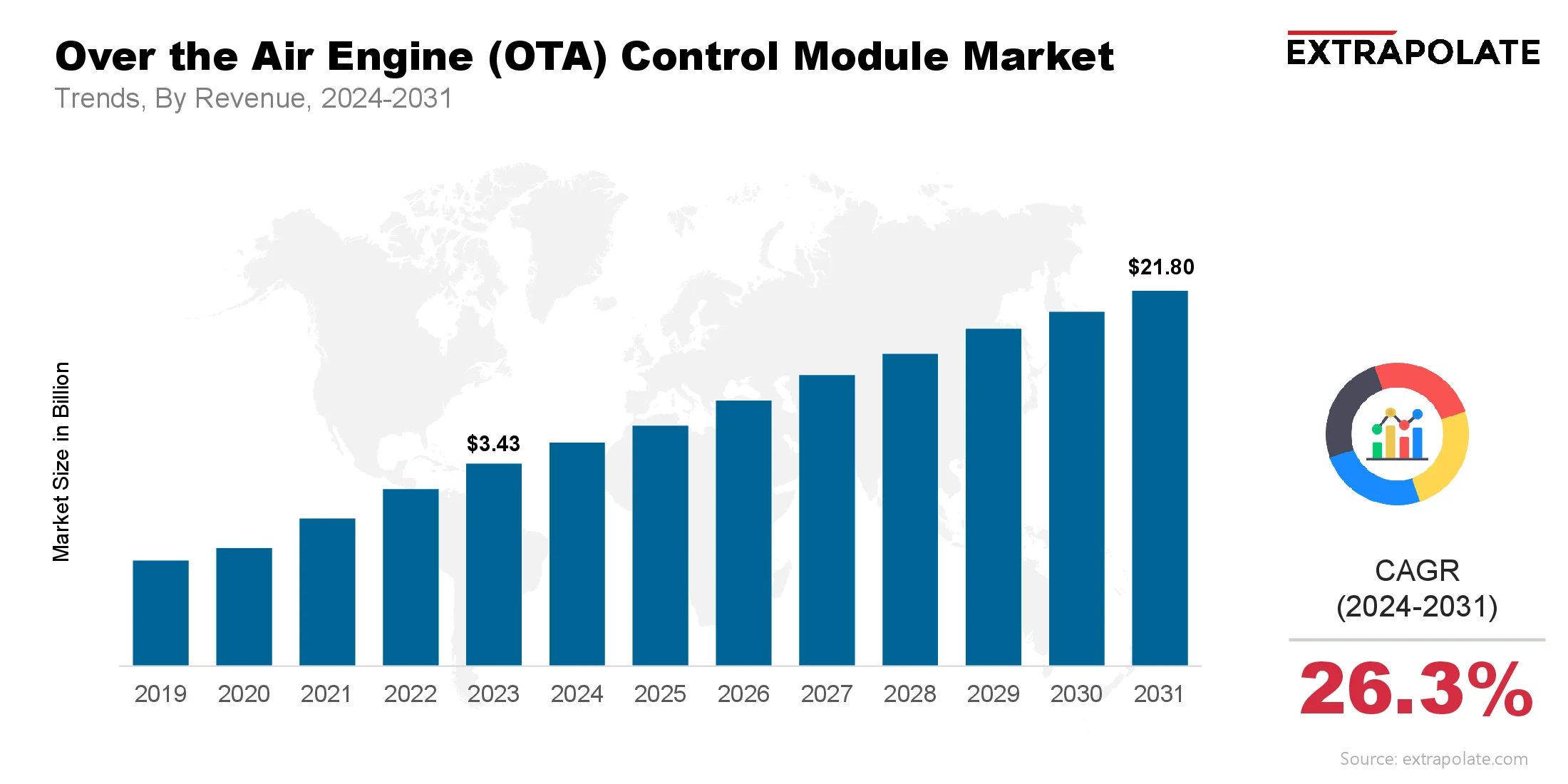
The global Over-the-Air (OTA) Engine Control Module market size was valued at USD 3.43 billion in 2023 and is projected to grow from USD 4.25 billion in 2024 to USD 21.80 billion by 2031, exhibiting a CAGR of 26.3% during the forecast period.

The global market is undergoing a transformative surge, driven by a shift toward connected vehicles, rising demands for enhanced engine performance, and the need for real-time diagnostics and software updates. OTA engine control modules (ECMs) are pivotal in modern vehicle architecture, enabling manufacturers to wirelessly update and optimize engine performance software without requiring physical access to the vehicle. This capability streamlines maintenance, enhances operational efficiency, and plays a key role in modern automotive lifecycle management.

OEMs and Tier 1 suppliers are increasingly leveraging OTA-enabled ECMs to respond swiftly to regulatory changes, software bug fixes, and performance enhancements. These modules are critical for improving fuel efficiency, reducing emissions, and ensuring that vehicles meet the evolving demands of sustainability and digital transformation in mobility. As automotive connectivity becomes a standard across passenger and commercial vehicles, the OTA ECM market is expected to witness sustained and substantial growth over the coming decade.

The rise of autonomous and electric vehicles, alongside growing consumer expectations for real-time vehicle intelligence, is further accelerating the adoption of OTA ECMs. By enabling remote engine parameter reconfiguration, fault detection, and firmware updates, these modules contribute to proactive vehicle management, cost savings, and enhanced driving experiences.

Over the Air Engine (OTA) Control Module Market Size & Share, By Revenue, 2024-2031

Key Market Trends Driving Product Adoption

Rising Demand for Connected Vehicle Infrastructure

As vehicles become increasingly connected, the demand for seamless data transmission between onboard systems and cloud platforms is soaring. OTA engine control modules are at the core of this transformation, offering real-time integration between the engine and the cloud. The ability to send updates and calibrate performance remotely eliminates the need for time-consuming and costly dealership visits, making them highly attractive for both consumers and manufacturers.

Automakers are implementing telematics solutions that allow real-time vehicle monitoring, which, when paired with OTA ECMs, ensures optimal performance and predictive maintenance. This development is especially prevalent in fleet management, where downtime can severely impact operational efficiency.

Accelerated Software Integration in Vehicles

With the increasing electrification and digitization of vehicles, software is becoming as critical as hardware. The growing dependence on vehicle software for emissions control, fuel management, and driveability has made OTA-capable ECMs indispensable. These systems allow manufacturers to manage their vehicle fleets dynamically, updating software modules as needed to improve performance or comply with regional emission standards.

Moreover, the adoption of AI and edge computing is expanding the role of ECMs beyond traditional functions. Engine modules are now designed to learn driving behaviors and adjust performance in real-time, capabilities that are unlocked and enhanced via OTA functionalities.

Increasing Focus on Emission Regulations

Globally, stringent emission norms are being enforced to curb environmental degradation. Governments across Europe, North America, and Asia-Pacific are mandating strict limits on vehicular emissions. OTA engine control modules offer a viable solution for automakers to comply with these regulations without recalling vehicles. They allow software patches to be deployed across thousands of vehicles instantly, ensuring conformity with new standards and enhancing engine efficiency.

This capability not only reduces the financial burden associated with manual recalls but also supports sustainable automotive practices by minimizing carbon footprints and resource use.

Major Players and their Competitive Positioning

The Over-the-Air Engine Control Module market is characterized by intense competition and innovation, with several key players vying for technological supremacy and market share. Major participants in the market include are Continental AG, Robert Bosch GmbH, Denso Corporation, Magneti Marelli S.p.A, Delphi Technologies, ZF Friedrichshafen AG, Hella GmbH & Co. KGaA, Hitachi Astemo, Ltd., Valeo SA, Infineon Technologies AG and others.

These companies are investing significantly in R&D, strategic alliances, and mergers and acquisitions to strengthen their OTA capabilities. Collaborations with cloud service providers and automotive OEMs are becoming increasingly common, aimed at developing robust OTA frameworks that can be scaled across various vehicle platforms.

Consumer Behavior Analysis

  • Rising Awareness and Preference for OTA Capabilities: Modern consumers are tech savvy and expect their vehicles to be like their smartphones, getting updates and improvements in real time. This shift in expectation is driving demand for OTA ECMs that enhance vehicle functionality after purchase. Consumers love convenience and OTA enabled systems fit perfectly into this trend by eliminating the need to visit the service center for engine tuning or diagnostics.
  • Perceived Value in Long Term Ownership: Vehicle owners are considering total cost of ownership when buying cars. ECMs with OTA capabilities reduce service costs over the life of the vehicle by enabling remote diagnostics and software repairs. This builds trust and loyalty especially among premium and electric vehicle buyers who prioritize performance and sustainability.
  • Commercial Fleet Adoption: Fleet managers are looking for solutions that minimize downtime. OTA ECMs give remote control over engine configurations so performance can be optimized based on geography, driver behavior or payload. With diagnostic reporting this has led to rapid adoption in logistics and commercial sectors.

Pricing Trends

Pricing in the OTA Engine Control Module market varies based on application complexity, vehicle class, integration with cloud and AI platforms and security features. Entry level ECMs with limited OTA functionality are relatively affordable and targeted at compact or budget vehicles. High end systems that support autonomous driving features, AI based analytics and full OTA stack integration are priced much higher.

OEMs are exploring cost effective deployment models through modular ECM architecture so they can scale OTA capabilities based on market and vehicle segmentation. Partnerships with cloud providers are also helping manufacturers reduce software deployment costs through shared infrastructure.

Subscription based OTA services are emerging where consumers or fleet managers pay for premium updates, enhanced diagnostics or performance tuning and introducing a new revenue stream for automakers and technology providers.

Growth Factors

Electric and Autonomous Vehicles:

The rise of EVs and AVs is a key driver for OTA ECMs. Electric vehicles rely heavily on software to manage battery life, torque delivery and regenerative braking. OTA ECMs provide the flexibility to optimize these parameters remotely and get performance upgrades and extended battery life without hardware changes.

AVs on the other hand need frequent updates to their control software which can only be delivered through robust OTA systems. This is creating a fertile ground for advanced ECMs with AI and edge computing.Shared mobility platforms like ride sharing and car subscription require centralised monitoring and frequent updates across large fleets. OTA ECMs enable real time diagnostics and remote tuning to maintain operational efficiency and safety. As urbanization increases and car ownership models change the demand for remotely manageable engine control systems will only grow.

Government Mandates and Smart Mobility Infrastructure:

Governments around the world are promoting smart transportation infrastructure through funding, regulatory support and emissions targets. OTA ECMs support these goals by improving engine compliance, fuel efficiency and air quality. For instance, real-time calibration updates can ensure engines operate optimally under varying city driving conditions or weather patterns, essential for urban mobility planning.

Regulatory Landscape

OTA Engine Control Modules are heavily regulated, especially around cybersecurity, emissions and vehicle safety. Key regulations include:

  • UNECE WP.29 (UN Regulation No. 156 & 157): Requires cybersecurity and software update management in vehicles with OTA capabilities.
  • ISO 26262: Covers functional safety of automotive electronics, including ECMs.
  • ISO/SAE 21434: Focuses on cybersecurity risks in the automotive supply chain.

In the US, the NHTSA regulates ECM safety and compliance, while the EPA enforces emissions standards. Same in Europe (EEA and CE certification) and Asia-Pacific (through regional authorities like Japan’s MLIT and India’s ARAI).

These require full validation, testing and certification of any OTA capable ECM before deployment, adding complexity and assurance to the market.

Recent Developments

 Bosch Teams with Microsoft: Bosch is working with Microsoft to create a cloud based software platform for vehicles that enables OTA updates including engine management systems.

  • Continental Launches New Modular OTA Platform: This platform supports multiple ECM architectures and allows remote firmware updates with end to end encryption, security and performance tuning.
  • Infineon Introduces Automotive SoC for OTA: Infineon Technologies has launched a system on chip solution for OTA and engine control integration, more processing power and energy efficiency.
  • EV Startups use OTA ECMs: Companies like Rivian and NIO are using ECMs with full OTA in their EVs to offer dynamic driving modes, personalized engine responses and remote troubleshooting.

Current and Potential Growth Implications

Demand-Supply Analysis

The market is witnessing rising demand from OEMs, fleet operators, and EV manufacturers, pressuring suppliers to scale production while ensuring compliance with strict safety and cybersecurity standards. However, the shortage of semiconductors and skilled software developers is posing temporary supply-side constraints.

Gap Analysis

Although the market is advancing rapidly in developed regions, developing economies lag in OTA infrastructure and regulatory clarity. Additionally, a gap remains between OTA capability and actual utilization, as many vehicles are sold with latent features that are never activated due to lack of consumer awareness or support.

Top Companies in the OTA Engine Control Module Market

  • Continental AG
  • Robert Bosch GmbH
  • Denso Corporation
  • Magneti Marelli S.p.A
  • Delphi Technologies
  • ZF Friedrichshafen AG
  • Hella GmbH & Co. KGaA
  • Hitachi Astemo, Ltd.
  • Valeo SA
  • Infineon Technologies AG

These firms continue to push the boundaries of innovation in real-time engine management and over-the-air diagnostics.

In September 2024, Cummins Inc., in collaboration with Bosch Global Software, ETAS, and KPIT, launched the open-source Eclipse CANought telematics platform. The project standardizes secure CAN bus access to vehicle ECUs, facilitating OTA software updates and simplifying integration for OEMs and Tier‑1 suppliers across commercial vehicles.

In March 2025, NXP launched the S32K5 MCU family, designed for software-defined vehicle architectures and supporting OTA functionality in zonal ECUs.

OTA Engine Control Module Market: Report Snapshot

Segmentation

Details

By Vehicle Type

Passenger Cars, Commercial Vehicles, Electric Vehicles

By Propulsion Type

Internal Combustion Engine, Battery Electric Vehicle, Hybrid Electric Vehicle

By Application

Engine Management, Diagnostics, Performance Tuning, Emission Control

By Region

North America, Europe, Asia-Pacific, Latin America, Middle East & Africa

High Growth Segments

  • Electric Vehicles: OTA ECMs offer seamless integration with electric drivetrains, enabling dynamic control over battery and motor systems.
  • Fleet Management: Adoption is strong in logistics and delivery sectors, where real-time diagnostics reduce downtime and maintenance costs.
  • Hybrid Powertrains: ECMs in hybrid systems benefit significantly from OTA updates to manage the complex interplay between electric and fuel-powered engines.

Major Innovations

  • Edge-Based Engine Analytics: ECMs with edge computing enable localized data processing for real-time decisions.
  • AI-Driven Performance Optimization: Adaptive learning mechanisms fine-tune engine behavior based on driver habits and road conditions.
  • Encrypted OTA Protocols: Advanced cybersecurity protocols ensure secure remote access to vehicle engine software.

Potential Growth Opportunities

  • Expansion into Smart Cities: As cities develop smart infrastructure, real-time OTA engine adjustments will align with traffic and environmental data to optimize emissions.
  • Integration with 5G and V2X: Faster, more secure data transmission via 5G and Vehicle-to-Everything (V2X) networks will enhance the responsiveness of OTA ECMs.
  • Aftermarket Upgrades: Consumers may increasingly demand ECM upgrades post-sale, representing a new revenue stream for OEMs.

Extrapolate says:

The Over-the-Air Engine Control Module market is poised for dynamic expansion amid increasing vehicle connectivity, regulatory complexity, and technological advancement. As consumers and fleet operators prioritize convenience, efficiency, and performance, OTA ECMs are becoming indispensable. With AI integration, real-time analytics, and growing EV adoption, these modules will form the backbone of next-generation automotive intelligence. Manufacturers that invest early in secure, scalable OTA platforms will be well-positioned to lead the future of engine control innovation.


FAQ

The global market is projected to reach USD 21.80 billion by 2031, growing at a CAGR of 26.3 % from 2024 to 2031.
The global market was valued at USD 4.25 billion in 2024.
Key factors that are driving the Over the Air Engine (OTA) Control Module Are The exponential growth of data generated from IoT devices, social media, and enterprise systems is driving the need for advanced analytics solutions.
Key players in the market are Continental AG, Robert Bosch GmbH, Denso Corporation, Magneti Marelli S.p.A, Delphi Technologies, ZF Friedrichshafen AG, Hella GmbH & Co. KGaA, Hitachi Astemo, Ltd., Valeo SA, Infineon Technologies AG and Others.

ARE YOU SEEKING COMPREHENSIVE INSIGHT ON VARIOUS MARKETS?
CONTACT OUR EXPERTS TODAY

Speak to an Expert
Over the air engine ota control module market

Over the Air Engine

  • August-2025
  • 140
  • Global
  • automotive
3499

SELECT AN OPTION

  • 1 User Access
  • PDF Report View
  • Non-Printable
  • 32 Man-hours Analyst Support
  • Post-Sale Support 48 Hours
  • Access upto 5 users
  • PDF Report View
  • Print Available
  • Access to Data Sheet
  • Up to 10% Customization
  • 40 Man-hours Analyst Support
  • Post-Sale Support 72 Hours
  • Annual Update
  • Unlimited User Access
  • Downloadable PDF Report. Data Sheet, Power Point Presentation
  • Print Available
  • Up to 20% Customization
  • 72 Man-hours Analyst Support
  • Post-Sale Support 120 Hours
  • Bi-Annual Update

ENQUIRE NOW REQUEST SAMPLE
Dale Byrne

HAVE A QUESTION?
Samuel will help you find what you are looking for.


Call: 888-328-2189


Related Research

"Automotive Towbar, Market Size, Share & Trends Analysis Report By Application (OEM ,OES ,), By Type

February-2021


(AVM) with Moving Object Detection (MOD) Market Size, Share & Trends Analysis Report By Application

February-2021


1:18 Scale Diecast Automotive Market Size, Share & Trends Analysis Report By Application (Collection

February-2021


3-in-1 Electric Drive Module (eDrive Modules) Market Size, Share & Trends Analysis Report By Applica

February-2021


3D Map System For Automotive Market Size, Share & Trends Analysis Report By Application (Passenger V

February-2021


3PL Service Market Size, Share & Trends Analysis Report By Application (Consumer Goods, Healthcare,

February-2021


4WS Vehicle Market Size, Share & Trends Analysis Report By Application (Passenger Use, Commercial Us

February-2021


4x4 Tyres Market Insights 2022, Global Analysis and Forecast to 2030

July-2021


8X8 Armored Vehicle Market Size, Share & Trends Analysis Report By Application (Defense,Homeland Sec

February-2021


>14T Duty Truck Market Size, Share & Trends Analysis Report By Application (Construction, Manufactur

February-2021


Sample Request

Over the Air Engine (OTA) Control Module Market Size, Share, Growth & Industry Analysis, By Vehicle Type (Passenger Cars, Commercial Vehicles, Electric Vehicles), By Propulsion Type (Internal Combustion Engine, Battery Electric Vehicle, Hybrid Electric Vehicle), By Application (Engine Management, Diagnostics, Performance Tuning, Emission Control), and Regional Analysis, 2024-2031

Publisher: Kings Research   |   Date: 2025-08-07   |   No. Of Pages: 140

Send Your Query

Over the Air Engine (OTA) Control Module Market Size, Share, Growth & Industry Analysis, By Vehicle Type (Passenger Cars, Commercial Vehicles, Electric Vehicles), By Propulsion Type (Internal Combustion Engine, Battery Electric Vehicle, Hybrid Electric Vehicle), By Application (Engine Management, Diagnostics, Performance Tuning, Emission Control), and Regional Analysis, 2024-2031

Publisher: Kings Research   |   Date: 2025-08-07   |   No. Of Pages: 140
Extrapolate

Extrapolate has a refined network of top publishers across the globe covering markets and micro markets who bring in the power of decision making. Our network of publishers is ranked based on the quality of reports produced along with customer feedback Indexing.

 talk@extrapolate.com

888-328-2189


Connect With Us

twitter logo

Industry

Quick Links

  • About Us
  • Contact Us
  • FAQ
  • Privacy Policy
  • Disclaimer
  • Refund Policy
  • Sitemap


Payment Gateway
Sign up for newsletter and updates


Powered By

Kings Research
© 2025 Kingsresearch. All Rights Reserved.