Automotive Chemicals Market Size, Share, Growth & Industry Analysis, By Product Type (Lubricants, Coolants, Brake Fluids, Cleaners & Degreasers, Adhesives & Sealants) By Application (Engine & Transmission, Exhaust Systems, Interior & Exterior Maintenance, Battery & Electrical Systems) By End User (OEMs, Aftermarket, Automotive Workshops, Individual Consumers), and Regional Analysis, 2024-2031
Automotive Chemicals Market: Global Share and Growth Trajectory
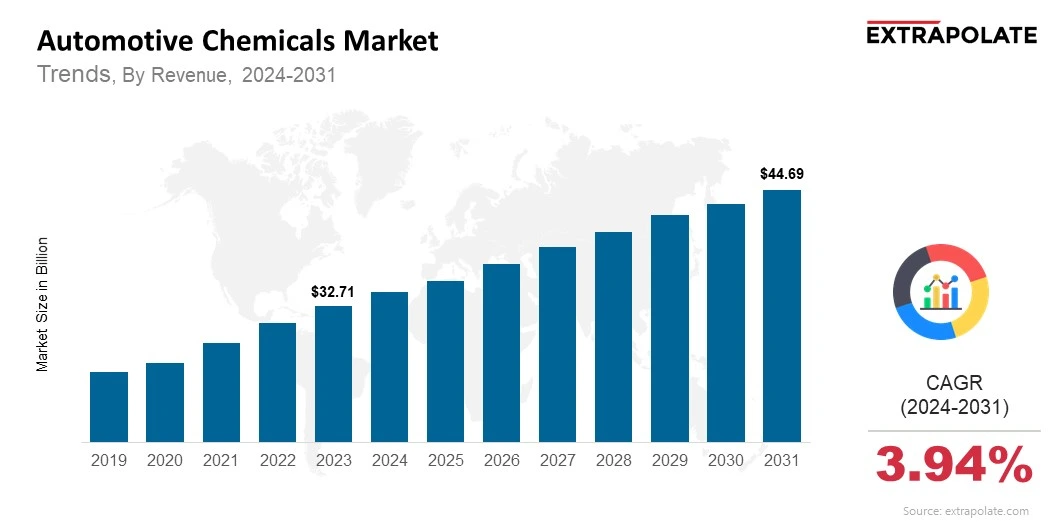
The global Automotive Chemicals Market size was valued at USD 32.71 billion in 2023 and is projected to grow from USD 34.08 billion in 2024 to USD 44.69 billion by 2031, exhibiting a CAGR of 3.94% during the forecast period.
The global market is observing steady advancement, driven by evolving automotive technologies, rising vehicle production, and the increasing demand for fuel efficiency and sustainability. Automotive chemicals play an essential role in the performance, maintenance, and durability of vehicles.
This market includes a vast array of products like lubricants, coolants, adhesives, sealants, cleaning agents, coatings, and several performance-enhancing additives. These chemicals are crucial for supporting vehicle manufacturing, ensuring compliance with environmental standards, and enhancing the safety, effectiveness, and longevity of both traditional and electric vehicles.
As environmental regulations become more stringent worldwide, manufacturers are increasingly shifting towards eco-friendly and sustainable chemical solutions, prompting innovation and investment in green chemistry. Moreover, the transition towards electric vehicles (EVs) is opening up new avenues for specialty chemicals that cater to battery performance, thermal management systems, and lightweight materials.
The automotive chemicals industry is also being influenced by the growth of the aftermarket segment, where regular maintenance and customization fuel a steady demand for products like cleaners, waxes, polishes, and specialty lubricants.
Technological innovations in automotive design and engineering are further boosting the demand for high-performance chemical solutions. OEMs (original equipment manufacturers) are seeking advanced adhesives and sealants to replace traditional welding and mechanical fastening methods, thereby improving aerodynamics and cutting-down vehicle weight.
Similarly, the rising adoption of advanced driver-assistance systems (ADAS) and onboard electronics requires chemical solutions that can ensure precision assembly and long-term component reliability.
Regionally, Asia-Pacific dominates the global automotive chemicals market, propelled by high vehicle production in countries such as China, Japan, South Korea, and India. North America and Europe are also key markets, with strong R&D activities and a focus on innovation and regulatory compliance. Latin America and the Middle East & Africa are developing economies, benefiting from increased vehicle ownership and infrastructure development.
As the automotive industry continues to grow, the role of automotive chemicals is becoming increasingly strategic. Market players are investing heavily in R&D, strategic partnerships, and sustainable product development to maintain competitiveness.
With the growing focus on energy efficiency, performance, and environmental impact, the global automotive chemicals market is poised for sustained growth, offering significant opportunities for manufacturers, suppliers, and investors alike.
Key Market Trends Driving Product Adoption
The automotive chemicals market is marked by continuous innovation, growing environmental concerns, and stringent regulatory requirements. Key trends influencing market expansion include:
• Eco-Friendly Formulations: Low-VOC and biodegradable chemicals are safer for health and the planet. Their use is rising to meet global emission and waste rules.
• High-Performance Materials: New lubricants and coatings are being made for modern engines. They help cut down friction and wear.
• Electrification of Vehicles: Fluids for electric cars are gaining focus. Cooling systems are now a key growth area.
• Lightweighting: Adhesives and sealants are replacing bolts and screws in vehicles. This helps reduce weight and improve fuel efficiency.
• Sustainability Goals: Manufacturers choose eco-safe methods. They recycle more to hit sustainability targets.
Major Players and their Competitive Positioning
The automotive chemicals market features strong competition among major global players like BASF SE, Dow Inc., ExxonMobil Corporation, and Shell. These companies are using R&D, strategic partnerships, and acquisitions to strengthen their positions. Moreover, regional players are gaining momentum by offering specialized and affordable products.
Consumer Behavior Analysis
Consumers, especially in emerging economies, are showing increased awareness about vehicle maintenance and sustainability, fueling the demand for high-quality automotive chemicals. Key motivators include:
• Performance Enhancement: People want smoother rides. They aim for good fuel economy and a strong engine.
• Preventive Maintenance: More vehicle owners are choosing regular servicing. They use high-grade chemicals to keep cars in top shape.
• Environmental Consciousness: Demand grows for safe and green products. Non-toxic products are in higher demand.
Pricing Trends
Pricing in the automotive chemicals market differs depending on the type of product, brand, and end-use application. While premium products command higher charged due to advanced formulations and performance benefits, a rise in demand for mid-range and value-based products is evident in price-sensitive markets.
Growth Factors
Several factors are catalyzing the growth of the automotive chemicals market:
• Rising Vehicle Ownership: Asia-Pacific sees fast urban growth. Rising incomes add to this trend.
• Technological Innovations: Chemicals with multiple uses are made for hybrid and electric cars. They aid in better vehicle function.
• Stringent Emission Norms: Boosting the adoption of advanced exhaust and engine treatment chemicals.
• Expansion of Automotive Aftermarket: Rising vehicle age and miles driven spur maintenance product sales.
Regulatory Landscape
The automotive chemicals industry is governed by strict environmental and safety rules, like REACH (EU) and EPA (USA). Compliance with chemical safety, labeling, and emissions standards is essential for market access and brand credibility.
Recent Developments
The market is evolving with innovations and strategic initiatives:
• Bio-Based Automotive Chemicals: More firms use plant-based formulations now. This supports sustainability efforts.
• Partnerships for EV Chemicals: Joint efforts aim at thermal fluids and battery-safe coolants. They also develop safe coolants for batteries.
• Digitized Supply Chains: Improved tracking helps distribution work well. Efficiency in the network grows.
• Smart Coatings: Nanotech-based coatings fix small damages. They stop corrosion on surfaces.
Current and Potential Growth Implications
Demand Supply Analysis
Steady growth in demand for automotive chemicals is matched by capacity expansions, though raw material availability and cost volatility could pose challenges.
Gap Analysis
Despite significant advances, gaps remain:
• Recyclability: Used car fluids have few recycling options. The lack of systems causes waste problems.
• Standardization: Different regions have varied standards. This affects global business operations.
• Awareness: Lack of consumer awareness in some regions about product quality and maintenance benefits.
• EV Adaptation: Need for faster development of EV-compatible chemical products.
Top Companies in the Automotive Chemicals Market
• BASF SE
• Dow Inc.
• ExxonMobil Corporation
• Shell plc
• Chevron Corporation
• Petronas Chemicals Group
• TotalEnergies SE
• Valvoline Inc.
• Fuchs Petrolub SE
• Lubrizol Corporation
Automotive Chemicals Market: Report Snapshot
Segmentation | Details |
By Product Type | Lubricants, Coolants, Brake Fluids, Cleaners & Degreasers, Adhesives & Sealants |
By Application | Engine & Transmission, Exhaust Systems, Interior & Exterior Maintenance, Battery & Electrical Systems |
By End User | OEMs, Aftermarket, Automotive Workshops, Individual Consumers |
By Region | North America, Europe, Asia-Pacific, Latin America, Middle East & Africa |
High-Growth Segments
Segments with high potential growth include:
• EV-Specific Fluids: Built for battery cooling needs. Also made for electric drivetrain use.
• High-Performance Lubricants: These are made for turbocharged engines. They also suit hybrid engines.
• Eco-Friendly Cleaners: Non-toxic products are becoming popular. Biodegradable goods are also in demand.
Major Innovations
Innovation remains the cornerstone of the automotive chemicals market:
• Self-Healing Coatings: Reducing maintenance costs.
• Low-Friction Lubricants: Improving energy efficiency.
• Smart Additives: Enhancing chemical performance and diagnostics.
Potential Growth Opportunities
The industry faces several challenges and opportunities:
• Sustainability Mandates: Demand is rising for green innovation. Firms need to develop cleaner solutions.
• Supply Chain Resilience: Raw material supplies can face disruptions. Firms must plan to keep work running smoothly.
• Technological Evolution: New drivetrain technologies are emerging. Vehicle architectures are also changing.
• Price Sensitivity: Firms must cut cost but keep good work. This helps them grow in new markets.
Extrapolate Research says:
The global automotive chemicals market is on a path for sustainable expansion, driven by rising automotive production, green chemistry innovations, and growing demand for high-performance vehicle care products. Companies that align with evolving industry trends and sustainability demands will be well-positioned for long-term success.
ARE YOU SEEKING COMPREHENSIVE INSIGHT ON VARIOUS
MARKETS?
CONTACT OUR EXPERTS TODAY
Automotive Chemicals Market Size
- June-2025
- 148
- Global
- automotive
Related Research
"Automotive Towbar, Market Size, Share & Trends Analysis Report By Application (OEM ,OES ,), By Type
February-2021
(AVM) with Moving Object Detection (MOD) Market Size, Share & Trends Analysis Report By Application
February-2021
1:18 Scale Diecast Automotive Market Size, Share & Trends Analysis Report By Application (Collection
February-2021
3-in-1 Electric Drive Module (eDrive Modules) Market Size, Share & Trends Analysis Report By Applica
February-2021
3D Map System For Automotive Market Size, Share & Trends Analysis Report By Application (Passenger V
February-2021
3PL Service Market Size, Share & Trends Analysis Report By Application (Consumer Goods, Healthcare,
February-2021
4WS Vehicle Market Size, Share & Trends Analysis Report By Application (Passenger Use, Commercial Us
February-2021
8X8 Armored Vehicle Market Size, Share & Trends Analysis Report By Application (Defense,Homeland Sec
February-2021
>14T Duty Truck Market Size, Share & Trends Analysis Report By Application (Construction, Manufactur
February-2021