Extrapolate Extrapolate
  • 888-328-2189
  • ABOUT US
  • CONTACT US
  • SIGN IN
  • INDUSTRIES
  • BLOGS
  • Home
  • Agritech
  • Vertical farming market

Vertical Farming Market Size, Share, Growth & Industry Analysis, By Farming Technique (Hydroponics, Aeroponics, Aquaponics, Soil-based Vertical Farming), By Application (Commercial Agriculture, Urban Agriculture, Research & Development, Others), By Crop Type (Leafy Greens, Herbs, Microgreens, Fruits, Others), Large Enterprises), By End User (Consumers, Retailers, Restaurants, Food Processing, Others), and Regional Analysis, 2024-2031

  • Description
  • Table Of Content
  • Sample Request

Vertical Farming Market: Global Share and Growth Trajectory

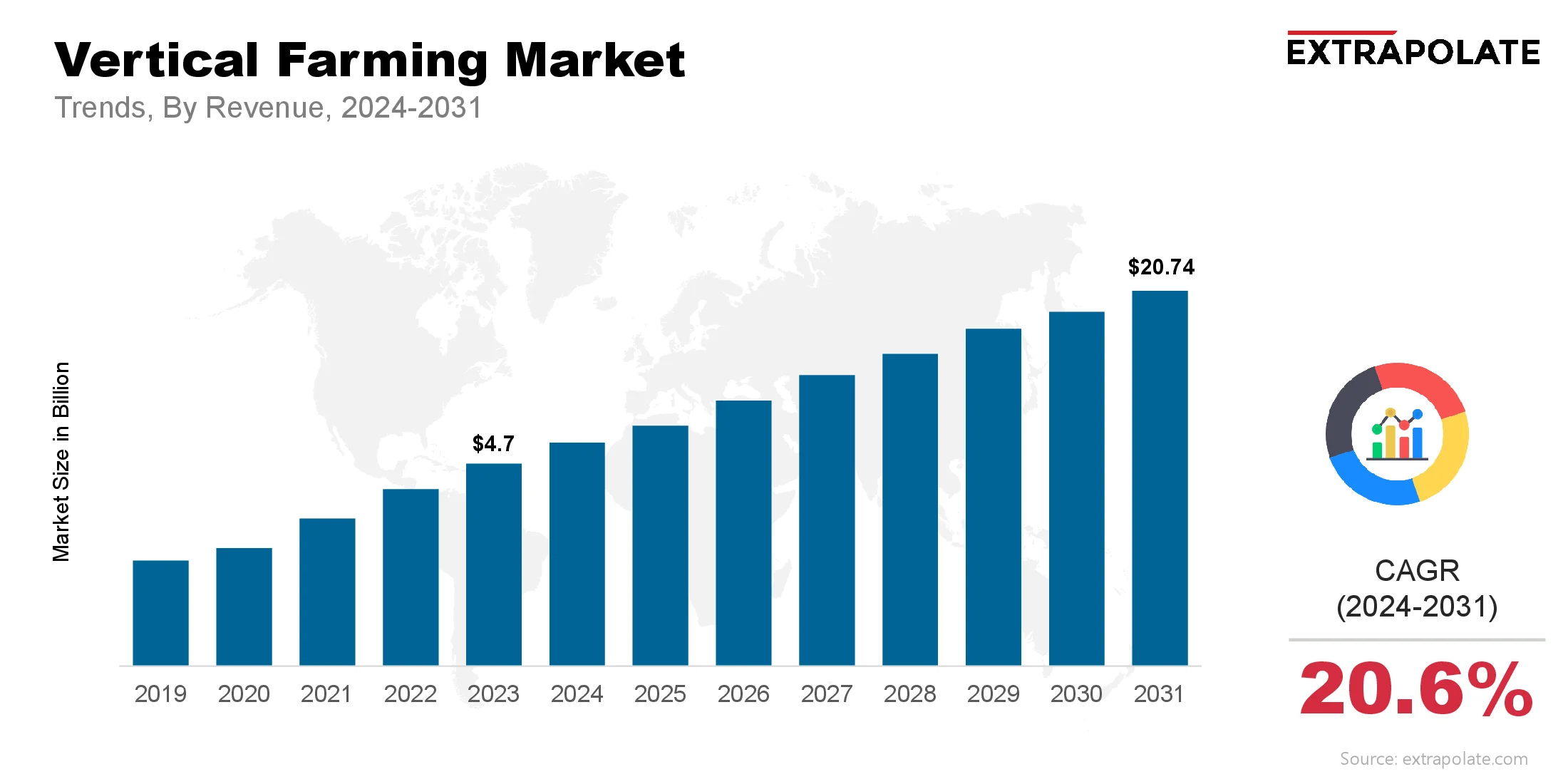
The global Vertical Farming Market size was valued at USD 4.76 billion in 2023 and is projected to grow from USD 5.76 billion in 2024 to USD 20.74 billion by 2031, exhibiting a CAGR of 20.6% during the forecast period.

The vertical farm market is increasing rapidly. This is fuelled by urbanization, restricted agricultural land, environmental degradation, and technological advancements in agriculture. Vertical farming is the production of crops on vertically stacked levels or on the sides of structures. It is gaining popularity as a means to satisfy the global food demand. '

With the world's demand for sustainable agriculture growing, vertical farming maximizes the use of land, minimizes water usage, and reduces environmental degradation from conventional farming. Urban populations are growing. This leads to a higher demand for fresh, locally grown vegetables. Vertical farming allows for a variety of crops to be grown, including leafy veggies, herbs, and fruits, in urban settings.

This change helps lower transportation costs. This, in turn, reduces carbon emissions from traditional farming. Vertical farms often use reused structures like warehouses, empty factories, and shipping containers. This is because these options fit well in towns with little agricultural land.

Vertical farming also tackles water scarcity. Traditional farming uses large amounts of water, harming the environment in water-scarce areas. Vertical farms use hydroponic and aeroponic systems that require up to 90% less water than traditional methods. This makes them appealing for regions facing water shortages. These water-saving practices are paired with renewable energy sources, boosting the sustainability of vertical farming.

The newest technologies are improving vertical farming techniques. Automation, artificial intelligence, and machine learning improve crop yield, quality, and efficiency. Planting, harvesting, and plant monitoring automated systems minimize labor requirements. LED lighting technology offers more control over light, maximizing plant growth and enhancing per-square-foot yield. These technologies maximize productivity and cost reduction in vertical farming.

The market is gaining increasing investment from public and private sectors. Vertical farming is a means through which governments are able to enhance food security and advance sustainable practice. Venture capital and large agricultural firms are willing to invest in new markets and technology.

Consumer recognition of the environmental impact of conventional farming is increasing. Vertical farming is to take center stage in the future of farming. The industry is revolutionized by having fresh, local produce with limited environmental footprints, which qualifies it as an industry game changer.

The market will continue growing, with dominant players looking at areas of expansion, such as international markets and emerging, advanced farming solutions. The global market for vertical farming is set for significant growth in a focus on sustainable, efficient, and modern methods of farming.

Vertical Farming Market Size & Share, By Revenue, 2024-2031

Key Market Trends Fueling Product Adoption

The vertical farming industry flourishes on innovation, green consciousness, and effective food production. The key trends fueling its adoption are:

  • Sustainability Focus: Vertical farming consumes less water, land, and pesticides. It is an environmentally friendly method that appeals to consumers and companies who are concerned about the environment.
  • Technological Integration: Automation, artificial intelligence, and the Internet of Things (IoT) support vertical farming. Intelligent systems control lighting, temperature, and humidity, raising crop yields.
  • Urban Agriculture: Vertical farming is ideal in cities with constricted space. Cultivating crops vertically satisfies food requirements of dense urban areas with increasing populations.
  • Consumer Preference for Freshness: Vertical farms produce fresh products locally. It eliminates long-distance transportation and prolongs freshness in produce.
  • Organic Farming Trends: Organic demand fuels vertical farming, which is a chemical-free method of producing food.

Major Players and Their Competitive Positioning

The vertical farming industry is expanding rapidly. Old players and new entrants desire more market share. Prominent players are AeroFarms, Plenty, and Infarm. They are employing cutting-edge technologies to grow their vertical farming businesses. There are smaller companies emerging as well. They provide niche solutions for certain crops or geographies.

Consumer Behavior Analysis

Increasing numbers of consumers are opting for vertical farming products due to various reasons:

  • Health and Freshness: They prefer fresh, pesticide-free crops that are richer in nutrients.
  • Environmental Impact: Such methods promote sustainability as they consume less and reduce carbon footprints.
  • Convenience: Locally produced crops are available nearby, reducing transportation time and expense.
  • Ethical Sourcing: Vertical farming provides transparent production processes, which is preferred by those concerned with ethical sourcing of food.

Pricing Trends

Pricing trends in the vertical farming market depend on crop type, technology, and operation scale. Initial investments in vertical farming systems may be high. However, long-term savings from lower water use and energy-efficient practices drive market growth. As efficiencies improve, consumer prices for vertically farmed produce should stay competitive with traditional products.

Growth Factors

A few major changes are growing the vertical farming industry:

  • Urbanization: Increased population in cities is growing the demand for local food production.
  • Technological Advancements: Improved automation, AI, and IoT are enhancing yields of crops and reducing expenses.
  • Climate Change: Vertical farming reduces the impact of volatile weather and decreases dependence on conventional farming, which is exposed to climate risks.
  • Resource Efficiency: Growing food using fewer inputs such as water and land makes vertical farming attractive.

Regulatory Landscape

The regulatory landscape for vertical farming is changing. Different regions are adopting various policies to promote sustainable farming. Governments may offer incentives for vertical farming projects, especially in cities. They also set standards for food safety, energy efficiency, and environmental impact.

Recent Developments

Vertical farming is evolving rapidly. New technologies and breakthroughs emerge frequently. Some recent highlights include:

  • Sophisticated Growing Systems: Computer-based systems now adjust and regulate conditions for various crops.
  • Venturing into New Markets: Vertical farming is moving outside North America and Europe. Huge investments are happening in Asia and the Middle East.
  • Energy Efficiency Advances: New technology is lowering energy consumption, making vertical farming more affordable.
  • Sustainability Certifications: Firms are obtaining certifications for sustainable processes to appeal to environmentally conscious customers.

Current and Potential Growth Implications

  1. Demand-Supply Analysis

Demand for vertically farmed produce is steadily rising. This trend comes from consumers wanting fresh, local, and sustainable food. However, challenges exist. Scaling production and handling initial capital investments may affect the supply of vertically farmed products in some areas.

  1. Gap Analysis

The vertical farming market has made strides, but improvements are still needed:

  • Scalability: Expanding vertical farming on a larger scale is tough due to high costs.
  • Energy Consumption: Energy-efficient technologies are better, but we still need to cut energy use in vertical farming.
  • Crop Diversity: Leafy greens are the main crops in vertical farms. More research is needed to grow a wider variety.

Top Companies in the Vertical Farming Market

Some of the top companies in the vertical farming market include:

  • AeroFarms
  • Plenty
  • Infarm
  • Bowery Farming
  • Green Spirit Farms
  • Local Roots Farms
  • Rise Gardens
  • Urban Crop Solutions
  • Sky Greens
  • One

Vertical Farming Market: Report Snapshot

Segment

Details

Farming Technique

Hydroponics, Aeroponics, Aquaponics, Soil-based Vertical Farming

Application

Commercial Agriculture, Urban Agriculture, Research & Development, Others

Crop Type

Leafy Greens, Herbs, Microgreens, Fruits, Others

End User

Consumers, Retailers, Restaurants, Food Processing, Others

Region

North America, Europe, Asia-Pacific, Middle East & Africa, South America

High Growth Segments

The following market segments will likely see strong growth:

  • Leafy Greens: These crops thrive in vertical farming. They grow quickly and need little space.
  • Microgreens: This high-value crop needs minimal space and resources. It’s perfect for urban vertical farming.
  • Herbs: Vertically grown herbs are gaining popularity. They are in high demand and can be grown in small areas.

Major Innovations

Innovation is key to staying competitive in vertical farming. Here are some recent advances:

  • AI-Powered Systems: These use automation and AI to boost crop yields and lower costs.
  • LED Lighting Systems: Tailored lighting that enhances plant growth and cuts energy use.
  • Water Recycling Technologies: New methods recycle water in closed-loop systems to reduce consumption.

Potential Growth Opportunities

Companies in the vertical farming market face several challenges:

  • High Capital Costs: The upfront investment in vertical farming is high. This often keeps smaller players out of the market.
  • Energy Efficiency: Lowering energy use is essential. It's a major challenge for vertical farms to stay economically viable.
  • Consumer Awareness: The market is still new, so boosting consumer awareness about the benefits of vertical farming is crucial for adoption.

Kings Research says:

The vertical farming industry is on the verge of dramatic expansion. It is driven by emerging technology, urbanization, and environmental concerns. Businesses that address issues such as scalability, energy efficiency, and capitalization will succeed in this rapidly evolving industry.

FAQ

The global market is projected to reach USD 20.74 billion by 2031, growing at a CAGR of 20.6% from 2024 to 2031.
The global market was valued at USD 5.76 billion in 2024.
Vertical farming is ideal in cities with constricted space. Cultivating crops vertically satisfies food requirements of dense urban areas with increasing populations.
Key players in the market are AeroFarms, Plenty, Infarm, Bowery Farming, Green Spirit Farms, Local Roots Farms, Rise Gardens, Urban Crop Solutions, Sky Greens, Farm One and Others.

ARE YOU SEEKING COMPREHENSIVE INSIGHT ON VARIOUS MARKETS?
CONTACT OUR EXPERTS TODAY

Speak to an Expert
Vertical farming market

Vertical Farming Market Size

  • May-2025
  • 140
  • Global
  • agritech
3499

SELECT AN OPTION

  • 1 User Access
  • PDF Report View
  • Non-Printable
  • 32 Man-hours Analyst Support
  • Post-Sale Support 48 Hours
  • Access upto 5 users
  • PDF Report View
  • Print Available
  • Access to Data Sheet
  • Up to 10% Customization
  • 40 Man-hours Analyst Support
  • Post-Sale Support 72 Hours
  • Annual Update
  • Unlimited User Access
  • Downloadable PDF Report. Data Sheet, Power Point Presentation
  • Print Available
  • Up to 20% Customization
  • 72 Man-hours Analyst Support
  • Post-Sale Support 120 Hours
  • Bi-Annual Update

ENQUIRE NOW REQUEST SAMPLE
Dale Byrne

HAVE A QUESTION?
Samuel will help you find what you are looking for.


Call: 888-328-2189


Related Research

Agricultural Biologicals Market Size, Share, and COVID-19 Impact Analysis, By Function Type (Biopest

July-2022


Agricultural Supply Chain Service Market Size, Share, Growth & Industry Analysis, By Service Type (P

June-2025


Agriculture Drippers Market Insights 2022, Global Analysis and Forecast to 2030

July-2021


Agrigenomics Market Size, Share, Growth & Industry Analysis, By Technology (Gene Editing, Genetic Se

March-2025


Agritourism Market Size, Share, Growth & Industry Analysis, By Activity Type (Farm Stays, Direct Mar

May-2025


Birch Wood Product Market Insights 2022, Global Analysis and Forecast to 2030

July-2021


Feed Grade Vitamin and Mineral Premixes Market Insights 2022, Global Analysis and Forecast to 2030

July-2021


Feed Grade Vitamin Premixes Market Insights 2022, Global Analysis and Forecast to 2030

July-2021


Global Acid And Nutrient In Animal Nutrition Market Research Report 2022 (Status and Outlook)

June-2022


Global Advanced Herbicides Market Research Report 2022

December-2022


Sample Request

Vertical Farming Market Size, Share, Growth & Industry Analysis, By Farming Technique (Hydroponics, Aeroponics, Aquaponics, Soil-based Vertical Farming), By Application (Commercial Agriculture, Urban Agriculture, Research & Development, Others), By Crop Type (Leafy Greens, Herbs, Microgreens, Fruits, Others), Large Enterprises), By End User (Consumers, Retailers, Restaurants, Food Processing, Others), and Regional Analysis, 2024-2031

Publisher: Kings Research   |   Date: 2025-05-20   |   No. Of Pages: 140

Send Your Query

Vertical Farming Market Size, Share, Growth & Industry Analysis, By Farming Technique (Hydroponics, Aeroponics, Aquaponics, Soil-based Vertical Farming), By Application (Commercial Agriculture, Urban Agriculture, Research & Development, Others), By Crop Type (Leafy Greens, Herbs, Microgreens, Fruits, Others), Large Enterprises), By End User (Consumers, Retailers, Restaurants, Food Processing, Others), and Regional Analysis, 2024-2031

Publisher: Kings Research   |   Date: 2025-05-20   |   No. Of Pages: 140
Extrapolate

Extrapolate has a refined network of top publishers across the globe covering markets and micro markets who bring in the power of decision making. Our network of publishers is ranked based on the quality of reports produced along with customer feedback Indexing.

 talk@extrapolate.com

888-328-2189


Connect With Us

twitter logo

Industry

Quick Links

  • About Us
  • Contact Us
  • FAQ
  • Privacy Policy
  • Disclaimer
  • Refund Policy
  • Sitemap


Payment Gateway
Sign up for newsletter and updates


Powered By

Kings Research
© 2025 Kingsresearch. All Rights Reserved.