Replenishment Facial Mask Market Size, Share, Growth & Industry Analysis, By Product Type (Sheet Masks, Gel Masks, Cream Masks, Clay Masks, Hydrogel Masks), By Skin Concern (Hydration, Anti-Aging, Brightening, Acne-Prone, Sensitive Skin), By Distribution Channel (Online Retail, Supermarkets/Hypermarkets, Pharmacies, Specialty Stores), By End-User (Household, Salons & Spas, Dermatology Clinics), and Regional Analysis, 2024-2031
Replenishment Facial Mask Market: Global Share and Growth Trajectory
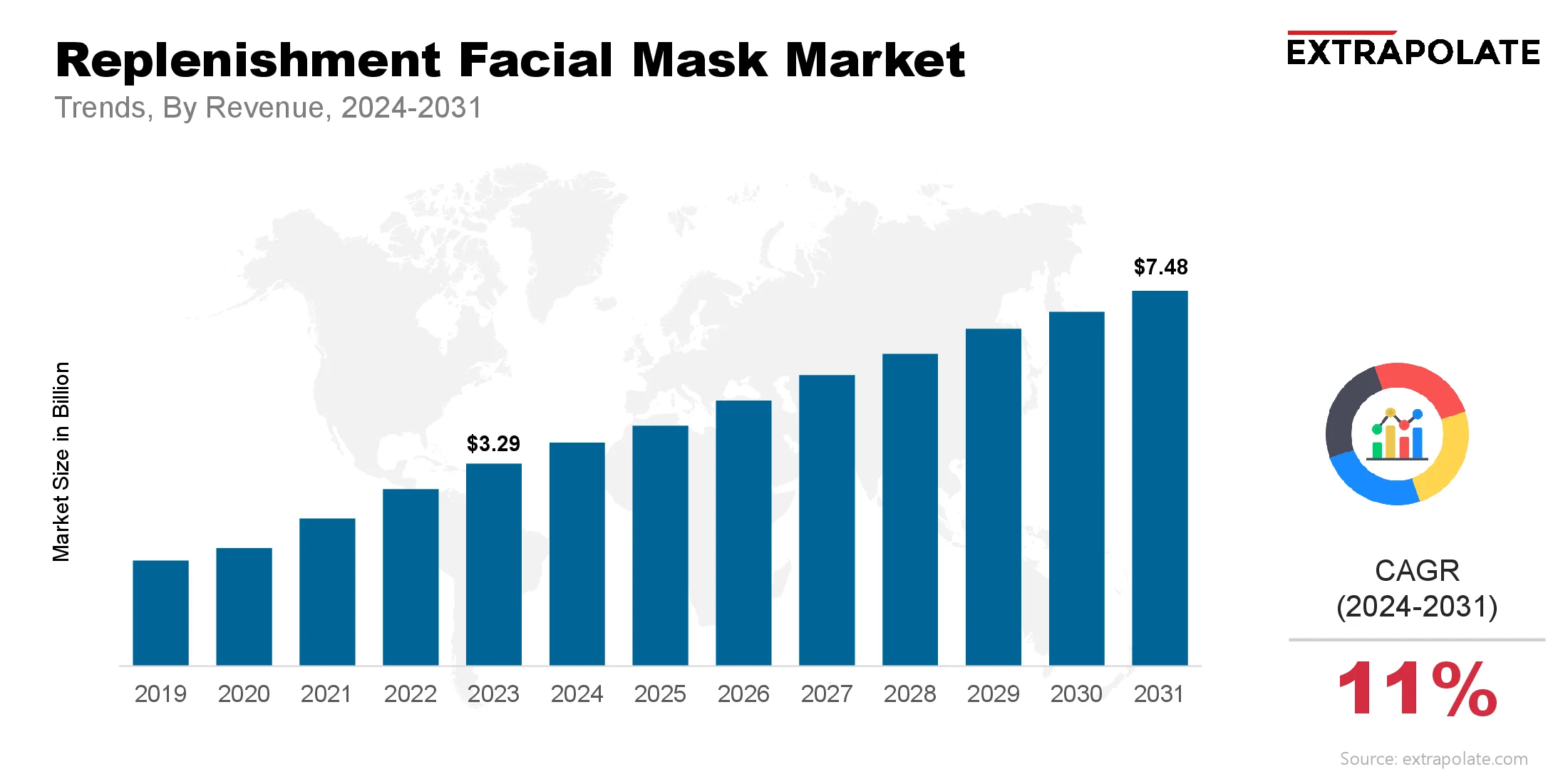
The global Replenishment Facial Mask Market size was valued at USD 3.29 billion in 2023 and is projected to grow from USD 3.60 billion in 2024 to USD 7.48 billion by 2031, exhibiting a CAGR of 11% during the forecast period.
The worldwide market for replenishment facial masks is expanding steadily. This growth is stimulated by increased consumer demand for self-care and enhanced skincare regimens. They contain potent active ingredients that are used once or more in a while. They restore moisture, enhance texture, and increase the strength of the skin barrier. They are easy to use and effective, making them unavoidable components in skincare routines today.
There are many drivers behind this market growth. Growing personal grooming awareness, social media, and concern over anti-aging products are transforming the beauty market. Coupled with growing disposable incomes, expanding middle classes in emerging markets stimulate demand. The trend toward natural, biodegradable, and sustainable ingredients is also creating new avenues for growth. This change appeals to green consumers and shapes product development.
Key Market Trends Driving Product Adoption
- Increased Awareness of Skin Health and Preventative Skincare: One of the biggest drivers of the replenishment facial mask industry is increasing preventive skincare. People are now looking for proactive solutions rather than reactive ones. Replenishment facial masks provide a simple yet effective means of feeding the skin. They treat dryness, redness, and uneven tone. The masks are frequently made with hyaluronic acid, ceramides, peptides, and plant actives. The formulas are designed to recapture moisture and enhance skin elasticity with consistent use.
- Personalized and Functional Skincare Products: Personalized and functional beauty products are on the rise among consumers. Brands are introducing targeted replenishment masks addressing individual issues such as anti-aging, brightening, acne control, and barrier repair. Sophisticated technologies like skin diagnostics and AI personalization enable customized skincare. All these trends inspire consumers to use replenishment masks on a regular basis, increasing brand loyalty and repeat purchases.
- Natural, Vegan, and Eco-Friendly Innovations: Today's consumers care more about what they put on their skin and its environmental impact. Clean beauty and sustainability have gone mainstream. Many replenishment mask brands are adopting eco-friendly practices. They use vegan ingredients and avoid harmful chemicals like parabens and sulfates. They also employ biodegradable materials like bamboo fiber or cotton cellulose for their sheets. Packaging innovations that cut down plastic use and enhance recyclability are also shaping consumer choices.
- Integration of E-Commerce and Influencer Marketing: E-commerce and online interaction have transformed the process of purchasing skincare. Digital platforms, particularly beauty marketplaces and social media, significantly impact customer preferences. Dermatologists and influencers provide mask routines, reviews, and tutorials, forming an educational setting that encourages takeup. Auto-replenishment services and subscription models also enhance consistent demand for replenishment masks.
Major Players and their Competitive Positioning
The market for replenishment facial masks is competitive and fragmented. Global cosmetic firms and specialty skincare start-ups compete for consumer minds. Market leaders differentiate with innovative formulations, high-end packaging, celebrity endorsements, and powerful distribution channels. Prominent companies in the space include:
- L'Oréal Group
- The Estée Lauder Companies Inc.
- Shiseido Co., Ltd.
- Unilever PLC
- Procter & Gamble Co.
- Johnson & Johnson
- Amorepacific Corporation
- Beiersdorf AG
- Dr. Jart+ (now under Estée Lauder)
- Sephora (LVMH)
- The Ordinary (DECIEM)
These brands continue to expand their product lines to address evolving skincare needs. Many have also partnered with dermatologists, beauty influencers, and research institutes to enhance credibility and consumer trust.
Consumer Behavior Analysis
- Routine and Consistency Focus: Whereas occasional-use skincare products get used sometimes, replenishment facial masks are applied regularly—daily, bi-weekly, or weekly—based on skin type and desired results. Consumers see these masks as a maintenance routine and not a luxury, which fuels demand for multi-pack products and subscription services. Frequent use creates brand loyalty and increases customer lifetime value.
- Dermatologist-Recommended and Clinical-Grade Preferred: Consumers are now more attracted to evidence-based skincare. This has resulted in increased demand for dermatologically tested, hypoallergenic, and clinically proven products. Transparancy of ingredient list and clear efficacy information are what brands with transparent ingredient lists and clear efficacy data are experiencing stronger consumer loyalty.
- Demand for Quick and Visible Results: Replenishment facial masks are generally popular since they provide visibly improved hydration, texture, and radiance in a matter of minutes. The instant result is tempting to young consumers and busy people who want ease without sacrificing effectiveness.
- Price Sensitivity and Value-Driven Choices: While premium masks are in high demand in developed markets, price sensitivity is still a key factor in emerging economies. Price-conscious consumers in such countries use cheap, multi-pack options or locally produced solutions that provide acceptable quality. Value propositions such as ingredient transparency, longer shelf-life, and bundling play a powerful role in influencing purchasing.
Pricing Trends
Prices for replenishment facial mask products are highly variable depending on ingredients, prestige brand, packaging, and geographic area. Luxury brand single-use masks can be priced between $8–$20, while drugstore and mass-market brands provide multiple packs costing less than $1 per mask. Price differentiation also comes from advances in materials and active ingredients.
High-end players typically employ hydrogel, bio-cellulose, or fermented essences that drive up cost of production but heighten product experience. While mass-market players realize economies of scale by way of reduced formulations and distribution through general retail channels.
Growth Factors
- Skincare Expansion by Age Groups and Gender: Skincare is no longer confined to women or mature consumers. Gen Z, millennials, and men are all becoming more involved in skincare routines, driving demand up. Brands are launching unisex and youth-oriented lines of replenishment masks to address these new trends.
- Emerging Market Penetration: Accelerating urbanization, increased incomes, and beauty education are creating new markets throughout Asia-Pacific, Latin America, and the Middle East. South Korea, Japan, and China continue to be innovation centers and consumption drivers, while major growth potential lies in Southeast Asia, India, and Africa.
- Growth of At-Home Beauty and Wellness: Post-pandemic normalization of home self-care rituals has fortified the category of replenishment masks. Since consumers still favor convenience at home when it comes to skincare, the post-pandemic relevance of the category expands beyond salons and spas.
- Innovation in Formulation and Application: Advances in slow-release encapsulation, probiotics for skincare, and two-layer masks advance product functionality. Additionally, no-drip, easy-to-apply formats and travel-friendly packaging enhance user experience, lowering friction in frequent use.
Regulatory Landscape
The replenishment facial mask market is governed by cosmetic regulations that vary by region:
- United States (FDA): Masks are regulated under the Federal Food, Drug, and Cosmetic Act. Claims must be substantiated, and ingredients deemed safe.
- European Union (EC No 1223/2009): Products require notification through the Cosmetic Product Notification Portal (CPNP) and must comply with safety assessments.
- Asia-Pacific: Countries like South Korea, Japan, and China have increasingly rigorous regulations. China now allows some cosmetic imports without animal testing, signaling regulatory modernization.
- ISO 22716 Compliance: Many manufacturers adhere to ISO guidelines to ensure good manufacturing practices, especially for sensitive skin and medical-grade masks.
Recent Developments
- Sustainable Packaging Launches: Large brands such as Unilever and L'Oréal are testing 100% recyclable or compostable mask packaging.
- Microbiome-Based Formulas: New products center around preserving or enhancing the skin microbiome, an area of new frontiers in long-term skin health.
- Influencer Collaborations: Social media influencers and dermatologists are both partnering with niche and legacy brands to introduce limited-edition replenishment mask collections.
- Rise of Local Indie Brands: Small-scale brands in regions such as Southeast Asia and Eastern Europe are seeing success based on cultural saliency, pricing, and local sourcing.
Current and Potential Growth Implications
Demand-Supply Analysis
Demand continues to outpace supply in specific high-performance segments like probiotic masks or clinical-grade anti-aging masks. However, established mass-market categories face saturation in mature markets. This dichotomy is leading to segmentation-driven production planning and SKU diversification.
Gap Analysis
While awareness is growing, gaps persist in product availability across rural and semi-urban markets. Furthermore, access to dermatologist-backed or sensitive skin-friendly options is limited in emerging regions. Addressing these gaps presents opportunities for new entrants and regional players.
Top Companies in the Replenishment Facial Mask Market
Leading global players include:
- L'Oréal Group
- The Estée Lauder Companies Inc.
- Shiseido Co., Ltd.
- Unilever PLC
- Procter & Gamble Co.
- Amorepacific Corporation
- Beiersdorf AG
- Dr. Jart+
- Innisfree
- The Face Shop
Replenishment Facial Mask Market: Report Snapshot
Segmentation | Details |
By Product Type | Sheet Masks, Gel Masks, Cream Masks, Clay Masks, Hydrogel Masks |
By Skin Concern | Hydration, Anti-Aging, Brightening, Acne-Prone, Sensitive Skin |
By Distribution Channel | Online Retail, Supermarkets/Hypermarkets, Pharmacies, Specialty Stores |
By End-User | Household, Salons & Spas, Dermatology Clinics |
By Region | North America, Europe, Asia-Pacific, Latin America, Middle East & Africa |
High Growth Segments
- Hydrogel and Biocellulose Masks: These offer superior adherence, enhanced absorption, and premium skincare benefits.
- Online Subscription Channels: Auto-replenishment services for masks are gaining traction in developed markets.
- Clinical-Grade Brightening Masks: Products targeting pigmentation and uneven skin tone are witnessing rapid adoption.
Major Innovations
- Dual-Chamber Mask Packaging: Separating essence from the sheet to activate only when opened ensures freshness and potency.
- AI-Powered Skin Diagnostics: Apps and devices recommend replenishment masks based on real-time skin analysis, personalizing product selection.
- Waterless Formulas: Concentrated masks reduce water usage, improve ingredient efficacy, and support sustainability.
Potential Growth Opportunities
- Dermatologist Collaborations: Partnering with skincare professionals adds scientific credibility and appeals to clinical skincare users.
- Men’s Grooming: A largely untapped segment, particularly in Asia and North America, where men are beginning to explore replenishment masks.
- Localized Formulations: Adapting product lines to suit regional climatic conditions, pollution levels, and cultural skincare habits can unlock new growth.
Kings Research says:
The replenishment facial mask market is positioned for sustained and dynamic growth, driven by the convergence of scientific innovation, shifting consumer behavior, and expanding access across regions. With rising global interest in skincare wellness, brands that prioritize efficacy, sustainability, and personalization are poised to lead. The increasing demand for clinically-backed, natural, and purpose-driven formulations highlights a more informed and intentional consumer base. As competition intensifies, success will hinge on a brand's ability to integrate digital touchpoints, offer differentiated value, and adapt to localized preferences. Kings Research believes that replenishment facial masks will continue to evolve from being a cosmetic accessory to an essential component of holistic skin health, opening up robust opportunities for brands, formulators, and investors alike.
ARE YOU SEEKING COMPREHENSIVE INSIGHT ON VARIOUS
MARKETS?
CONTACT OUR EXPERTS TODAY
Replenishment Facial Mask Market Size
- June-2025
- 148
- Global
- Retail
Related Research
Activewear Market Size, Share, Growth & Industry Analysis, By Product Type (Athletic Shoes, Sports B
March-2025
Agrobacterium tumefaciens Competent Cells Market Insights 2022, Global Analysis and Forecast to 2030
July-2021
Aluminium Composite Panels (ACP) Market Insights 2022, Global Analysis and Forecast to 2030
July-2021