Digital Twin Market Size, Share, Growth & Industry Analysis, By Type (Product Digital Twins, Process Digital Twins, System Digital Twins), By End-User Industry (Manufacturing, Automotive, Healthcare, Energy, Aerospace & Defense, Construction), By Application (Predictive Maintenance, Process Optimization, Product Design, Supply Chain Management), and Regional Analysis, 2024-2031
Digital Twin Market: Global Share and Growth Trajectory
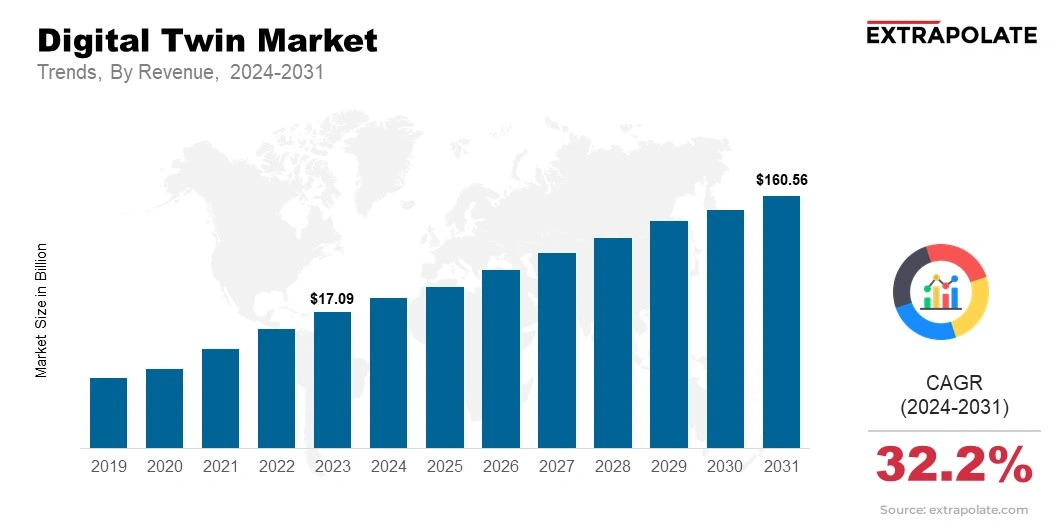
The global digital twin market size was valued at USD 17.09 billion in 2023 and is projected to grow from USD 22.77 billion in 2024 to USD 160.56 billion by 2031, exhibiting a CAGR of 32.2% during the forecast period.
The market is growing fast, with IoT, AI, and data analytics driving this growth. A digital twin is a digital version of a physical asset, process, or system. It enables live monitoring, examination, and improvement.
The digital twins market is significantly expanding. Their ability to track asset performance and health, cut costs, and improve decision-making is propelling this growth. Manufacturing, automotive, healthcare, and energy segments are making use of digital twins.
They aim to boost efficiency, predict failures, and optimize operations. The market is estimated for continuous growth, with key markets progressively depending on digital twin technologies for several applications, which include predictive maintenance, refinement of the process, and design of the product.
Key Market Trends Driving Product Adoption
Various key trends are instrumental in the rapid adoption of digital twin technologies:
- Advancements in IoT and Connectivity: Advancements in IoT are accelerating the rise of digital twins. A plethora of Internet of Things devices sends live data from real assets. This data becomes the foundation for crafting precise digital models.
- Predictive Maintenance: In a world where downtime can mean dollars lost, digital twins emerge as the solution. These innovative virtual models empower industries to anticipate equipment failures before they occur. By harnessing predictive maintenance, companies reduce costs and keep operations seamless.
- Integration with AI and Machine Learning: The association of AI, machine learning, and digital twin technology is upgrading the predictive capabilities of digital twins, making way for more precise forecasts and refinement.
- Industry 4.0 and Smart Manufacturing: Digital twin is leading Industry 4.0 revolution by transforming smart factories. This revolutionary tech enables real-time monitoring, paving the way for seamless automation. With the power to enhance efficiency, it makes improvements intuitive and effortless.
- Increased Demand for Real-Time Data Analysis: The need for real-time insights across multiple industries is fuelling the acquisition of digital twin, which provide constant feedback and decisions based on data.
Major Players and Their Competitive Positioning
The Digital Twin market thrives in fierce competition, buzzing with innovation. Industry giants like Siemens, GE Digital, IBM, Microsoft, and Dassault Systèmes are pouring resources into digital twin solutions. These trailblazers aim to expand their product portfolio and embrace AI and machine learning. They’re committed to crafting sector-specific solutions, ensuring relevance in a dynamic landscape.
These leaders leverage strategic partnerships, collaborations, and savvy procurements to fortify their competitive edge.
Consumer Behavior Analysis
As industries become more data-driven and automation continues to progress, the adoption of digital twin technology is progressively growing. Key shifts in consumer behavior comprise of:
- Emphasis on Efficiency and Cost Savings: Companies are exploring ways to upgrade their operations and cut-down costs. Digital twins offer an economical solution for predictive maintenance, process optimization, and management of assets.
- Focus on Data-Driven Decision-Making: Organizations are tapping into the digital twin trend for decision-making success. With real-time data at their fingertips, they refine their operational prowess. This boost in efficiency comes with the bonus of reduced risks.
- Industry-Specific Customization: As digital twin technologies mature, businesses are looking for individualized solutions. Whether in manufacturing, healthcare, energy, or transportation, each industry seeks answers tailored to its unique challenges. The demand for specialized strategies is growing, driving innovation in every sector.
- Growing Awareness and Training: With the increasing demand for digital twin solutions, companies are significantly investing in training their workforce to efficiently leverage the technology and boost its benefits.
Pricing Trends
Pricing of digital twin solutions depends on the complexity of the technology, scale of implementation, and industry. Basic digital twin models are not very expensive, especially for small applications, but more complex and large-scale systems designed for industries like aerospace or energy are quite expensive.
Furthermore, subscription-based pricing models are coming into use, offering flexible pricing structures for customers. With improvement in maturity and competition in the technology, there will be a more aggressive price structure for the digital twin platforms, which will help businesses of all sizes make more affordable procurements.
Regional Analysis
North America accounted for around 34% share of the Digital Twin market in 2023, with a valuation of USD 5.93 billion. The incorporation of AI, machine learning, and advanced analytics is upgrading the potential of digital twins, enabling more precise predictions and streamlined operations.
The Asia Pacific Digital Twin market is poised to grow at a CAGR of 33% through the projection period.
Growth Factors
Key factors fueling the growth of the market include:
- Increased Adoption in Manufacturing: Manufacturing industries are implementing digital twin technology to streamline operations, minimize downtime, and enhance overall equipment efficiency.
- Advancements in AI and Analytics: The incorporation of AI, machine learning, and advanced analytics is upgrading the potential of digital twins, enabling more precise predictions and streamlined operations.
- Need for Real-Time Monitoring and Control: As industries look to upgrade real-time monitoring and command over their processes, digital twins offer a useful resource for attaining these goals.
- Support from Government Initiatives: Governments all over the world are progressively supporting the digital transformation of industries through policies and incentives, which are driving the implementation of digital twin systems.
Regulatory Landscape
The regulatory environment for digital twin technology is constantly evolving and has resulted in the development of various standards for interoperability, security, and privacy guarantees for the digital twin systems.
In areas such as health and energy, regulatory bodies are formulating norms meant to guide the use of digital twins at par with industry-specific regulations. Thus, more and more regulations are expected come up to oversee data protection, cyber security, and system integration as the technology advances.
Recent Developments
Key innovations in the market are:
- Expansion of Cloud-Based Digital Twin Platforms: Cloud-based platforms are making digital twins easier to access by permitting businesses to access live data and analytics from anywhere, cutting down the need for on-premise infrastructure.
- Integration of 5G Technology: The adoption of 5G technology is optimizing performance of digital twins by providing quicker transmission of data and more trustworthy connectivity, allowing real-time updates and effortless integration with IoT devices.
- Collaborations with Industry Leaders: Companies like IBM, Microsoft, and GE Digital are collaborating with industry leaders to create specialized digital twin solutions, such as for smart cities, autonomous vehicles, and industrial IoT applications.
Current and Potential Growth Implications
a. Demand-Supply Analysis
Digital twin solutions are becoming more in demand in various industries because of growing requirements for real-time monitoring, predictive analytics, and process optimization.
However, in some sectors, the supply of digital twin solutions remains limited as those require models to be more highly customized or complex. With continued technological improvement, the supply of affordable and scalable digital twin solutions will rise, making it more available to a wider range of industries and applications.
b. Gap Analysis
Regardless of its development, multiple gaps still sustain in the market:
- High Implementation Costs: While the benefits of digital twins are clear, the costs incurred in the initial stages can be premium, specifically for industries with complicated systems that require customized digital twin solutions.
- Lack of Standardization: The absence of widely recognized guidelines for digital twin technologies can pose obstacles for organizations while incorporating multiple systems and platforms.
- Skill Shortages: The demand for experts who can manage, maintain, and optimize digital twin systems is on the rise, and there is a shortage of skilled staff in the market.
Top Companies in the Digital Twin Market
- Siemens
- General Electric (GE)
- IBM
- Microsoft
- Dassault Systèmes
- PTC
- ANSYS
- Bentley Systems
- Honeywell International
Digital Twin Market: Report Snapshot
Segmentation | Details |
By Type | Product Digital Twins, Process Digital Twins, System Digital Twins |
By End-User Industry | Manufacturing, Automotive, Healthcare, Energy, Aerospace & Defense, Construction |
By Application | Predictive Maintenance, Process Optimization, Product Design, Supply Chain Management |
By Region | North America, Europe, Asia-Pacific, Latin America, Middle East & Africa |
High Growth Segments
Particular sections are expected to see a substantial increase, including:
- Manufacturing: Digital twins are being universally recognized in the manufacturing sector for predictive maintenance and streamlining of the process, which are projected to boost market development.
- Automotive & Aerospace: The automotive and aerospace industries are progressively making use of digital twins for designing products, testing, and optimization, specifically for autonomous vehicles and aircraft systems.
- Healthcare: The use of digital twins in healthcare for customized medicine, keeping a watch on patients, and hospital management is a rapidly developing area, opening doors for market development.
Major Innovations
Key innovations in the Digital Twin market include:
- Integration with Edge Computing: Edge computing is being combined with digital twin technologies to allow high-speed data processing at the source, minimizing delay and optimizing immediate decision-making.
- Use of AI and Machine Learning: AI and machine learning algorithms are being incorporated into digital twin systems to upgrade predictive analytics, making way for more precise forecasting and process optimization.
- Cloud-Based Solutions: The emergence of cloud computing has made digital twin platforms more extensible, enabling live processing of data and distance monitoring.
Potential Growth Opportunities
In spite of difficulties, the market presents remarkable growth opportunities:
- Growth in Industrial IoT: The rise of IoT technologies in industries such as manufacturing, energy, and healthcare is providing prime opportunities for digital twins to improve operations and maximize asset value.
- Emerging Markets: Emerging markets, specifically in Asia-Pacific and Latin America, are implementing digital twin technologies as part of their industrial conversion, fostering development potential for digital twin vendors.
- Smart Cities and Infrastructure: The acquisition of digital twin technology for smart cities, urban development, and infrastructure management presents a major market potential.
Extrapolate Research says:
The Digital Twin market is likely to witness high growth as the IoT, AI, and data analytics technologies continue to advance. As industries are constantly seeking improvements in efficiency and cost savings, digital twin technologies are becoming increasingly important in various sectors. With applications growing in predictive maintenance, process optimization, and product design, digital twins have the potential to be transformative. With further maturation of this technology, there would be further innovation and adoption in the market, led by cloud-based platforms and industry-specific solutions.
ARE YOU SEEKING COMPREHENSIVE INSIGHT ON VARIOUS
MARKETS?
CONTACT OUR EXPERTS TODAY
Digital Twin Market Size
- February-2025
- 140
- Global
- Information-Technology-Communication-IoT
Related Research
2018-2023 Commercial Interior Design Market Size, Share & Trends Analysis Report By Application ( O
March-2021
2018-2023 Industrial Product Design Market Size, Share & Trends Analysis Report By Application ( Tr
March-2021
2D Animation Software Market Size, Share & Trends Analysis Report By Application (Construction Field
March-2021
2D Vision Measuring Systems Market Size, Share & Trends Analysis Report By Application ( Commercial
March-2021
360 Degree Feedback Software Market Size, Share & Trends Analysis Report By Application ( Corporatio
March-2021
3D and 4D Technology Market Size, Share & Trends Analysis Report By Application (Entertainment, Cons
March-2021
3D Animated Films Market Size, Share & Trends Analysis Report By Application ( Children, Adults, Oth
March-2021
3D CAD Design Software Market Size, Share & Trends Analysis Report By Application (Small Business, M
March-2021
3D CAD Software Market Size, Share & Trends Analysis Report By Application ( Manufacturing, Automo
March-2021
3D CAD Software Market Size, Share & Trends Analysis Report By Application (Manufacturing, Automotiv
March-2021
