Organized Retail Market Size, Share, Growth & Industry Analysis, By Type (Supermarkets, Hypermarkets, Convenience Stores, Ecommerce), and Regional Analysis, 2024-2031
Organized Retail Market: Global Share and Growth Trajectory
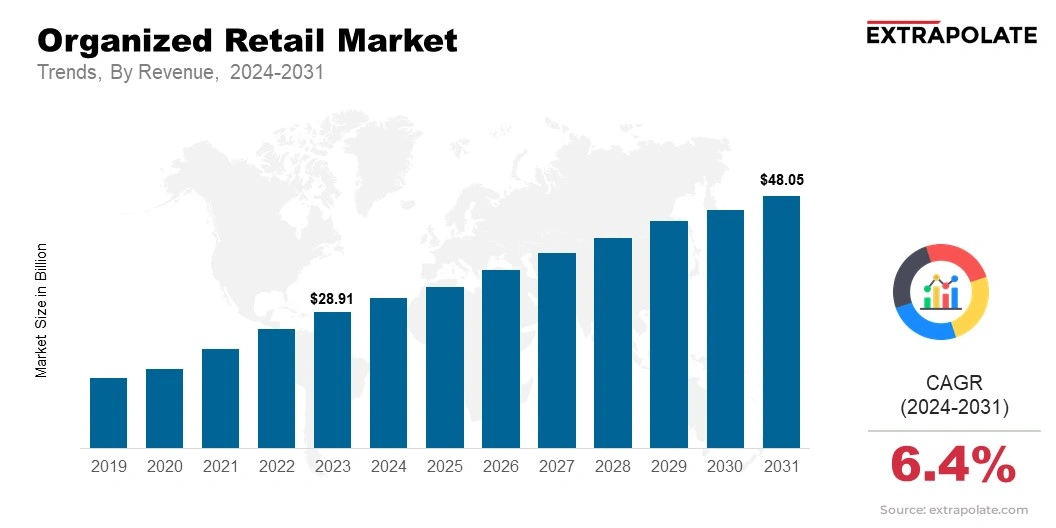
The global organized retail market size was valued at USD 28.91 billion in 2023 and is projected to grow from USD 31.03 billion in 2024 to USD 48.05 billion by 2031, exhibiting a CAGR of 6.4% during the forecast period.
The global market is experiencing substantial growth, driven by rapid urbanization, the increasing adoption of digital technologies, and shifting consumer preferences towards convenience and personalized shopping experiences.
This market encompasses a wide range of retail formats, including supermarkets, hypermarkets, department stores, specialty stores, and e-commerce platforms. As organized retail becomes more accessible and consumer-centric, it is reshaping the retail landscape by providing a diverse range of products and services in a well-structured, customer-focused environment.
Technological advancements, such as artificial intelligence (AI), machine learning, and data analytics, are transforming the way retailers understand and engage with customers. By leveraging these technologies, retailers can offer tailored shopping experiences, optimize supply chains, and predict demand more accurately.
E-commerce, which has seen a surge in popularity, plays a significant role in the expansion of organized retail, enabling businesses to reach a broader audience and offer online-to-offline (O2O) shopping experiences. Furthermore, the growth of mobile commerce and payment solutions is allowing consumers to shop more conveniently and securely, further driving the market’s growth.
The increasing preference for quality products, better customer service, and an enhanced shopping experience is also fueling the demand for organized retail. Consumers are seeking brands and retailers that can offer a wide variety of products, quick delivery options, and a seamless shopping experience across multiple channels.
Retailers are adapting to these demands by investing in omnichannel strategies and enhancing in-store and online experiences.
In addition to the growing demand for organized retail in developed markets, emerging economies are also contributing significantly to the market's expansion. With rising disposable incomes, a growing middle class, and an increasing number of shopping malls and organized retail outlets in countries such as India, China, and Brazil, the market is expected to continue its robust growth trajectory in these regions.
The market is expanding rapidly, driven by digital transformation, evolving consumer preferences, and increased investment in customer experience. As technology continues to shape the future of retail, businesses will need to adapt to stay competitive in an ever-changing landscape.

Key Market Trends Driving Product Adoption
Several key trends are driving the adoption of organized retail:
- E-commerce Expansion: The rise of e-commerce platforms is revolutionizing the organized retail sector. Online shopping offers consumers convenience, competitive prices, and a wide range of products, leading to an increased preference for online retail.
- Technological Innovations: The integration of technology such as AI, big data analytics, and IoT into retail operations is improving customer experience, supply chain efficiency, and inventory management, which is driving market growth.
- Shift Towards Omnichannel Retail: Retailers are focusing on providing an integrated shopping experience across physical and online stores, leading to the rise of omnichannel retailing. This trend is increasingly popular among consumers who prefer the flexibility of shopping both online and offline.
- Rising Consumer Demand for Convenience: With busy lifestyles, consumers are gravitating towards organized retail formats like supermarkets, hypermarkets, and convenience stores that offer a one-stop shopping experience with a wide variety of products under one roof.
- Urbanization and Changing Demographics: Rapid urbanization and the expansion of middle-class populations, especially in emerging economies, are driving the growth of organized retail. Urban centers provide higher disposable incomes and a larger consumer base, contributing to the increased demand for organized retail formats.
Major Players and their Competitive Positioning
The organized retail market is highly competitive, with key players such as Walmart, Amazon, Costco, Carrefour, The Home Depot, Target Corporation, and Tesco PLC leading the charge. These companies innovate with new retail formats. They enhance online and offline capabilities and improve customer experience to stay competitive. Regional players and new entrants are expanding in many countries. This increases competition and drives growth in the sector.
Consumer Behaviour Analysis
Consumer behavior in organized retail is changing. Shoppers now prioritize convenience, variety, and value. Major factors influencing consumer behaviour include:
- Convenience and Accessibility: Consumers value convenience in shopping. Organized retail formats offer easy access to various products and services in one place.
- Price Sensitivity: Price is a key factor in consumer decisions. Shoppers seek competitive prices and great deals, especially in emerging markets.
- Technological Influence: Consumers are becoming more tech-savvy. They prefer personalized shopping experiences using AI, VR, and AR. Retailers that leverage these technologies can enhance customer loyalty and engagement.
- Preference for Sustainable Products: Sustainability is gaining importance in retail. Consumers prefer eco-friendly, ethically sourced, and environmentally conscious products.
Pricing Trends
Pricing strategies in organized retail vary by product category and target market. Retailers adjust prices to meet consumer demand and competition. Common trends include:
- Competitive Pricing: Organized retailers use competitive pricing to attract consumers. They offer discounts, promotions, and loyalty programs, especially in e-commerce and supermarkets.
- Bundling: Some retailers use bundling strategies. They offer discounts on combined products, creating perceived value for consumers.
- Dynamic Pricing: Some retailers are using dynamic pricing models. Prices adjust in real time based on demand, competition, and consumer behavior.
Regional Insights and Market Growth Projections
The organized retail market is witnessing strong growth across all regions, with notable contributions from North America, Europe, Asia-Pacific, and Latin America.
- North America: North America holds a large market share. Key retailers like Walmart and Costco and high disposable income or consumer spending drive growth.
- Europe: The European market is growing steadily. Omnichannel retailing and technological innovations are key drivers.
- Asia-Pacific: China and India is set for the highest growth. Rapid urbanization, a rising middle class, and online retail expansion are key drivers. The region offers major opportunities for organized retail. Developing countries with changing consumer preferences are driving this growth.
- Latin America: The Latin American market is expanding with increasing urbanization and a growing middle class. Brazil and Mexico are driving demand for organized retail solutions.
- Middle East & Africa: The market in the Middle East & Africa is expanding. Urbanization, global brand entry, and rising consumer spending are driving this growth. Countries like the UAE and South Africa are becoming key retail hubs in the region.
Growth Factors
Several factors are propelling the growth of the organized retail market:
- Urbanization: Urban population growth is driving demand for organized retail formats. Supermarkets, malls, and hypermarkets offer a wide range of products and services in one place.
- Improved Consumer Spending: Rising disposable incomes and a growing middle class are boosting consumer spending. This trend is driving growth in organized retail formats.
- Adoption of E-commerce: The rise of online shopping and omnichannel strategies is expanding organized retail. Retailers can now reach more tech-savvy consumers.
- Changing Consumer Preferences: Consumers prefer organized retail formats for a convenient, one-stop shopping experience. This drives demand for larger retail spaces and multi-functional outlets.
Regulatory Landscape
The market follows various regulations. These include labor laws, product safety, and environmental standards. Retailers must follow local regulations on data privacy, consumer protection, and sustainability. Compliance ensures smooth operations and customer trust. Governments are introducing policies to support e-commerce and organized retail growth. These efforts are especially strong in emerging markets.
Recent Developments
Key developments in the organized retail market include:
- Expansion of Ecommerce: Major retailers are making considerable investments in ecommerce platforms. They are using Omnichannel strategies to help customers shop online and offline. This improves the shopping experience.
- Adoption of AI and Automation: AI and automation are altering retail. They improve personalized shopping, improve inventory management. AI is also streamlining logistics.
- Focus on Sustainability: Many retailers are adopting eco-friendly packaging and sourcing ethical products. They are also cutting carbon emissions to support sustainability. This meets the growing demand for green shopping options.
Current and Potential Growth Implications
a. Demand-Supply Analysis
Retailers must innovate with the rising demand for organized retail in developing regions. This will help them Keep pace in a growing market. Retailers can accommodate the surging demand by supplying a broad selection of products and personalized experiences. Using digital tools will also help provide convenience, variety, and affordability.
b. Gap Analysis
Organized retail is growing, but there are omissions in availability and affordability. These issues persist in certain emerging markets. Retailers will need to offer localized solutions to address these shortcomings. Expanding into underserved regions and improving product availability will be main strategies.
Top Companies in the Organized Retail Market
- Walmart
- Amazon
- Costco Wholesale
- Carrefour
- The Home Depot
- Tesco PLC
- Target Corporation
- Apple
- Alibaba
- eBay
Organized Retail Market: Report Snapshot
Segmentation | Details |
By Type | Supermarkets, Hypermarkets, Convenience Stores, Ecommerce |
By Region | North America, Europe, Asia-Pacific, Middle East & Africa, South America |
High Growth Segments
The following segments are expected to experience significant growth:
- E-commerce Retail: Ecommmerce will have a large market share because of its increasing popularity. Retailers are updating digital systems to delight customers.
- Supermarkets and Hypermarkets: Supermarkets and hypermarkets are broadening in urban areas. Consumers want bigger stores for convenience and more product choices.
Major Innovations
Recent innovations in the market include:
- Omnichannel Integration: Retailers are Prioritizing customer experience across all channels. This allows customers to Shop easily across platforms
- Smart Stores: The rise of Intelligent stores with AI is Creating positive customer interactions. This is made possible by delivering customized shopping recommendations, automating checkout, and Improving product discovery.
Potential Growth Opportunities
The organized retail market presents several growth opportunities, including:
- Expansion into Emerging Markets: Progressive urbanization in Asia-Pacific and Latin America will boost organized retail adoption. This shift will support retail growth in these regions.
- Digital Transformation: Retailers Capitalizing in AI, big data, and e-commerce technologies will be well-positioned to meet evolving consumer preferences. This will drive personalized service and improve operational efficiency.
Extrapolate Research says:
The organized retail market is growing quickly. The growing desire for user-friendliness, along with progress in technology and rising disposable incomes, contributes to this trend. The sector is moving towards e-commerce and omnichannel strategies. It is also adopting sustainable practices. The global organized retail sector is set for growth. This growth is driven by a focus on technological advancements and better customer interactions. The growth opens up exciting prospects for existing retailers and newcomers in emerging markets.
ARE YOU SEEKING COMPREHENSIVE INSIGHT ON VARIOUS
MARKETS?
CONTACT OUR EXPERTS TODAY
Organized Retail Market Size
- February-2025
- 182
- Global
- Information-Technology-Communication-IoT
Related Research
2018-2023 Commercial Interior Design Market Size, Share & Trends Analysis Report By Application ( O
March-2021
2018-2023 Industrial Product Design Market Size, Share & Trends Analysis Report By Application ( Tr
March-2021
2D Animation Software Market Size, Share & Trends Analysis Report By Application (Construction Field
March-2021
2D Vision Measuring Systems Market Size, Share & Trends Analysis Report By Application ( Commercial
March-2021
360 Degree Feedback Software Market Size, Share & Trends Analysis Report By Application ( Corporatio
March-2021
3D and 4D Technology Market Size, Share & Trends Analysis Report By Application (Entertainment, Cons
March-2021
3D Animated Films Market Size, Share & Trends Analysis Report By Application ( Children, Adults, Oth
March-2021
3D CAD Design Software Market Size, Share & Trends Analysis Report By Application (Small Business, M
March-2021
3D CAD Software Market Size, Share & Trends Analysis Report By Application ( Manufacturing, Automo
March-2021
3D CAD Software Market Size, Share & Trends Analysis Report By Application (Manufacturing, Automotiv
March-2021