Extrapolate Extrapolate
  • 888-328-2189
  • ABOUT US
  • CONTACT US
  • SIGN IN
  • INDUSTRIES
  • BLOGS
  • Home
  • ICT & IoT
  • Chip less RFID Market Size Share and

Chip-less RFID Market Size, Share, Growth & Industry Analysis, By Product Type (Passive Chip-less RFID, Active Chip-less RFID) By Material (Paper, Plastic, Glass, Others) By Frequency (Low Frequency, High Frequency, Ultra-High Frequency) By Application (Retail, Logistics & Transportation, Healthcare, Manufacturing, Others), and Regional Analysis, 2024-2031

  • Description
  • Table Of Content
  • Sample Request

Chip-less RFID Market: Global Share and Growth Trajectory

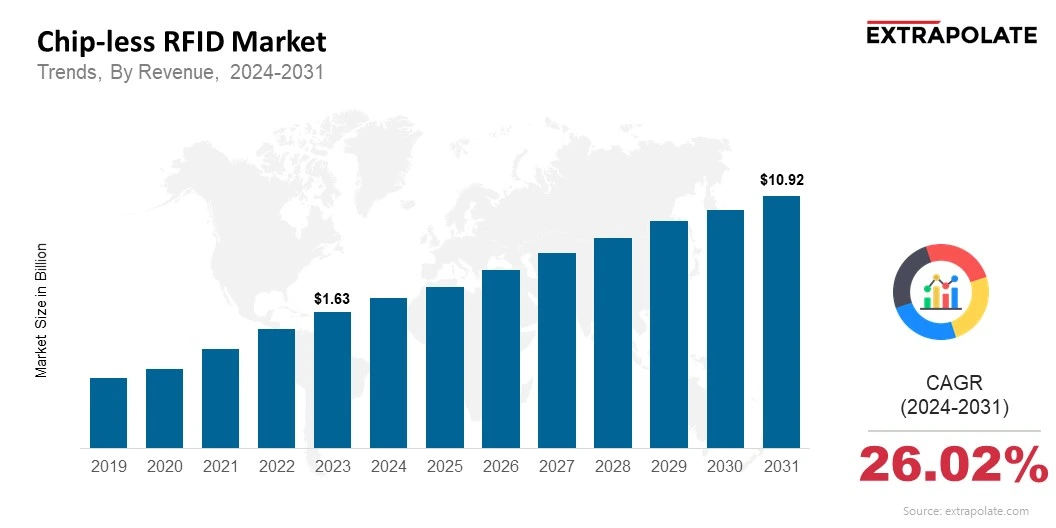
The global Chip-less RFID Market size was valued at USD 1.63 Billion in 2023 and is projected to grow from USD 2.16 Billion in 2024 to USD 10.92 Billion by 2031, exhibiting a CAGR of 26.02% during the forecast period.

The global chip-less RFID market is witnessing significant momentum as industries seek cost-effective and efficient alternatives to traditional RFID technologies. Chip-less RFID systems, which function without the use of an integrated microchip, offer a compelling solution for sectors that require large-scale item-level tracking, such as retail, logistics, healthcare, and supply chain management.

With the increasing emphasis on automation and inventory accuracy, chip-less RFID is rapidly emerging as a vital component in the broader digital transformation strategy across various industries.

One of the key drivers of the market is its affordability and ease of deployment compared to conventional RFID systems. By eliminating the need for silicon chips, manufacturers are able to reduce production costs significantly while maintaining functional efficiency.

This cost advantage makes chip-less RFID particularly attractive in emerging markets, where businesses often operate under tight budget constraints but still aim to modernize their operations. Additionally, chip-less RFID tags are more environmentally friendly, which aligns with the growing demand for sustainable technologies across global markets.

Technological innovations are further propelling the market forward. Advancements in materials science, such as printable electronics and conductive inks, are enabling the production of flexible, lightweight, and highly durable RFID tags that can be embedded into various types of packaging and surfaces.

These innovations are not only expanding the range of applications but also improving the performance and reliability of chip-less RFID systems. Moreover, integration with IoT platforms and big data analytics is enhancing real-time visibility and asset tracking, which is critical for efficient logistics and inventory management.

The retail sector continues to be a major end-user of chip-less RFID, driven by the need for improved product tracking, theft prevention, and customer engagement. In logistics, these systems are being increasingly adopted for streamlining warehouse operations and optimizing supply chain processes. In healthcare, chip-less RFID is being utilized to track medical equipment and manage pharmaceutical inventories, ensuring compliance with safety and regulatory standards.

Regionally, North America holds a substantial share of the global market due to early technology adoption and robust infrastructure. However, the Asia-Pacific region is expected to witness the fastest growth during the forecast period, fueled by rapid industrialization, expanding retail and manufacturing sectors, and increasing government investments in smart city initiatives.

As the market continues to evolve, the focus will be on improving read range, data storage capacity, and interoperability with existing systems. With strong growth potential and expanding applications, the market is poised to become a key enabler of digital tracking and smart automation in the coming years.

Size, Share & Forecast 2031Key Market Trends Driving Product Adoption

The chip-less RFID market is evolving rapidly with technological breakthroughs and growing interest from industries looking for low-cost alternatives to traditional RFID. Key trends driving market growth include:
• Cost Efficiency and Scalability: Chip-less RFID tags are significantly cheaper than traditional RFID systems, making them ideal for large-scale applications in industries like supply chain management and retail.
• Printable and Flexible Tags: The emergence of printable electronics is facilitating the production of flexible and eco-friendly chip-less RFID tags, which can be embedded into a variety of surfaces and packaging materials.
• Smart Packaging and Anti-Counterfeiting: Chip-less RFID is gaining traction in smart packaging for real-time product tracking and in brand protection through anti-counterfeiting measures.
• Wider Frequency Range Utilization: Tags are being designed for a wide frequency range. This enhances performance in challenging environments.
• Integration with IoT Platforms: Chip-less RFID is being integrated with IoT systems. It improves asset monitoring, data collection, and operational intelligence.

Major Players and their Competitive Positioning

The chip-less RFID market is characterized by both established companies and innovative startups. Key players include Zebra Technologies, Avery Dennison, BASF, Alien Technology, and SATO Holdings. These firms are investing in research and development to improve the read range, data capacity, and environmental resistance of chip-less RFID systems. Additionally, academic institutions and research labs are playing a crucial role in advancing material sciences and encoding techniques.

Consumer and Industry Behavior Analysis

Industries are adopting chip-less RFID for various reasons:
• Cost-Effective Tracking: Businesses are turning to chip-less RFID in inventory and asset management. It helps reduce operational costs.
• Security and Authentication: Chip-less RFID is used for product authentication. It also detects tampering in pharmaceuticals and luxury goods.
• Environmental Compliance: Many manufacturers prefer chip-less RFID. It is recyclable and reduces electronic waste.
• Ease of Use: Without a chip and fewer parts, deployment is easier. Maintenance becomes simpler and more scalable.

Pricing Trends

Pricing for chip-less RFID solutions is highly competitive, primarily due to the absence of silicon chips. Tags can be manufactured using low-cost materials such as conductive inks and polymers. This affordability is a key driver for adoption in cost-sensitive sectors like retail and logistics. The increasing production scale and improvements in printing technologies are expected to further reduce unit costs.

Growth Factors

Several factors are propelling the expansion of the chip-less RFID market:
• Rising Demand for Automation: Businesses are adopting RFID more. It helps streamline operations and reduce human involvement.
• Expansion of Retail and E-commerce: Chip-less RFID is used for item-level tagging and real-time tracking. It also improves the customer shopping experience.
• Increasing Counterfeit Products: Counterfeit products are on the rise. Chip-less RFID offers a low-cost, secure way to verify authenticity.
• Environmental Regulations: The demand for sustainable solutions is growing. This is driving the shift toward chip-less technologies.

Regulatory Landscape

The regulatory framework for RFID technology is still evolving, with varying standards across regions. Data privacy, frequency, and environmental regulations are shaping product design. They also influence implementation strategies. Companies are focusing on adherence to regional RFID norms and environmental guidelines to ensure successful deployment.

Recent Developments

The chip-less RFID space is seeing continuous innovation. Notable developments include:
• New Encoding Techniques: Advancement in spectral signature and magneto-static encoding is improving data storage and read accuracy.
• Eco-Friendly Materials: Biodegradable substrates and non-metallic inks are used for RFID solutions. They promote sustainability.
• Expanded Read Range Capabilities: Research in electromagnetic material science is boosting read range performance.
• Integration with Blockchain: Combining chip-less RFID with blockchain for secure data sharing and supply chain transparency.

Current and Potential Growth Implications

Demand Supply Analysis
The demand for chip-less RFID tags is surging due to their affordability and application versatility. However, challenges remain in large-scale manufacturing standardization and achieving consistent read accuracy.
Gap Analysis
Despite significant progress, the chip-less RFID market still faces key challenges:
• Limited Data Storage Capacity: Innovations are needed to match the capabilities of chip-based counterparts.
• Read Range and Accuracy: Enhancing the performance in metal-rich and liquid environments remains a priority.
• Standardization Issues: The lack of unified standards impacts interoperability. This causes integration challenges.
• Awareness and Adoption: Educating industries about chip-less RFID benefits is important. It helps drive broader adoption.

Top Companies in the Chip-less RFID Market

• Zebra Technologies
• Avery Dennison Corporation
• BASF SE
• Alien Technology
• SATO Holdings
• Molex LLC
• Tageos
• Thin Film Electronics ASA
• InkSure Technologies
• Spectra Systems

Chip-less RFID Market: Report Snapshot

Segmentation

Details

By Product Type

Passive Chip-less RFID, Active Chip-less RFID

By Material

Paper, Plastic, Glass, Others

By Frequency

Low Frequency, High Frequency, Ultra-High Frequency

By Application

Retail, Logistics & Transportation, Healthcare, Manufacturing, Others

By Region

North America, Europe, Asia-Pacific, Middle East & Africa, South America

Chip-less RFID Market: High Growth Segments

The following market segments are expected to witness strong growth:
• Passive Chip-less RFID: Ideal for cost-effective tagging with minimal infrastructure.
• Ultra-High Frequency Tags: Preferred for longer range and high-speed item tracking.
• Retail and Logistics: Key industries utilizing chip-less RFID for inventory and supply chain management.

Major Innovations

Innovation remains a critical factor for market players. Recent advancements include:
• Nano-Materials for Printed Antennas: Enhancing performance while reducing size.
• Smart Ink Technologies: Development of thermochromic and photochromic inks for dynamic tag responses.
• AI-Driven RFID Readers: Machine learning to optimize signal interpretation and improve read reliability.

Chip-less RFID Market: Potential Growth Opportunities

Companies entering or operating in this market must address key challenges to unlock its full potential:
• Technology Awareness Gap: More industry education is needed to drive adoption.
• Limited Standardization: Establishing universal protocols is essential for interoperability.
• Reader Infrastructure: Upgrading to readers compatible with chip-less systems.
• Environmental Resistance: Improving durability in harsh or high-moisture environments.
• Scalability in Mass Production: Enhancing the production process for consistent, large-scale output.

Extrapolate Research says:

The global chip-less RFID market is set for rapid expansion, fueled by technological innovations, affordability, and expanding industry applications. Companies that invest in product development, standardization, and market education will be best positioned to lead in this dynamic and fast-evolving sector.

FAQ

The global market is projected to reach USD 10.92 Billion by 2031, growing at a CAGR of 26.02% from 2024 to 2031.
The global market was valued at USD 2.16 billion in 2024.
Key players in the market are Zebra Technologies, Avery Dennison Corporation, BASF SE, Alien Technology, SATO Holdings, Molex LLC, Tageos, Thin Film Electronics ASA, InkSure Technologies, Spectra Systems
Key factors that are driving the Chip-less RFID Market growth include The Businesses are adopting RFID more. It helps streamline operations and reduce human involvement.

ARE YOU SEEKING COMPREHENSIVE INSIGHT ON VARIOUS MARKETS?
CONTACT OUR EXPERTS TODAY

Speak to an Expert
Chip less RFID Market Size Share and

Chip-less RFID Market Size

  • May-2025
  • 148
  • Global
  • Information-Technology-Communication-IoT
3499

SELECT AN OPTION

  • 1 User Access
  • PDF Report View
  • Non-Printable
  • 32 Man-hours Analyst Support
  • Post-Sale Support 48 Hours
  • Access upto 5 users
  • PDF Report View
  • Print Available
  • Access to Data Sheet
  • Up to 10% Customization
  • 40 Man-hours Analyst Support
  • Post-Sale Support 72 Hours
  • Annual Update
  • Unlimited User Access
  • Downloadable PDF Report. Data Sheet, Power Point Presentation
  • Print Available
  • Up to 20% Customization
  • 72 Man-hours Analyst Support
  • Post-Sale Support 120 Hours
  • Bi-Annual Update

ENQUIRE NOW REQUEST SAMPLE
Dale Byrne

HAVE A QUESTION?
Samuel will help you find what you are looking for.


Call: 888-328-2189


Related Research

2018-2023 Commercial Interior Design Market Size, Share & Trends Analysis Report By Application ( O

March-2021


2018-2023 Industrial Product Design Market Size, Share & Trends Analysis Report By Application ( Tr

March-2021


2D Animation Software Market Size, Share & Trends Analysis Report By Application (Construction Field

March-2021


2D Vision Measuring Systems Market Size, Share & Trends Analysis Report By Application ( Commercial

March-2021


360 Degree Feedback Software Market Size, Share & Trends Analysis Report By Application ( Corporatio

March-2021


3D and 4D Technology Market Size, Share & Trends Analysis Report By Application (Entertainment, Cons

March-2021


3D Animated Films Market Size, Share & Trends Analysis Report By Application ( Children, Adults, Oth

March-2021


3D CAD Design Software Market Size, Share & Trends Analysis Report By Application (Small Business, M

March-2021


3D CAD Software Market Size, Share & Trends Analysis Report By Application ( Manufacturing, Automo

March-2021


3D CAD Software Market Size, Share & Trends Analysis Report By Application (Manufacturing, Automotiv

March-2021


Sample Request

Chip-less RFID Market Size, Share, Growth & Industry Analysis, By Product Type (Passive Chip-less RFID, Active Chip-less RFID) By Material (Paper, Plastic, Glass, Others) By Frequency (Low Frequency, High Frequency, Ultra-High Frequency) By Application (Retail, Logistics & Transportation, Healthcare, Manufacturing, Others), and Regional Analysis, 2024-2031

Publisher: Kings Research   |   Date: 2025-05-15   |   No. Of Pages: 148

Send Your Query

Chip-less RFID Market Size, Share, Growth & Industry Analysis, By Product Type (Passive Chip-less RFID, Active Chip-less RFID) By Material (Paper, Plastic, Glass, Others) By Frequency (Low Frequency, High Frequency, Ultra-High Frequency) By Application (Retail, Logistics & Transportation, Healthcare, Manufacturing, Others), and Regional Analysis, 2024-2031

Publisher: Kings Research   |   Date: 2025-05-15   |   No. Of Pages: 148
Extrapolate

Extrapolate has a refined network of top publishers across the globe covering markets and micro markets who bring in the power of decision making. Our network of publishers is ranked based on the quality of reports produced along with customer feedback Indexing.

 talk@extrapolate.com

888-328-2189


Connect With Us

twitter logo

Industry

Quick Links

  • About Us
  • Contact Us
  • FAQ
  • Privacy Policy
  • Disclaimer
  • Refund Policy
  • Sitemap


Payment Gateway
Sign up for newsletter and updates


Powered By

Kings Research
© 2025 Kingsresearch. All Rights Reserved.