Extrapolate Extrapolate
  • 888-328-2189
  • ABOUT US
  • CONTACT US
  • SIGN IN
  • INDUSTRIES
  • BLOGS
  • Home
  • Energy and Power
  • Solar microinverter market

Solar Microinverter Market Size, Share, Growth & Industry Analysis, By Technology (AC Coupled, DC Coupled), By End-Use (Residential, Commercial, Industrial), By Component (Hardware, Software), and Regional Analysis, 2024-2031

  • Description
  • Table Of Content
  • Sample Request

Solar Microinverter Market: Global Share and Growth Trajectory

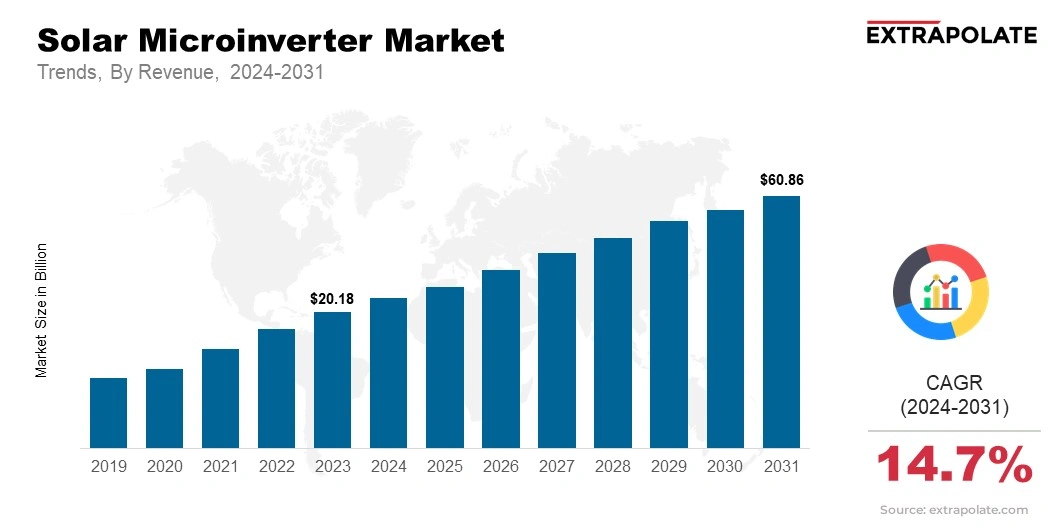
The global Solar Microinverter Market size was valued at USD 20.18 billion in 2023 and is projected to grow from USD 23.33 billion in 2024 to USD 60.86 billion by 2031, exhibiting a CAGR of 14.7% during the forecast period.

The global solar microinverter market is experiencing significant growth, driven by the increasing adoption of solar energy, technological advancements, and the growing demand for efficient and cost-effective energy solutions.

Solar microinverters are small inverters designed to convert the direct current (DC) electricity generated by individual solar panels into alternating current (AC) electricity.

Unlike traditional string inverters, which connect multiple solar panels in series, microinverters are installed on each panel, allowing for better energy harvest and enhanced system performance, particularly in residential and commercial solar installations.

As solar power becomes more mainstream and accessible, the demand for solar microinverters is rising, driven by the desire for more efficient, reliable, and scalable solar energy systems.

Technological advancements in solar microinverter design have contributed to the growing popularity of these systems. Modern microinverters are more compact, reliable, and cost-effective, offering improved power output, longer lifespans, and enhanced safety features.

Additionally, the increasing need for smart energy solutions, with features such as remote monitoring and system diagnostics, has fueled the growth of the solar microinverter market. These systems provide real-time data on energy production and consumption, allowing users to optimize their solar energy systems for maximum efficiency.

The market is also benefiting from government incentives and policies that promote the adoption of renewable energy solutions. As countries worldwide push for cleaner, more sustainable energy sources, solar power is emerging as a key component of energy strategies, and solar microinverters are integral to maximizing the performance of solar installations.

This trend is particularly evident in residential and commercial applications, where the desire for energy independence, lower electricity costs, and reduced carbon footprints is driving the demand for more efficient and scalable solar energy solutions.

North America and Europe are leading the solar microinverter market due to the high adoption of solar energy, strong governmental support, and technological advancements in these regions. However, the Asia-Pacific region is expected to see the highest growth rate in the coming years, driven by the expanding solar power installations in countries like China and India, as well as the increasing demand for renewable energy solutions.

Solar Microinverter Market Size & Share, By Revenue, 2024-2031

Key Market Trends Driving Product Adoption

The solar microinverter sector is rapidly making progress, with significant developments influencing the growth in its adoption:

  • Efficiency Gains: By confronting hurdles like shading, panel degradation, and mismatched panels, microinverters help in streamlining energy conversion efficiency. This results in amplified energy, positioning them as the most suitable solution for solar power systems.
  • Declining Costs: As technology advances and economies of scale are realized, the cost of solar microinverters is decreasing, making them more affordable and accessible to a broader range of customers.
  • Smart Solar Systems: The integration of smart technology, including IoT and cloud-based monitoring, is increasing the appeal of solar microinverters. These systems provide real-time data, system health monitoring, and remote troubleshooting, improving overall performance.
  • Growth of Distributed Generation: The growing trend of distributed solar generation, where power is generated locally and consumed on-site, is fueling the demand for microinverters. These systems provide greater flexibility and scalability for residential and commercial solar installations.
  • Government Incentives: Governments worldwide are offering incentives and subsidies to promote the adoption of renewable energy technologies, including solar power systems equipped with microinverters.

Major Players and their Competitive Positioning

The worldwide solar microinverter industry is competitive and fragmented. Furthermore, majority of the market share is held by well-established firms in the market namely, SolarEdge Technologies, Enphase Energy, and SMA Solar Technology.

These manufacturers dominate the solar microinverter landscape when it comes to innovation of new products, new development, quality, and geographic distribution. However, there are also various smaller manufacturing firms and start-ups operating in the space that provide advanced microinverter capabilities to meet more specific geographic or technology-specific demand.

Consumer Behavior Analysis

The growth in the adoption of solar microinverters can be credited to the following factors:

  • Efficiency and Reliability: Consumers are increasingly seeking solar power systems that offer greater reliability and efficiency. Microinverters provide solutions to issues such as shading and panel mismatch, resulting in higher energy production.
  • Affordability and Return on Investment: As the cost of solar microinverters continues to decrease, consumers are finding these systems to be more affordable. The long-term benefits, including improved energy yield and lower maintenance costs, are appealing to both residential and commercial consumers.
  • Sustainability Awareness: With an increased focus on sustainability and carbon reduction, a larger number of consumers are adopting solar power as a practical solution for renewable energy.

Pricing Trends

Solar microinverter pricing developments include technology improvements, scale of manufacturing, and competitive nature. Price expectations rely on a continual decrease in price over recent years. As components get cheaper to manufacture and more stable in operation, the need for affordability in residential and commercial applications is at an all-time high. The integration trend will occur through solutions integration that offers a similar blended solution price with upgraded offerings. New subscription services blend into microgrid projects with payment plans for a large number of end users.

Growth Factors

Major factors influencing the rise in demand for Solar Microinverters:

  • Rising Adoption of Solar Energy: The increasing adoption of solar energy systems in residential, commercial, and industrial sectors is the primary growth driver for the solar microinverter market.
  • Technological Advancements: Continuous advancements in solar microinverter technology, including improved energy conversion efficiency and integration with smart systems, are fueling market growth.
  • Favorable Government Policies: Government incentives, such as tax rebates and subsidies for renewable energy technologies, are encouraging the adoption of solar power systems, which in turn is driving the demand for microinverters.
  • Cost Reduction: As manufacturing costs decrease and economies of scale are realized, solar microinverters are becoming more affordable, making them attractive for consumers and businesses alike.

Regulatory Landscape

The solar microinverter market operates within a regulatory framework governed by adherence to national and international standards that ensure the safety, performance, and reliability of solar power systems. Earlier, companies such as International Electrotechnical Commission (IEC), National Electrical Code (NEC), and Underwriters Laboratories (UL) put in place the compliance standards that the microinverters need to abide by. Government policies and sustainable energy targets in North America, Europe, and Asia-pacific are essential factors propelling the growth of the solar microinverter market.

Recent Developments

Recent developments in the solar microinverter market include:

  • Innovating New Products: Businesses are constantly improving their microinverter designs, making them more compact, sustainable, and adaptable for multiple configurations of solar panels.
  • Advanced Features: Advanced features, like live monitoring, remote diagnostics, and automated system optimization, are becoming well-known in the solar microinverter market.
  • Collaborative Alliances: Leading organizations in the solar microinverter industry are benefitting from partnerships with solar panel manufacturers and installation providers to upgrade their offerings and expand their influence in the market.

Current and Potential Growth Implications

  • Demand Supply Analysis: With the adoption of solar increasing, especially across North America, Europe, and Asia-Pacific, demand for solar microinverters is set for growth. The continuing change to solar energy will fulfil the need for effective and dependable systems for power conversion.
  • Gap Analysis: Even with quick progression, financial constraints and the lack of awareness continues to hinder adoption in particular regions. In addition to this, combining solar microinverters with battery storage and other eco-friendly solutions holds strong prospects for growth.

Top Companies in the Solar Microinverter Market

  • Enphase Energy
  • SolarEdge Technologies
  • SMA Solar Technology
  • Tigo Energy
  • Altenergy Power System
  • Involar
  • APsystems

Solar Microinverter Market: Report Snapshot

Segmentation

Details

By Technology

AC Coupled, DC Coupled

By End-Use

Residential, Commercial, Industrial

By Component

Hardware, Software

By Region

North America, Europe, Asia-Pacific, Latin America, MEA

High-Growth Segments

The following market segments are expected to experience significant growth:

  • Residential Sector: As the importance of renewable energy and affordability is increasing, the housing industry stays in command of the development of the solar microinverter market.
  • Commercial and Industrial Applications: Large-scale commercial and industrial installations are expected to witness substantial growth, with businesses seeking efficient energy solutions and long-term cost savings.

Major Innovations

Advanced technology is having its effect on the solar microinverter sector, giving prominence to notable features like:

  • Energy Efficiency: Microinverters are optimizing the use of energy, offering increased output and enhanced performance in less than ideal circumstances, like partial shading.
  • Optimized Energy Utilization: The pairing up of solar microinverters with energy storage enables greater sustainability of energy, safeguarding a more steady and effective solar power system.
  • Advanced Monitoring: Users obtain an instant analysis on the performance, with the help of cloud-based analytics, which leads to streamlined processes and swift resolution of issues.

Potential Growth Opportunities

Even with bright prospects for growth, the solar microinverter industry faces difficulties with various challenges:

  • Challenges in Pricing: Even with prices are going down, solar microinverters are still a financial obstacle for several consumers, especially in markets conscious about budget.
  • Competition from Central Inverters: Although microinverters have unique strengths, central inverters are more prevalent in large commercial and industrial setups because of their cost-effectiveness and greater effectiveness in applications that require significant resources.

Extrapolate Research Says:

The solar microinverter market is poised to expand because of the growing need for effective solar energy systems with relatively simple applications. Technological developments, larger solar arrays, and favorable government policies for the renewable energy sector project established market leaders and newcomers alike to a sustainably growing growth trajectory in the evolving market.

FAQ

The global market is projected to reach USD 60.86 billion by 2031, growing at a CAGR of 14.7% from 2024 to 2031.
The global market was valued at USD 23.33 billion in 2024.
The increasing adoption of solar energy systems in residential, commercial, and industrial sectors is the primary growth driver for the solar microinverter market.
Key players in the market are Enphase Energy, SolarEdge Technologies, SMA Solar Technology, Tigo Energy, Altenergy Power System, Involar, APsystems and Others.

ARE YOU SEEKING COMPREHENSIVE INSIGHT ON VARIOUS MARKETS?
CONTACT OUR EXPERTS TODAY

Speak to an Expert
Solar microinverter market

Solar Microinverter Market Size

  • March-2025
  • 148
  • Global
  • Energy-and-Power
3499

SELECT AN OPTION

  • 1 User Access
  • PDF Report View
  • Non-Printable
  • 32 Man-hours Analyst Support
  • Post-Sale Support 48 Hours
  • Access upto 5 users
  • PDF Report View
  • Print Available
  • Access to Data Sheet
  • Up to 10% Customization
  • 40 Man-hours Analyst Support
  • Post-Sale Support 72 Hours
  • Annual Update
  • Unlimited User Access
  • Downloadable PDF Report. Data Sheet, Power Point Presentation
  • Print Available
  • Up to 20% Customization
  • 72 Man-hours Analyst Support
  • Post-Sale Support 120 Hours
  • Bi-Annual Update

ENQUIRE NOW REQUEST SAMPLE
Dale Byrne

HAVE A QUESTION?
Samuel will help you find what you are looking for.


Call: 888-328-2189


Related Research

Organic Rankine Cycle Market Size, Share, Growth & Industry Analysis, By Application (Solar Thermal

February-2023


Air Electrode Battery Market Size, Share, Growth & Industry Analysis, By Product (Zinc-Air Batteries

September-2024


Battery Recycling Market Size, Share, Growth & Industry Analysis, By Battery Chemistry (Lead-Acid, L

August-2025


Biodiesel Market By Feedstock (Soybean, Rapeseed, Palm, Palm, Poultry, Tallow, White Grease, and Oth

January-2023


Biomass Boiler Market Size, Share, Growth & Industry Analysis, By Product Type (Fully Automated Boil

August-2025


Biomass Power Generation Market Size, Share, Growth & Industry Analysis, By Feedstock (Woody Biomass

August-2025


Biomethane Market by Application (Automotive, Power Generation, and Others), Production Method (Ferm

February-2023


Cable Entry Systems and Components Market Size, Share, Growth & Industry Analysis, By Product Type (

February-2025


Carbon Capture and Storage Market Size, Share, and COVID-19 Impact Analysis, By Capture Source (Chem

August-2025


Diesel Market Size, Share, Growth & Industry Analysis, By Application (Transportation (On-road, Off-

April-2025


Sample Request

Solar Microinverter Market Size, Share, Growth & Industry Analysis, By Technology (AC Coupled, DC Coupled), By End-Use (Residential, Commercial, Industrial), By Component (Hardware, Software), and Regional Analysis, 2024-2031

Publisher: Kings Research   |   Date: 2025-03-26   |   No. Of Pages: 148

Send Your Query

Solar Microinverter Market Size, Share, Growth & Industry Analysis, By Technology (AC Coupled, DC Coupled), By End-Use (Residential, Commercial, Industrial), By Component (Hardware, Software), and Regional Analysis, 2024-2031

Publisher: Kings Research   |   Date: 2025-03-26   |   No. Of Pages: 148
Extrapolate

Extrapolate has a refined network of top publishers across the globe covering markets and micro markets who bring in the power of decision making. Our network of publishers is ranked based on the quality of reports produced along with customer feedback Indexing.

 talk@extrapolate.com

888-328-2189


Connect With Us

twitter logo

Industry

Quick Links

  • About Us
  • Contact Us
  • FAQ
  • Privacy Policy
  • Disclaimer
  • Refund Policy
  • Sitemap


Payment Gateway
Sign up for newsletter and updates


Powered By

Kings Research
© 2025 Kingsresearch. All Rights Reserved.