Extrapolate Extrapolate
  • 888-328-2189
  • ABOUT US
  • CONTACT US
  • SIGN IN
  • INDUSTRIES
  • BLOGS
  • Home
  • Energy and Power
  • Organic solar cell market

Organic Solar Vell Market Size, Share, Growth & Industry Analysis, By Product Type (Polymer Solar Cells, Small Molecule Solar Cells, Hybrid Organic Solar Cells) By Application (BIPV, Portable Devices, Automotive, Consumer Electronics, Others) By End-User Residential, Commercial, Industrial), and Regional Analysis, 2024-2031

  • Description
  • Table Of Content
  • Sample Request

Organic Solar Cell Market: Global Share and Growth Trajectory

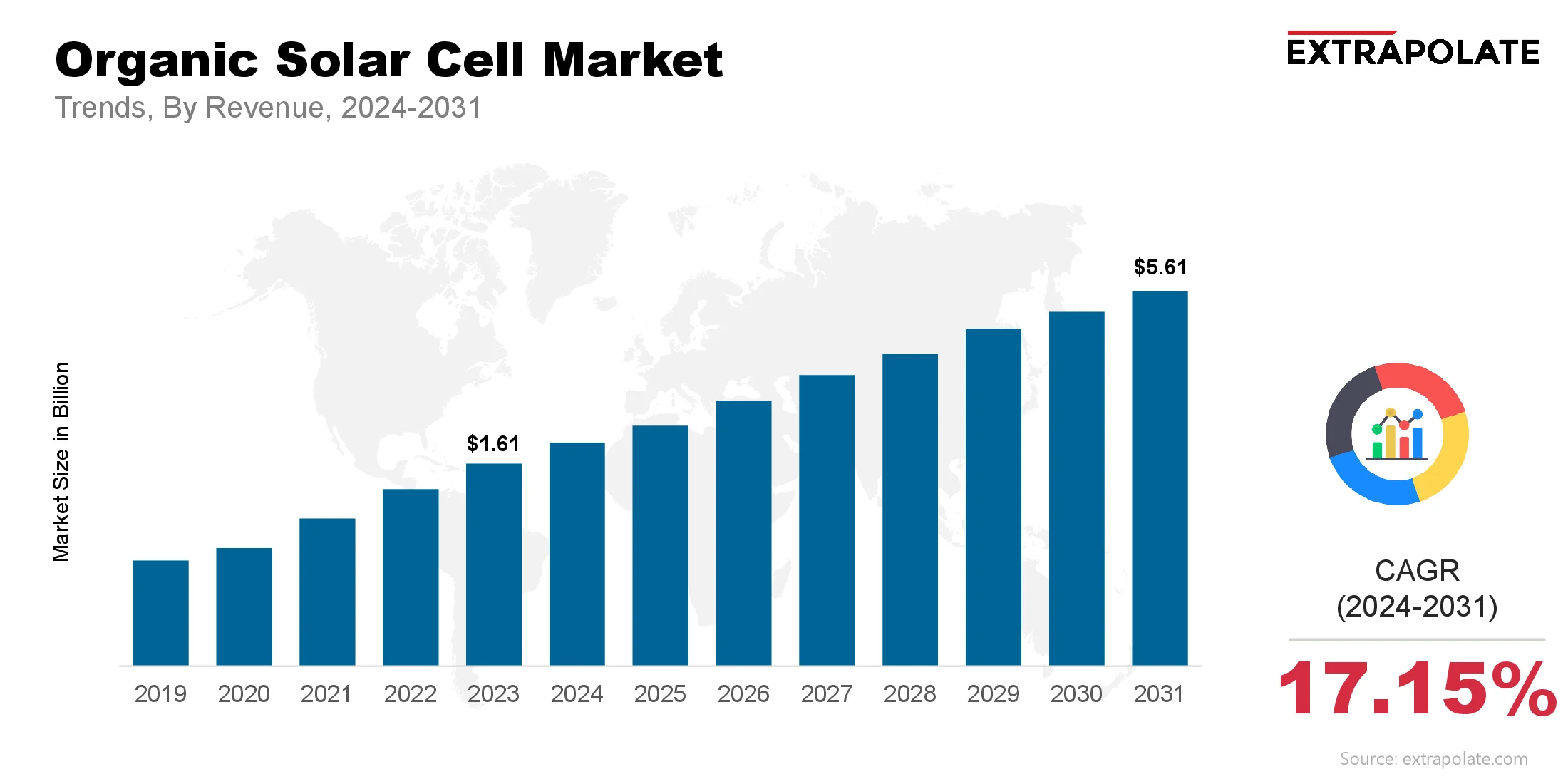
The global Organic Solar Cell Market size was valued at USD 1.61 billion in 2023 and is projected to grow from USD 1.85 billion in 2024 to USD 5.61 billion by 2031, exhibiting a CAGR of 17.15% during the forecast period.

The market is on the rise as the renewable energy sector moves towards sustainable solutions. Organic solar cells (OSCs) are flexible, lightweight and can be produced at low cost. With the emphasis on clean power and eco friendly technologies OSCs are emerging as a alternative to traditional photovoltaic technologies.

This growth is driven by a mix of environmental concerns, government policies and technological innovation. As manufacturing processes improve and power conversion efficiencies increase OSCs are attracting attention from industries from electronics to building integrated photovoltaics. With developments in organic semiconductors, electrode materials and encapsulation techniques the organic solar cell industry is set to grow steadily and substantially across global markets.

A most important thing about organic solar cells is their ability to be integrated into non-traditional surfaces. Unlike rigid silicon panels OSCs can be printed on flexible substrates like plastic films or fabrics. This means they can be integrated into wearables, vehicle rooftops and building facades. This versatility opens up a whole new world of applications many of which were previously impossible with traditional solar.

Organic Solar Cell Market Size & Share, By Revenue, 2024-2031

Key Market Trends Driving Product Adoption

Several key trends are driving the adoption of organic solar cells:

Lightweight and Flexible Design: One of the biggest advantages of OSCs is their lightweight and flexible nature. This allows OSCs to be used in many applications from smart textiles to flexible electronics. Their ability to be applied to different surface geometries – curved, angled or even mobile – sets them apart from rigid and bulky silicon based panels.

Low-Cost, Scalable Manufacturing: OSCs can be produced using roll-to-roll printing techniques, similar to newspaper printing, which reduces manufacturing costs to almost zero. This enables mass production with minimal environmental impact, making it a key driver of growth as economies of scale improve.

Aesthetic and Transparent Variants: Modern developments have led to semi-transparent and colored OSCs, opening up applications for architectural and consumer electronics. Building-integrated photovoltaics (BIPV) and agrivoltaic installations are increasingly looking at OSCs for their visual and structural compatibility.

Green Energy Incentives: Governments around the world are actively supporting the renewable energy transition. This includes tax incentives, feed-in tariffs and R&D funding for emerging solar technologies like OSCs. These policy frameworks are encouraging the use of green materials.

Major Players and their Competitive Positioning

The organic solar cell market is seeing a lot of innovation and competition. Leading players are investing in R&D to improve efficiency, stability and lifetime of OSC products. Key players include: Heliatek GmbH, ARMOR Group (ASCA), NanoFlex Power Corporation, Solarmer Energy Inc., Mitsubishi Chemical Corporation, Konarka Technologies Inc., BELECTRIC OPV GmbH, EMD Performance Materials (Merck KGaA).

These companies are developing advanced organic photovoltaic (OPV) modules and forming partnerships to scale up production. Partnerships with universities, research institutions and renewable energy companies are becoming more common as companies compete for technological leadership and commercial scalability.

Consumer Behavior Analysis

Consumer behavior in the organic solar cell (OSC) market is shaped by economic, environmental, and performance-related factors.

Environmental Consciousness:
More consumers and businesses are choosing sustainable options. OSCs have a low carbon footprint and eco-friendly production, which appeals to environmentally aware buyers—especially in Europe and North America.

Design-Integrated Preferences:
In industries like architecture, fashion, and electronics, appearance is important. OSCs can be thin, transparent, or patterned, allowing solar power to blend into products without affecting design. In February 2025, Next Energy Technologies released what they claim is the world’s largest fully transparent organic photovoltaic (OPV) window, 101.6 × 152.4cm. This laminated glass power generating window blends into architecture. Big step for building integrated photovoltaics en.wikipedia.org+15usasolarcell.com+15link.springer.com+15.

Cost vs. Efficiency Trade-Off:
OSCs have lower efficiency than silicon panels. However, their lower production costs and good performance in low-light conditions are appealing. This makes them attractive for off-grid and portable use. In May 2025, Researchers at Zhengzhou University developed PTQ15, a low cost polymer that gets organic solar cells to 19.96% certified efficiency at one fifth the cost of previous benchmark polymers. Big step for OSC commercialization notebookcheck.netgizmochina.com.

Technology Awareness:
As people learn more about OSC benefits, adoption is increasing. Training programs, green certifications, and government demos are helping build trust and familiarity with the technology.

Pricing Trends

Pricing in the organic solar cell (OSC) market is influenced by several factors. These include production volume, material availability, and advances in manufacturing methods. At present, OSCs are more expensive per watt than traditional solar options. This is mainly due to lower efficiency and a shorter operational life.

However, the situation is improving. Roll-to-roll manufacturing is becoming more efficient, helping reduce costs. As production scales up, unit prices are steadily dropping.

New materials like non-fullerene acceptors (NFAs) and advanced barrier films are also increasing OSC durability. This is boosting their commercial potential. Government subsidies and green energy incentives are further easing the financial burden. These supports make initial investments more attractive to early adopters.

Growth Factors

Here are the factors driving the growth of the organic solar cell market:

Building-Integrated Photovoltaics (BIPV): OSCs are finding a home in BIPV where they offer design flexibility and aesthetics. Skyscrapers, greenhouses and even windows can be energy generating surfaces without compromising design.

Organic Materials Advancements: Progress in polymer chemistry and molecular engineering is boosting OSC performance. Improvements in donor and acceptor materials are increasing efficiency, moisture resistance and lifespan.

Urban Energy Solutions: As cities look for decentralized renewable energy sources the potential of OSCs for urban deployment – solar canopies, awnings and mobile chargers – is becoming more attractive.

Low Light Performance: OSCs perform better in low light or indoor lighting conditions than traditional solar cells. This makes them perfect for powering IoT devices, sensors and wearable electronics in smart environments.

Regulatory Landscape

The organic solar cell (OSC) market is shaped by a strong regulatory framework. These rules ensure product safety, reliability, and environmental compliance.

IEC and ISO Standards:
Global standards such as IEC 61215 guide the design and testing of PV modules. ISO 14001 helps ensure proper environmental management during production and deployment.

CE Certification (Europe):
To be sold in the European Economic Area, OSCs must meet CE marking requirements. This confirms they are safe, perform well, and follow environmental rules.

UL Certifications (North America):
In the U.S., OSCs must meet UL 1703 standards. This certification ensures they are safe, especially when used in buildings or homes.

Government Incentives and Subsidies:
Many governments offer financial support like grants, tax credits, or feed-in tariffs. These policies promote innovation and help bring OSC technologies to market faster.

Recent Developments

Recent developments highlight the strong growth potential of the OSC market.

  • Heliatek’s HeliaSol Panels:
    Heliatek introduced flexible, ultra-light solar films. These are suitable for rooftops and facades. They require no mounting structures and weigh less than 2 kg/m².
  • ASCA’s Transparent Solar Films:
    The ARMOR Group’s ASCA technology offers semi-transparent, customizable OPV films. These are used in greenhouses, windows, and mobile devices.
  • University Research Innovations:
    Institutions like KAUST and UCLA have made key advances in non-fullerene materials. These have pushed power conversion efficiency beyond 18% in laboratory conditions.
  • Collaborations with Architects and Designers:
    Companies are partnering with architects and designers. Together, they are integrating OSCs into products such as solar backpacks and aesthetic wall panels.

Current and Potential Growth Implications

a. Demand-Supply Analysis:

As global energy needs grow and fossil fuels run low, OSCs are stepping up. They offer a clean and scalable option. More people want flexible and easy-to-integrate solar tech. But scaling up production is still a big challenge. To meet global demand, companies need to expand capacity and streamline their supply chains.

b. Gap Analysis:

Even though interest in OSCs is high, there are still some gaps. Many people are not aware of them. Their efficiency is still lower than silicon-based panels. And there are concerns about how long they last. To fix this, we need more research, better performance benchmarks, and strong marketing efforts.

Top Companies in the Organic Solar Cell Market

  • Heliatek GmbH
  • ARMOR Group (ASCA)
  • Mitsubishi Chemical Corporation
  • NanoFlex Power Corporation
  • Solarmer Energy Inc.
  • BELECTRIC OPV GmbH
  • EMD Performance Materials (Merck KGaA)
  • Advent Technologies
  • InfinityPV ApS
  • Konarka Technologies Inc.

Organic Solar Cell Market: Report Snapshot

Segmentation

Details

By Product Type

Polymer Solar Cells, Small Molecule Solar Cells, Hybrid Organic Solar Cells

By Application

BIPV, Portable Devices, Automotive, Consumer Electronics, Others

By End-User

Residential, Commercial, Industrial

By Region

North America, Europe, Asia-Pacific, Latin America, Middle East & Africa

High Growth Segments

Some segments of the organic solar cell market are growing fast.

Polymer Solar Cells:
These are becoming more popular thanks to better material stability and easier processing. They’re a great fit for flexible and wearable tech.

BIPV (Building-Integrated Photovoltaics):
More architects and city planners are adding OSCs into buildings. They look good and generate energy at the same time.

Consumer Electronics:
OSCs can capture indoor light, which is super useful. That’s why they’re being used more in smart gadgets, sensors, and portable chargers.

Major Innovations

New innovations are changing the game for organic solar cells.

Perovskite-Organic Tandem Cells:
By combining OSCs with perovskite layers, scientists are creating tandem cells. These can beat the efficiency limits of regular organic solar panels.

Inkjet Printing:
New methods like inkjet and gravure printing are speeding up production. They also cut costs and are better for the environment.

Self-Healing Polymers:
Some new materials can fix small cracks and damage by themselves. This helps the panels last longer and work more reliably.

Potential Growth Opportunities

The organic solar cell market has many ways to grow.

Rural Electrification:
OSCs are lightweight and easy to install. That makes them perfect for off-grid areas in developing countries where many people still don’t have access to power.

Expanding in New Markets:
Places like Southeast Asia and Latin America are urbanizing fast. More people there care about the environment too. This makes them great markets for OSCs.

Smart Wearables and IoT:
OSCs can power small, low-energy devices. This is great for things like health trackers, smart home gadgets, and logistics tools.

Extrapolate Research Says:

The organic solar cell market is ready to grow. It’s being driven by the push for sustainability, new tech innovations, and more ways to use it. People want clean energy that fits easily into everyday life. That’s where organic solar cells (OSCs) come in. They’re shaping up to be a game-changing technology.

There are still issues with efficiency and durability. But researchers are making progress, and better production methods are helping. Support from governments and investors is also growing. Since OSCs can be used in many industries, they have a lot of potential. Solar energy’s future is looking bright, flexible, lightweight, and totally organic.

FAQ

The global market is projected to reach USD 5.61 billion by 2031, growing at a CAGR of 17.15% from 2024 to 2031.
The global market was valued at USD 1.85 billion in 2024.
OSCs are finding a home in BIPV where they offer design flexibility and aesthetics. Skyscrapers, greenhouses and even windows can be energy generating surfaces without compromising design
Key players in the market are Heliatek GmbH, ARMOR Group (ASCA), NanoFlex Power Corporation, Solarmer Energy Inc., Mitsubishi Chemical Corporation, Konarka Technologies Inc., BELECTRIC OPV GmbH, EMD Performance Materials (Merck KGaA). and Others.

ARE YOU SEEKING COMPREHENSIVE INSIGHT ON VARIOUS MARKETS?
CONTACT OUR EXPERTS TODAY

Speak to an Expert
Organic solar cell market

Organic Solar Vell Market Size

  • July-2025
  • ���1���4���0
  • Global
  • Energy-and-Power
3499

SELECT AN OPTION

  • 1 User Access
  • PDF Report View
  • Non-Printable
  • 32 Man-hours Analyst Support
  • Post-Sale Support 48 Hours
  • Access upto 5 users
  • PDF Report View
  • Print Available
  • Access to Data Sheet
  • Up to 10% Customization
  • 40 Man-hours Analyst Support
  • Post-Sale Support 72 Hours
  • Annual Update
  • Unlimited User Access
  • Downloadable PDF Report. Data Sheet, Power Point Presentation
  • Print Available
  • Up to 20% Customization
  • 72 Man-hours Analyst Support
  • Post-Sale Support 120 Hours
  • Bi-Annual Update

ENQUIRE NOW REQUEST SAMPLE
Dale Byrne

HAVE A QUESTION?
Samuel will help you find what you are looking for.


Call: 888-328-2189


Related Research

Organic Rankine Cycle Market Size, Share, Growth & Industry Analysis, By Application (Solar Thermal

February-2023


Air Electrode Battery Market Size, Share, Growth & Industry Analysis, By Product (Zinc-Air Batteries

September-2024


Battery Recycling Market Size, Share, Growth & Industry Analysis, By Battery Chemistry (Lead-Acid, L

August-2025


Biodiesel Market By Feedstock (Soybean, Rapeseed, Palm, Palm, Poultry, Tallow, White Grease, and Oth

January-2023


Biomass Boiler Market Size, Share, Growth & Industry Analysis, By Product Type (Fully Automated Boil

August-2025


Biomass Power Generation Market Size, Share, Growth & Industry Analysis, By Feedstock (Woody Biomass

August-2025


Biomethane Market by Application (Automotive, Power Generation, and Others), Production Method (Ferm

February-2023


Cable Entry Systems and Components Market Size, Share, Growth & Industry Analysis, By Product Type (

February-2025


Carbon Capture and Storage Market Size, Share, and COVID-19 Impact Analysis, By Capture Source (Chem

August-2025


Diesel Market Size, Share, Growth & Industry Analysis, By Application (Transportation (On-road, Off-

April-2025


Sample Request

Organic Solar Vell Market Size, Share, Growth & Industry Analysis, By Product Type (Polymer Solar Cells, Small Molecule Solar Cells, Hybrid Organic Solar Cells) By Application (BIPV, Portable Devices, Automotive, Consumer Electronics, Others) By End-User Residential, Commercial, Industrial), and Regional Analysis, 2024-2031

Publisher: Kings Research   |   Date: 2025-07-31   |   No. Of Pages: ���1���4���0

Send Your Query

Organic Solar Vell Market Size, Share, Growth & Industry Analysis, By Product Type (Polymer Solar Cells, Small Molecule Solar Cells, Hybrid Organic Solar Cells) By Application (BIPV, Portable Devices, Automotive, Consumer Electronics, Others) By End-User Residential, Commercial, Industrial), and Regional Analysis, 2024-2031

Publisher: Kings Research   |   Date: 2025-07-31   |   No. Of Pages: ���1���4���0
Extrapolate

Extrapolate has a refined network of top publishers across the globe covering markets and micro markets who bring in the power of decision making. Our network of publishers is ranked based on the quality of reports produced along with customer feedback Indexing.

 talk@extrapolate.com

888-328-2189


Connect With Us

twitter logo

Industry

Quick Links

  • About Us
  • Contact Us
  • FAQ
  • Privacy Policy
  • Disclaimer
  • Refund Policy
  • Sitemap


Payment Gateway
Sign up for newsletter and updates


Powered By

Kings Research
© 2025 Kingsresearch. All Rights Reserved.