Extrapolate Extrapolate
  • 888-328-2189
  • ABOUT US
  • CONTACT US
  • SIGN IN
  • INDUSTRIES
  • BLOGS
  • Home
  • Chemicals and Advanced Materials
  • Chemical protective gloves market

Chemical Protective Gloves Market Size, Share, Growth & Industry Analysis, By Material Type (Nitrile, Neoprene, Butyl Rubber, Latex, PVC, Others), By Product Type (Reusable Gloves, Disposable Gloves), By End-Use Industry (Chemicals, Pharmaceuticals, Oil & Gas, Manufacturing, Healthcare, Agriculture, Others), and Regional Analysis, 2024-2031

  • Description
  • Table Of Content
  • Sample Request

Chemical Protective Gloves Market: Global Share and Growth Trajectory

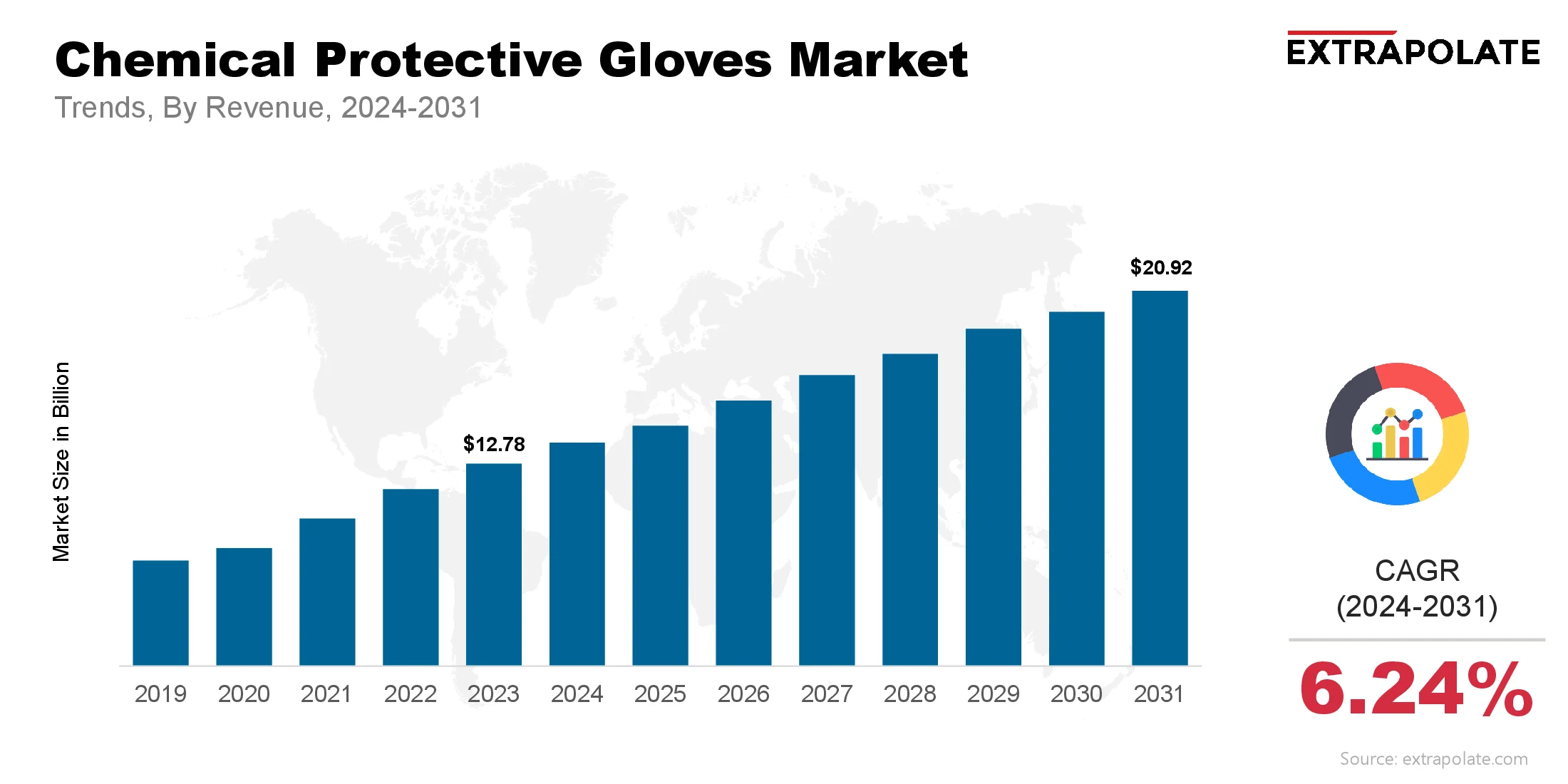
The global Chemical Protective Gloves Market size was valued at USD 12.78 billion in 2023 and is projected to grow from USD 13.69 billion in 2024 to USD 20.92 billion by 2031, exhibiting a CAGR of 6.24% during the forecast period.

The global chemical protective gloves market is witnessing steady growth, driven by the increasing focus on workplace safety, stringent occupational health regulations, and expanding industrialization. These gloves serve as essential personal protective equipment (PPE) in high-risk environments, offering critical protection against hazardous chemicals, corrosive substances, solvents, and infectious materials. Industries such as chemical processing, pharmaceuticals, oil & gas, manufacturing, agriculture, and healthcare are among the primary consumers of chemical-resistant gloves.

Growing awareness about occupational hazards and government mandates for employee safety are key factors propelling market demand. Regulatory bodies like OSHA (Occupational Safety and Health Administration), ANSI, and EU-OSHA are enforcing strict compliance, prompting companies to invest in high-quality protective gear. As industrial accidents related to chemical exposure continue to pose serious health and economic consequences, the need for reliable and durable gloves has become paramount.

Technological advancements have also played a crucial role in market expansion. Manufacturers are developing gloves with enhanced chemical resistance, flexibility, and comfort using advanced materials such as nitrile, neoprene, butyl rubber, and Viton. These innovations improve user safety while allowing greater dexterity and longer wear time, which are especially important in labor-intensive sectors.

The market is also benefitting from increased demand for disposable gloves in healthcare and laboratory environments, particularly in the post-COVID landscape. Meanwhile, rising environmental concerns are encouraging the development of sustainable and biodegradable glove alternatives.

Geographically, North America and Europe dominate the market due to strict safety norms and high awareness levels, while Asia-Pacific is emerging as a high-growth region owing to rapid industrialization and rising investments in safety infrastructure.

Chemical Protective Gloves Market Size & Share, By Revenue, 2024-2031Key Market Trends Driving Product Adoption

Growing Workplace Safety Awareness

One of the key drivers of the chemical protective gloves market is the increased emphasis on occupational safety. Industries are becoming more proactive in preventing accidents and injuries caused by chemical exposure. As awareness grows among workers and employers, the adoption of high-performance gloves that offer both chemical resistance and comfort has become widespread. Safety standards set by OSHA, EU-OSHA, and other international agencies have made protective gloves a non-negotiable component of workplace equipment.

Advancements in Material Science and Ergonomics

Technological advancements in materials—such as nitrile, neoprene, butyl rubber, and Viton—have revolutionized glove performance. Modern chemical protective gloves offer higher resistance to permeation, longer wear life, and better grip. In addition, manufacturers are focusing on ergonomically designed gloves that reduce fatigue and improve dexterity during prolonged use. Enhanced tactile sensitivity, breathable linings, and touchscreen compatibility are also becoming popular features, further boosting product appeal.

Expansion of the Chemical and Manufacturing Industries

The expansion of industries such as petrochemicals, agriculture, automotive, and electronics manufacturing has led to increased demand for chemical protective gloves. These industries frequently involve exposure to solvents, acids, oils, and hazardous compounds. To minimize occupational risks, companies are investing in advanced PPE. Moreover, as industrial operations scale in emerging markets like India, China, Brazil, and Southeast Asia, the market for chemical-resistant gloves is witnessing rapid expansion.

COVID-19 and the Rise of Infection Control

The pandemic created a surge in demand for protective equipment across sectors, including chemical protective gloves. While the healthcare industry led this surge initially, the increased focus on hygiene and contamination prevention extended the demand across laboratories, food processing, and manufacturing. This shift in global awareness regarding infection control is likely to have a lasting effect on glove consumption habits.

Major Players and their Competitive Positioning

The chemical protective gloves market is highly competitive, with several prominent companies driving innovation and market share. These companies are focusing on expanding product portfolios, improving safety standards, and meeting diverse industry requirements.

Key players included are Ansell Limited, Honeywell International Inc., 3M Company, SHOWA Group, Superior Glove Works Ltd., MCR Safety, Lakeland Industries, Inc., DuPont de Nemours, Inc., Kimberly-Clark Corporation, Hartalega Holdings Berhad and others.

These companies continuously invest in research and development, aiming to improve durability, comfort, and resistance across a variety of chemicals. Strategic partnerships, acquisitions, and the expansion of distribution networks are other tactics used to solidify market positioning globally.

In July 2025, Dyneema (Avient Corporation) launched its third-generation Dyneema Diamond 3.0 fiber, enabling gloves that are significantly lighter (up to ~40% reduction) and offer up to six times greater cut resistance delivering higher comfort and dexterity without reinforcements.

In February 2025, Midas Safety introduced the PU GMF Glove FA6, a glass‑ and metal‑free nitrile/polymer composite glove offering EN ISO Level F (A6) cut protection, exceptional flexibility, and comfort engineered for high-risk sectors like automotive and battery manufacturing.

Consumer Behaviour Analysis

  • Safety and Compliance: End-users in industries like pharma, agriculture and energy prioritise compliance with safety standards. Employers are focusing more on equipping workers with proper PPE to avoid legal liabilities and boost productivity. This consumer preference for certified and reliable products drives premium glove sales.
  • Comfort and Fit: As workers have to wear gloves for extended periods, comfort is now as important as protection. Consumers are looking for gloves with breathable linings, flexible materials and snug fits. Gloves that are lightweight yet offer superior protection are seeing higher adoption in labs, factories and chemical plants.
  • Sustainability and Disposable Options: Sustainability is gaining traction in the protective gloves market. Consumers are now looking for recyclable, biodegradable and latex free options that reduce allergic reactions and environmental impact. Single use disposable gloves are preferred in industries with high hygiene standards like food processing and healthcare.
  • Cost and Longevity: Although high performance gloves can be expensive, they provide long term value by reducing workplace injuries, improving worker efficiency and minimising replacement frequency. Consumers – especially large enterprises – are investing in premium products to lower total operational costs.

Pricing Analysis

The price of chemical protective gloves depends on several factors like material type, glove thickness, chemical resistance, reusability and certification levels. Nitrile and butyl gloves are more expensive than latex or PVC due to their superior resistance profiles. With raw material prices increasing and demand rising during and post-COVID, prices shot up between 2020-2022.

But the market has stabilised. Bulk procurement and OEM production has helped to regulate costs. Manufacturers are also exploring sustainable materials that offer high performance and affordability to widen access without compromising safety.

Growth Factors

  • Tight Government Regulations: Governments worldwide are enforcing workplace safety rules. OSHA standards in the US, EU PPE Regulation (EU) 2016/425 and REACH compliance in Europe are driving glove adoption. Companies that don’t comply face fines and legal action, so gloves are a must have.
  • Industrial Growth in Emerging Economies: Rapid urbanization and industrialization in countries like India, China and Brazil are creating new opportunities. These countries are investing in infrastructure and chemical industries and hence increasing demand for protective gloves. With government initiatives promoting manufacturing and exports the growth outlook is very positive.
  • Innovation in Glove Manufacturing: Seamless knitting, layered coatings and nanotechnology integration in glove manufacturing are improving protection and comfort. Smart gloves with sensors that monitor exposure levels are emerging and will have future potential for real time hazard tracking.
  • Growing Awareness and Training: Increased focus on training workers on safety equipment usage has boosted glove adoption. Industry associations, insurance providers and governments are working together to raise awareness on occupational hazards and importance of proper PPE usage.

Regulatory Landscape

The chemical protective gloves market is governed by strict standards to ensure user safety and product reliability. Regulatory bodies focus on chemical permeation resistance, material safety and manufacturing hygiene. Key frameworks are:

  • EN ISO 374 (Europe): Specifies performance requirements for gloves protecting against dangerous chemicals and microorganisms.
  • OSHA Standards (US): Set guidelines for PPE in general industry and chemical handling.
  • ASTM and ANSI Standards: Provide benchmarks for glove materials, thickness and resistance levels.
  • REACH and RoHS: Ensure gloves are free from harmful substances, improving environmental and user safety.

Manufacturers need to get certifications to market their products globally, so compliance is a business imperative.

Recent Developments

  • Sustainable Innovations: Several companies are launching biodegradable nitrile gloves and latex free alternatives to meet both performance and environmental goals.
  • Sensor Integrated Gloves: R&D in smart PPE is enabling development of gloves with integrated sensors that detect exposure to hazardous chemicals in real time.
  • Strategic Mergers and Expansions: Key players are acquiring regional manufacturers and expanding their facilities to meet global demand. For example Ansell and Honeywell have expanded their operations in Asia-Pacific due to growing regional demand.
  • COVID-19 Impact: Gloves went beyond healthcare to education, hospitality and logistics and this trend will continue.

Current and Potential Growth Implications

a. Demand-Supply Analysis

Chemical protective gloves market has a strong demand supply dynamics. As new industries adopt chemical resistant gloves demand is increasing. But raw material supply fluctuations especially synthetic rubber can strain production. Manufacturers are now investing in sustainable and local sourcing to overcome this challenge.

b. Gap Analysis

Despite growing demand there is a gap in product accessibility and affordability in low income regions. Many small enterprises in developing countries find high end gloves financially out of reach. Addressing this gap through scalable cost effective product lines and awareness campaigns will be key to inclusive growth.

Top Companies in the Chemical Protective Gloves Market

  • Ansell Limited
  • Honeywell International Inc.
  • 3M Company
  • SHOWA Group
  • Superior Glove Works Ltd.
  • MCR Safety
  • Lakeland Industries, Inc.
  • DuPont de Nemours, Inc.
  • Kimberly-Clark Corporation
  • Hartalega Holdings Berhad

Chemical Protective Gloves Market: Report Snapshot

Segmentation

Details

By Material Type

Nitrile, Neoprene, Butyl Rubber, Latex, PVC, Others

By Product Type

Reusable Gloves, Disposable Gloves

By End-Use Industry

Chemicals, Pharmaceuticals, Oil & Gas, Manufacturing, Healthcare, Agriculture, Others

By Region

North America, Europe, Asia-Pacific, Latin America, Middle East & Africa

High Growth Segments

  • Nitrile Gloves: Known for excellent resistance to solvents, oils and acids nitrile gloves are widely used in industrial and healthcare applications. Latex free nature also reduces allergy risks.
  • Reusable Gloves: As companies look to reduce waste and operating costs reusable gloves with superior durability and chemical resistance are gaining traction.

Major Innovations

  • Biodegradable Materials: Some gloves now use plant-based or breakable materials. They help cut harm to the environment.
  • Touchscreen Compatibility: New gloves work with screens, so workers keep them on. This helps in labs and factories.
  • Multi-Layered Protection: Some gloves now have two or three layers. This gives better block against chemicals.

Growth Opportunities

  • New Industries to Explore: Beyond chemicals and healthcare, automotive, electronics and biotechnology are new areas to tap into for glove manufacturers.
  • Custom and Industry Specific: Offering gloves for specific chemicals, temperatures or environments helps to meet niche demands and opens up premium pricing opportunities.
  • Smart Technology Integration: The potential to integrate sensors or RFID tags for exposure detection and inventory tracking is an opportunity for manufacturers to differentiate.

Extrapolate Research Says:

The chemical protective gloves market will grow strongly over the forecast period. Driven by regulation, industry growth and innovation in glove design the future looks good. As awareness grows and innovation accelerates chemical protective gloves will be an essential part of workplace safety, offering protection and performance across global industries.

FAQ

The global market is projected to reach USD 20.92 billion by 2031, growing at a CAGR of 6.24% from 2024 to 2031.
The global market was valued at USD 13.69 billion in 2024.
Key factors that are driving the Chemical Protective Gloves market is the increased emphasis on occupational safety. Industries are becoming more proactive in preventing accidents and injuries caused by chemical exposure.
Key players in the market are Ansell Limited, Honeywell International Inc., 3M Company, SHOWA Group, Superior Glove Works Ltd., MCR Safety, Lakeland Industries, Inc., DuPont de Nemours, Inc., Kimberly-Clark Corporation, Hartalega Holdings Berhad and others.

ARE YOU SEEKING COMPREHENSIVE INSIGHT ON VARIOUS MARKETS?
CONTACT OUR EXPERTS TODAY

Speak to an Expert
Chemical protective gloves market

Chemical Protective Gloves Market Size

  • August-2025
  • 140
  • Global
  • Chemicals-and-Advanced-Materials
3499

SELECT AN OPTION

  • 1 User Access
  • PDF Report View
  • Non-Printable
  • 32 Man-hours Analyst Support
  • Post-Sale Support 48 Hours
  • Access upto 5 users
  • PDF Report View
  • Print Available
  • Access to Data Sheet
  • Up to 10% Customization
  • 40 Man-hours Analyst Support
  • Post-Sale Support 72 Hours
  • Annual Update
  • Unlimited User Access
  • Downloadable PDF Report. Data Sheet, Power Point Presentation
  • Print Available
  • Up to 20% Customization
  • 72 Man-hours Analyst Support
  • Post-Sale Support 120 Hours
  • Bi-Annual Update

ENQUIRE NOW REQUEST SAMPLE
Dale Byrne

HAVE A QUESTION?
Samuel will help you find what you are looking for.


Call: 888-328-2189


Related Research

Carbohydrases Market Size, Share & Trends Analysis Report By Application (Food and beverages, Anima

January-2021


0-Global Market Status & Trend Report 2022-2030 Top 20 Countries Data

August-2021


0-Global Market Status & Trend Report 2022-2030 Top 20 Countries Data

April-2021


0-Global Market Status and Trend Report 2022-2030

August-2021


0-Global Market Status and Trend Report 2022-2030

April-2021


1,2,3,4-Tetrahydroquinaldine Reagent (CAS 1780-19-4) -Global Market Status & Trend Report 2022-2030

August-2021


1,2,3,4-Tetrahydroquinaldine Reagent (CAS 1780-19-4) -Global Market Status and Trend Report 2022-203

August-2021


1,2,3,4-Tetrahydroquinoline Reagent (CAS 635-46-1)-Global Market Status & Trend Report 2022-2030 Top

August-2021


1,2,3,4-Tetrahydroquinoline Reagent (CAS 635-46-1)-Global Market Status and Trend Report 2022-2030

August-2021


1,2-Dichloroethylene Market Insights 2022, Global Analysis and Forecast to 2030

July-2021


Sample Request

Chemical Protective Gloves Market Size, Share, Growth & Industry Analysis, By Material Type (Nitrile, Neoprene, Butyl Rubber, Latex, PVC, Others), By Product Type (Reusable Gloves, Disposable Gloves), By End-Use Industry (Chemicals, Pharmaceuticals, Oil & Gas, Manufacturing, Healthcare, Agriculture, Others), and Regional Analysis, 2024-2031

Publisher: Kings Research   |   Date: 2025-08-08   |   No. Of Pages: 140

Send Your Query

Chemical Protective Gloves Market Size, Share, Growth & Industry Analysis, By Material Type (Nitrile, Neoprene, Butyl Rubber, Latex, PVC, Others), By Product Type (Reusable Gloves, Disposable Gloves), By End-Use Industry (Chemicals, Pharmaceuticals, Oil & Gas, Manufacturing, Healthcare, Agriculture, Others), and Regional Analysis, 2024-2031

Publisher: Kings Research   |   Date: 2025-08-08   |   No. Of Pages: 140
Extrapolate

Extrapolate has a refined network of top publishers across the globe covering markets and micro markets who bring in the power of decision making. Our network of publishers is ranked based on the quality of reports produced along with customer feedback Indexing.

 talk@extrapolate.com

888-328-2189


Connect With Us

twitter logo

Industry

Quick Links

  • About Us
  • Contact Us
  • FAQ
  • Privacy Policy
  • Disclaimer
  • Refund Policy
  • Sitemap


Payment Gateway
Sign up for newsletter and updates


Powered By

Kings Research
© 2025 Kingsresearch. All Rights Reserved.