Construction Sealants Market Size, Share, Growth & Industry Analysis, By Product Type (Silicone Sealants, Polyurethane Sealants, Polysulfide Sealants, Others), By Application (Glazing, Flooring & Joining, Sanitary & Kitchen, Facades, Others), By End User (Residential, Commercial, Industrial, Infrastructure), and Regional Analysis, 2024-2031
Construction Sealants Market: Global Share and Growth Trajectory
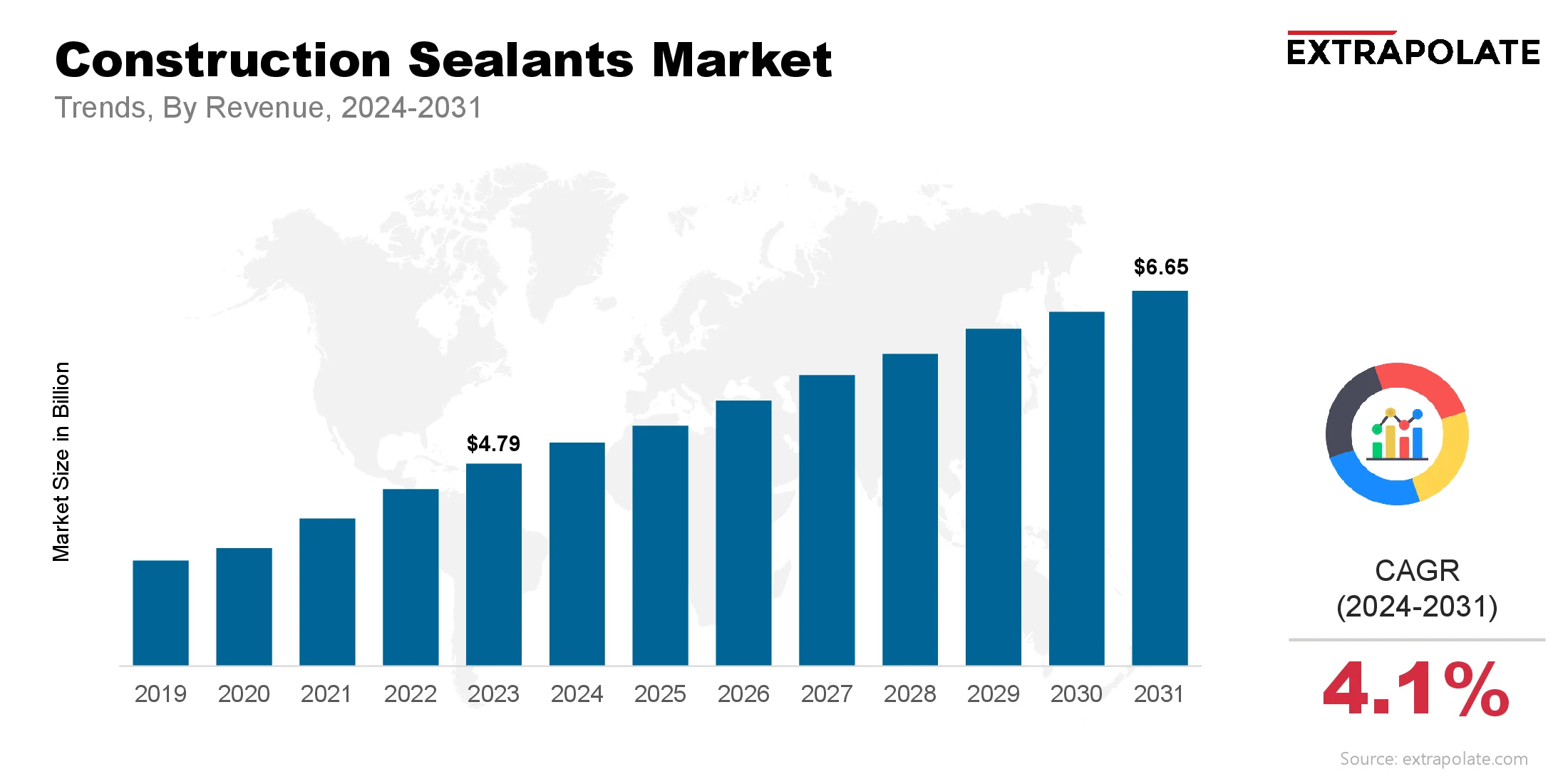
The global construction sealants market size was valued at USD 4.79 billion in 2023 and is projected to grow from USD 5.01 billion in 2024 to USD 6.65 billion by 2031, exhibiting a CAGR of 4.1 % during the forecast period.
Global market is growing at a swift pace. The reason for this is the growth in infrastructure projects, urbanization, and growing demand for energy-efficient buildings. Sealants are a major factor in structural stability, waterproofing, sound insulation, and thermal insulation in residential and commercial buildings. With the growth of new construction methods and sustainability being a major factor, sealants are a major factor in contemporary construction methods.
Construction sealant industry is changing with rapid advances in technology. Hybrid polymer sealants, silicones sealants, and polyurethane sealants are being used for better bonding, weathering, and safety. They are typically easy to apply and may be applied to plastic, metal, glass, or concrete. High-tech and innovative sealants are being used due to innovative designs and complex architecture with specialty sealing properties.
The rise in renovations, especially in regions like North America and Europe, also boosts market growth. Older buildings need upgrades for better insulation, leak repairs, and compliance with updated safety codes. Sealants are key in these retrofit projects, providing cost-effective ways to improve existing structures. Governments are pushing for energy-efficient and eco-friendly materials, which promotes sustainable sealants with low VOC emissions.
The focus on disaster-resilient construction, especially in areas prone to earthquakes, hurricanes, and floods, increases the demand for high-performance sealants. These materials help buildings resist harsh conditions by sealing gaps and preventing water damage. Construction companies are choosing sealants that meet LEED and other green building standards, leading to innovations in bio-based and non-toxic formulations.
Industry players are investing in R&D to develop next-generation sealants for the emerging industries' requirements. Companies are opting for strategic partnerships, mergers, and new product launches to expand their market share. For instance, the sealants which cure quickly, are UV-resistant, and will accommodate movement in high-rise buildings and infrastructure are being developed by the manufacturers.
Despite the positive outlook, the construction sealants industry also has some challenges like fluctuating raw material prices and strict regulations on solvent-based sealants. These challenges are, however, windows of opportunity for innovations, particularly on water-based and low-VOC solutions. Moreover, digital technologies and robotics are also enhancing the precision and automated application of the sealant, which is more efficient and less costly.

Key Market Trends Driving Product Adoption
Construction sealants is driven by technology, legislation, and new construction trends. A few of the trends that are driving growth are:
- Green Building Movement: Environmentally friendly and low-VOC sealants are becoming more popular with green initiatives.
- Increasing Expenditure on Infrastructure: Continued spending by governments on infrastructure is keeping demand for high-performing sealants on bridges, roads, tunnels, and airports high.
- New Sealant Technologies: New technologies like hybrid polymer sealants and self-healing chemistry deliver enhanced performance and durability.
- Multi-functionality: UV-protected fire-resistant seals with antimicrobial functions are also gaining wide acceptance.
- Prefabrication and Module Construction: Increased off-site construction generates need for quick-use, durable sealants.
Major Players and their Competitive Positioning
Global leaders like 3M, Henkel, Sika AG, and BASF SE dominate the construction sealants industry. These companies invest heavily in R&D to develop innovative solutions that meet customer needs. Regional players are also emerging with specialized products and competitive pricing.
Consumer Behavior Analysis
Construction industry stakeholder’s architects, contractors, developers, and DIY consumers are focusing on:
- Durability and Performance: Solutions that endure extreme conditions.
- Ease of Application: Products that cut labor time and costs.
- Sustainability: Eco-friendly, low-emission products.
- Brand Reliability: Trusted brands with a strong field record.
Pricing Trends
Sealant prices vary based on raw material costs, formulation complexity, and application type. Premium products with better durability and certifications often cost more. However, rising demand for mid-range and economy sealants in emerging markets is expanding product lines for diverse budgets.
Growth Factors
Several factors are driving the growth of the market:
- Urbanization and Housing Demand: Rapid urban development increases global construction activity.
- Focus on Building Safety and Comfort: Sealants improve fire safety, acoustics, and energy efficiency.
- Stringent Regulations: Environmental and safety standards are pushing the demand for high-quality sealants.
- Technological Integration: Smart materials and nanotechnology enhance sealant formulations.
Regulatory Landscape
Construction sealant industry is regulated by building codes standards, material safety standards, and emissions. Global LEED certifications and regulations such as Europe's REACH promote the use of non-toxic and green sealants. It is challenging for companies to meet regional requirements.
Recent Developments
Innovation and partnerships are shaping the market. Key developments include:
- Bio-Based Sealants Rollout: Environmentally friendly products derived from renewable sources.
- Expansion of Manufacturing Facilities: Firms are expanding in Asia-Pacific and Latin America to address local demand.
- Strategic Mergers and Acquisitions: Large companies are buying small companies to diversify their portfolios.
- Digital Application Tools: New tools and mobile apps help users with proper application techniques.
Current and Potential Growth Implications
- Demand-Supply Analysis: Demand is rising in both new construction and renovation sectors. However, raw material availability and global supply chain issues could affect prices and supply.
- Gap Analysis: Despite advancements, some gaps remain:
- Training and Skill Gaps: Poor application due to lack of training can hinder performance.
- Limited Low-VOC Options in Emerging Markets: Eco-friendly products are still rare in price-sensitive regions.
- Adhesion Issues: Performance varies significantly across different surfaces.
- Sustainability Challenges: Achieving full recyclability and biodegradability is still a long-term goal for many sealants.
Top Companies in the Construction Sealants Market
Key players shaping the market include:
- 3M
- HenkelAG&Co.KGaA
- SikaAG
- BASFSE
- Bostik(ArkemaGroup)
- p.A.
- TremcoIncorporated
- B.FullerCompany
Construction Sealants Market: Report Snapshot
Segmentation | Details |
By Product Type | Silicone Sealants, Polyurethane Sealants, Polysulfide Sealants, Others |
By Application | Glazing, Flooring & Joining, Sanitary & Kitchen, Facades, Others |
By End User | Residential, Commercial, Industrial, Infrastructure |
By Region | North America, Europe, Asia-Pacific, Middle East & Africa, South Ame |
High Growth Segments
Segments ready for quick growth include:
- Silicone Sealants: Favored for their flexibility and weather resistance.\
- Infrastructure Applications: Used in bridges, roads, and public facilities.
- Green Buildings: Eco-friendly sealants for LEED and BREEAM projects.
Major Innovations
Key innovations changing the industry include:
- Hybrid Sealants: Mixing different chemistries for better performance.
- Self-Healing Materials: Sealants that repair minor damages automatically.
- Smart Sealants: Materials that react to changes in temperature and moisture.
- Low-Emission Technologies: Made to meet global air quality and health standards.
Potential Growth Opportunities
While the outlook is bright, companies face challenges that need strategic solutions:
- Price Sensitivity: Especially in emerging markets where cost beats sustainability.
- Raw Material Volatility: Changes in petrochemical prices impact margins.
- Skill Shortage: Poor application can hurt performance.
- Regulatory Hurdles: Changing regional standards require ongoing adaptation.
- Environmental Concerns: Increased focus on lifecycle impact and recyclability.
Kings Research says:
The construction sealants market will experience tremendous growth in the coming decade. Growth is driven by increasing construction, green material demand, and improvements in sealant technologies. Those who invest in research and development, utilize eco-friendly formulations, and conform to regional needs will thrive in this ever-changing and competitive market.
ARE YOU SEEKING COMPREHENSIVE INSIGHT ON VARIOUS
MARKETS?
CONTACT OUR EXPERTS TODAY
Construction Sealants Market Size
- May-2025
- 140
- Global
- chemicals-and-advanced-materials
Related Research
Carbohydrases Market Size, Share & Trends Analysis Report By Application (Food and beverages, Anima
January-2021
1,2,3,4-Tetrahydroquinaldine Reagent (CAS 1780-19-4) -Global Market Status & Trend Report 2022-2030
August-2021
1,2,3,4-Tetrahydroquinaldine Reagent (CAS 1780-19-4) -Global Market Status and Trend Report 2022-203
August-2021
1,2,3,4-Tetrahydroquinoline Reagent (CAS 635-46-1)-Global Market Status & Trend Report 2022-2030 Top
August-2021
1,2,3,4-Tetrahydroquinoline Reagent (CAS 635-46-1)-Global Market Status and Trend Report 2022-2030
August-2021